Carrier Oil for Clove Oil: How to Dilute It Safely (Exact Ratios)
By Ellen Cooper, independent essential-oil reviewer (hands-on since 2018, no MLM affiliation)
Most advice you’ll find for diluting clove oil is too strong. Search results and AI answers routinely say “2 to 3 drops per teaspoon” or “15 drops per ounce” – that works out to roughly 2 to 3%, but clove bud’s safe ceiling is 0.5%. Clove is eugenol-rich and a known skin sensitizer, so it needs a heavier dilution than a gentle oil like lavender. This guide gives you the correct ratio, the exact drop math for any amount of carrier oil, which carrier to pick for each use, and the mistakes that cause clove burns.
Quick answer: Always dilute clove oil in a carrier oil – never use it neat. Keep it at or below 0.5%, which is about 3 to 4 drops of clove oil per ounce (30 mL) of carrier, or roughly 1 drop per 2 teaspoons. Good carriers are fractionated coconut, jojoba, or sweet almond oil. For mouth or gum use, switch to an edible carrier like virgin coconut or olive oil, and patch-test any new blend first.
Why does clove oil have to be diluted so much?
Clove bud oil is dominated by eugenol, the compound behind its warm, numbing, dentist-office smell. Of the three clove oils – bud, leaf, and stem – clove bud is the one you’ll usually buy, and it’s the most eugenol-rich (Liñán-Atero et al., 2024 review, PMC, retrieved 2026-06-29). That same eugenol makes clove a recognized dermal sensitizer: applied too strong, it can cause burning, redness, and over time an allergic reaction that doesn’t go away.
Because of that, aromatherapy safety references put clove bud’s maximum skin dilution at just 0.5% (Tisserand & Young, Essential Oil Safety, 2nd ed., 2014), and IFRA restricts how much eugenol a leave-on product can contain. For comparison, many everyday oils are used at 2%. Clove sits at a quarter of that, which is exactly why generic “essential oil dilution” advice gets clove wrong.
What is the correct clove oil dilution ratio?
For anything that stays on your skin, treat 0.5% as the ceiling, not the target. If your skin is sensitive or you’re blending for the face, drop to 0.25%. The reason this matters: a teaspoon is 5 mL, and at a standard 20 drops per millilitre, a 1% dilution is about 1 drop of essential oil per teaspoon. So the common “2 to 3 drops per teaspoon” advice is really 2 to 3% – four to six times stronger than clove’s safe limit.
One reputable seller gets this right: Plant Therapy lists clove bud at “a 0.5% dilution… approximately four drops per ounce of carrier oil” (planttherapy.com, retrieved 2026-06-29). That lines up with the safety standard. When a recipe tells you to add a teaspoon-per-drop amount that feels generous, that’s your signal it was written for a gentler oil, not for clove.
Clove oil dilution chart: exact drops for any amount
Here’s the math worked out so you don’t have to. Drop counts assume a standard dropper of about 20 drops per millilitre; droppers vary, so when in doubt, round down. The formula is simple: drops = percent × millilitres ÷ 5. At 0.5% in 30 mL, that’s 0.5 × 30 ÷ 5 = 3 drops.
| Carrier amount | 0.25% (sensitive / facial) | 0.5% (clove max for skin) |
|---|---|---|
| 1 teaspoon (5 mL) | under 1 drop | 1 drop per 2 teaspoons |
| 1 tablespoon (15 mL) | about 1 drop | 1 to 2 drops |
| 1 ounce (30 mL) | 1 to 2 drops | 3 to 4 drops |
| 2 ounces (60 mL) | 3 drops | 6 to 7 drops |
Leave-on skin blends. For diffusing, you don’t use a carrier at all – see the diffuser note below.
If you only remember one line from this page, make it this: 3 to 4 drops of clove per ounce of carrier is your safe default for skin. Scale up the carrier, not the clove.
Which carrier oil should you use with clove oil?
Any plant-based carrier will dilute clove safely – the percentage matters far more than the brand. That said, some carriers suit certain uses better, and one rule is non-negotiable: for anything going in your mouth, use an edible carrier (virgin coconut or olive oil), never jojoba.
| Carrier oil | Best for | Why |
|---|---|---|
| Fractionated coconut (FCO) | All-purpose skin | Liquid, odorless, very long shelf life – the easy default |
| Jojoba | Face & sensitive skin | Mimics skin’s own sebum, non-comedogenic (won’t clog pores) |
| Sweet almond | Body & massage | Light with a mild nutty scent (skip if you have a tree-nut allergy) |
| Grapeseed | Oily / acne-prone skin | Lightest feel, absorbs fast; shorter shelf life |
| Castor | Scalp & hair blends | Thick and rich; usually cut with a lighter carrier for hair use |
| Virgin coconut or olive (edible) | Mouth / gum use only | Food-safe for oral dabs – see the toothache note |
If you’re buying a carrier to keep on hand, fractionated coconut is the one I keep on my own bench for clove – it stays liquid year-round, doesn’t go rancid the way some nut oils can, and its neutral scent lets the clove come through. I save jojoba for facial blends, where the non-comedogenic point actually matters.
Popular carrier oils on Amazon
As an Amazon Associate we earn from qualifying purchases, at no extra cost to you. Product details and availability are subject to change – check the live listing on Amazon.
| Image | Product | Best for | Buy |
|---|---|---|---|
 | Cliganic Organic Jojoba Oil | Face & sensitive skin | Buy on Amazon |
 | NOW Foods Sweet Almond Oil | Body & massage | Buy on Amazon |
 | Handcraft Fractionated Coconut Oil | All-purpose, long shelf life | Buy on Amazon |
 | Majestic Pure Fractionated Coconut Oil | All-purpose, lightweight | Buy on Amazon |
 | Handcraft Castor Oil | Scalp & hair blends | Buy on Amazon |
Affiliate links · details and availability change · check the live Amazon listing.
How to dilute clove oil step by step
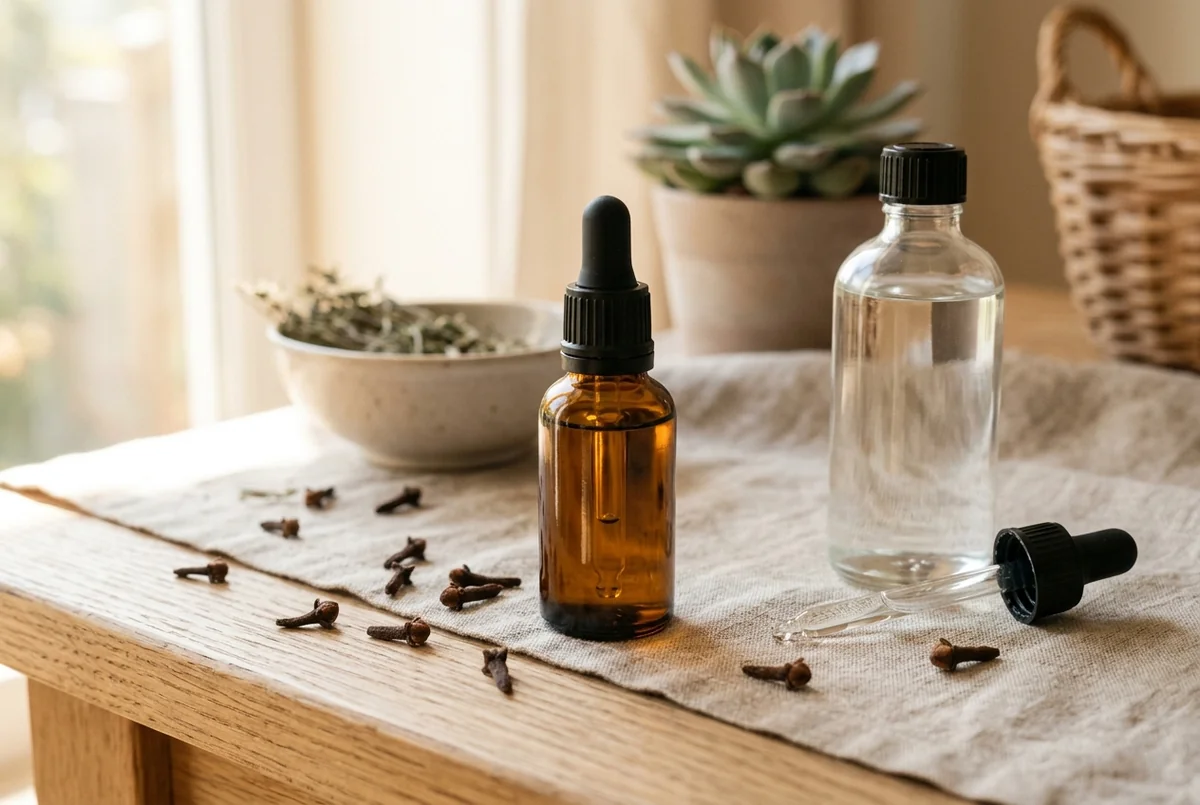
- Measure the carrier first. Pour a known amount into a clean bottle or dish – say, 1 ounce (30 mL). Measuring the carrier, not the clove, is what keeps your percentage honest.
- Add the clove oil by the drop. For that ounce, add 3 to 4 drops. Count them; don’t pour.
- Mix. Cap and roll the bottle between your palms, or stir gently. Clove disperses easily into oil.
- Label it. Note the oil, the carrier, the percentage, and the date. A blend you can’t identify in a month is a blend you’ll misuse.
- Patch-test before real use. Dab a little on your inner forearm, cover it, and wait 24 to 48 hours for any redness or itch (American Academy of Dermatology). Because clove is a known sensitizer, this step matters more than it does for gentler oils.
Diluting clove oil for specific uses
The 0.5% ceiling holds across most uses, but the carrier and method change depending on where the blend goes.
- Skin and spot use: 0.5% maximum, applied to a small area, not slathered over large areas. More on this in our clove oil for skin guide.
- Scalp and hair: blend at 0.5% into a carrier like jojoba or castor, and keep contact time short. See clove oil for hair for the full method.
- Mouth and gums (toothache): use an edible carrier, dilute, and dab on a cotton ball – avoid the gum line, and don’t swallow large amounts. This is short-term relief, not a fix; see a dentist. Details in our clove oil for toothache guide.
- Diffusing: no carrier needed. Add 1 to 3 drops to your diffuser’s water reservoir in a well-ventilated room, and keep it away from cats. Don’t apply diffuser blends to skin.
Mistakes that cause clove oil burns
- Using it neat. Undiluted clove on skin or gums is the number-one cause of burns and irritation. There’s no use case that calls for neat clove.
- Eyeballing the clove instead of measuring the carrier. “A few drops into my palm” has no percentage. Measure the carrier and count drops.
- Using the generic 2% “standard.” That’s fine for lavender, not clove. Clove’s ceiling is 0.5%.
- Reusing old, rancid carrier oil. Oxidized carrier oil irritates skin on its own and shortens your blend’s life. Smell it first; if it’s off, toss it.
- Skipping the patch test. Sensitization can build quietly, then show up as a reaction that sticks. The 24-to-48-hour test is cheap insurance.
- Using it around young children or cats. Clove isn’t recommended for children under 2 or in homes with cats. Our complete clove oil guide covers the safety details.
Frequently asked questions
What’s the best carrier oil for clove oil?
Fractionated coconut oil is the easiest all-purpose choice – it’s liquid, odorless, and lasts a long time. Jojoba is excellent for the face, and sweet almond suits body massage. For anything used in the mouth, switch to an edible carrier like virgin coconut or olive oil.
What should you not mix with clove oil?
Don’t combine clove with other “hot” oils (like cinnamon bark or oregano) in the same blend – the eugenol and phenol load adds up and raises the irritation risk. And never use clove neat, mixed only into water; water and oil don’t blend, so the clove stays undiluted on contact.
Can you put clove oil directly on your skin?
No. Clove should always be diluted in a carrier oil to 0.5% or less before it touches skin. Applied neat, it can cause burning, redness, and sensitization.
What carrier oil do you use for clove oil for a toothache?
Use an edible carrier – virgin coconut or olive oil – because it’s going near your mouth. Dilute a few drops, dab onto a cotton ball, and apply to the tooth while avoiding the gum line. Treat it as temporary relief and see a dentist for the underlying problem.
How do you dilute clove oil with coconut oil?
Use fractionated coconut oil so it stays liquid. Add 3 to 4 drops of clove per ounce (30 mL) for a 0.5% blend. If you’re using solid virgin coconut oil for oral use, warm a small amount until liquid, then mix in the clove by the drop.
The bottom line
Clove is a rewarding oil once you respect how strong it is. The one number to remember is 0.5% – about 3 to 4 drops per ounce of carrier – and the one habit that makes it safe is measuring the carrier and counting the clove. Ignore the recipes that call for two or three drops per teaspoon; they were written for gentler oils. Pick a carrier that fits your use, patch-test every new blend, and keep clove away from young kids and cats. Do that, and you get clove’s warmth without the burn.
Medical disclaimer: This article is for general information and isn’t medical advice. Essential oils aren’t evaluated by the FDA to treat any condition. For persistent pain, skin reactions, or before using essential oils during pregnancy or on children, talk to a qualified healthcare professional.