Lavender Essential Oil: Benefits, Uses & Safety Guide (2026)
By Ellen Cooper, independent essential-oil reviewer (hands-on since 2018, no MLM affiliation)
Lavender is the oil almost everyone starts with, and the one with the most actual research behind it – including a meta-analysis of 65 randomised trials, which is more evidence than the rest of the cabinet combined. It is also one of the most adulterated oils on the market, and the species on the label changes what you get. This covers what the evidence supports, how to use it without irritating your skin, and how to tell whether the bottle is real.
Quick answer: buy Lavandula angustifolia (true lavender), dilute to 1-2% on the body and 0.5-1% on the face, and never swallow it. The strongest evidence is for anxiety – a meta-analysis of 65 trials covering 7,993 people found inhaled lavender safe and effective. Skin and sleep claims are weaker but plausible. The most common problem people actually have is allergic contact dermatitis from using it neat.
Which lavender are you buying?
Three different plants get sold as lavender and they are not interchangeable.
Lavandula angustifolia – true lavender. This is the one the research uses and the one you want. GC-MS work published in 2024 confirms linalool at around 32.5% and linalyl acetate as its primary active compounds (ACS Omega). Soft, sweet, faintly green.
Spike lavender and lavandin. Both carry far more camphor and 1,8-cineole – lavandin runs roughly three times the cineole of true lavender (PMC, Plants). That makes them sharper and more medicinal, useful in a clearing blend, wrong if you are after the calming profile. They are also cheaper, which is why they turn up inside bottles labelled simply “lavender”.
If the label does not print a botanical name, that is the first thing wrong with it.
What does the evidence actually show?
Anxiety is the strong case. A 2019 meta-analysis pooled 65 randomised controlled trials covering 7,993 participants and concluded that inhaled lavender is safe and effective for anxiety symptoms (PubMed). That is an unusually solid base for anything in aromatherapy. Separately, an oral preparation called Silexan performed comparably to lorazepam in trial conditions and is authorised as a medicine in Germany (PMC) – worth knowing precisely because it shows what a regulated oral drug looks like, which a shop bottle is not.
Sleep is plausible but less direct. Most sleep findings ride on the anxiety effect rather than standing alone. Oral capsules beat placebo on anxiety measures in reviewed trials (NPS MedicineWise). If diffusing lavender at bedtime helps you settle, that is a good enough reason to do it – just do not expect it to treat insomnia.
Skin is promising and mostly preclinical. Lavender oil showed faster wound healing and increased collagen expression in 2020 research (PubMed), and a 2022 review catalogues antimicrobial, anti-inflammatory, analgesic and antioxidant activity (PMC, Molecules). Read that as laboratory and animal evidence, not a clinical result on human skin.
The evidence at a glance
| Year | Finding | Source |
|---|---|---|
| 2024 | GC-MS confirmed linalool (32.5%) and linalyl acetate as the primary active compounds in L. angustifolia | ACS Omega |
| 2022 | Lavender oil demonstrated antimicrobial, anxiolytic, anti-inflammatory, analgesic and antioxidant properties | PMC (Molecules) |
| 2022 | Aromatherapy with lavender is generally safe; reports of gynecomastia in boys are noted | NIH NCCIH |
| 2021 | Main compounds identified: linalool, linalyl acetate, 1,8-cineole, β-ocimene, terpinen-4-ol, camphor | PMC (Plants) |
| 2021 | Adulteration of lavender, bergamot and tea tree oils is documented and hard to detect without GC reference profiles | PMC (Molecules) |
| 2021 | Rising essential-oil use linked to more reports of allergic contact dermatitis | PubMed |
| 2020 | Lavender oil treatment showed faster wound healing and increased collagen expression | PubMed |
| 2020 | Oral lavender capsules improved overall anxiety symptoms more than placebo | NPS MedicineWise |
| 2019 | Meta-analysis of 65 RCTs (7,993 participants): lavender inhalation is safe and effective for anxiety | PubMed |
| 2019 | Lavender oil was toxic to human skin cells at 0.25% concentration in laboratory conditions | PMC |
| 2018 | Silexan (an oral lavender preparation) showed effectiveness comparable to lorazepam for anxiety; authorised in Germany | PMC (Int J Psychiatry) |
How to use it without irritating your skin
Dilute, always. 1-2% on the body – about 6 to 12 drops per 30 ml of carrier – and 0.5-1% on the face. Lavender has a gentle reputation that makes people careless with it, and neat application is the single most common cause of trouble.
There is a laboratory finding worth reading carefully rather than panicking about: lavender oil was cytotoxic to human skin cells at 0.25% concentration in cell culture (PMC). Cells in a dish are not skin on a body, and this is not evidence that a 1% blend harms you. It is a reason to respect the dilution numbers rather than treating lavender as harmless.
For diffusing, 3 to 5 drops in 100 ml of water, half an hour at a time in a ventilated room. Our guide to using essential oils covers the three safe application methods, and the carrier oil guide has the ratios by skin type. If you are choosing a machine, see diffuser vs humidifier and our ultrasonic, nebulizing and car picks.
Side effects, and who should avoid lavender
Allergic contact dermatitis is the common one. Reports have climbed alongside general essential-oil use (PubMed), and undiluted application is usually behind it. Sensitisation tends to be permanent: once it happens you can react even to properly diluted blends. Patch-test on the inner forearm and wait a full day.
Never swallow it. Poison Control is explicit that ingesting lavender oil can cause serious effects (Poison Control). The German oral preparation mentioned above is a regulated pharmaceutical taken under supervision – it is not a licence to drink from the bottle on your shelf.
Take extra care with: infants and young children; anyone pregnant or nursing, without medical advice; people on sedatives, since lavender may compound the effect. The NCCIH also records reports of gynecomastia in boys exposed to lavender products (NCCIH) – the evidence is limited and contested, but it is on the record and worth knowing before using it on a child.
Cats. They cannot process many essential-oil compounds, and diffused droplets settle on fur and get swallowed during grooming. Ask a vet before diffusing anything in a home with cats.
How to buy lavender that is actually lavender
Lavender is among the most adulterated oils sold. Cutting lavender with synthetic or cheaper compounds is documented in the scientific literature (PMC, Molecules). In a 2026 test, NOW Foods bought 28 lavender oils on Amazon and reported that only three brands, its own among them, met ISO criteria (NOW Foods; covered by Nutritional Outlook): a competitor testing rivals, not a peer-reviewed study.
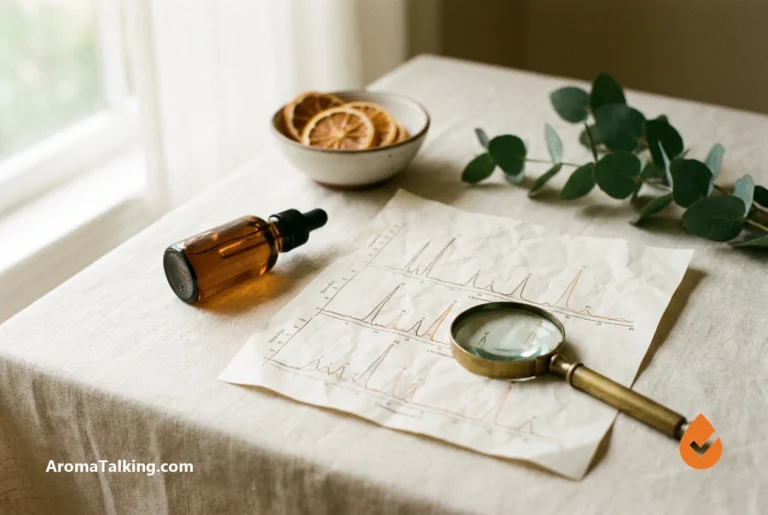
Two defences, and only two. Insist on Lavandula angustifolia printed on the label, and buy from a brand that publishes a batch GC/MS report you can match to your bottle. A report tells you the linalool and linalyl acetate are where they should be; a marketing phrase tells you nothing. Ignore “therapeutic grade” entirely – no independent body issues it.
Among the brands we have reviewed, Plant Therapy and Edens Garden publish per-batch reports at ordinary prices. The MLM brands – doTERRA and Young Living – sell genuine oil at prices that fund a distributor network. For the wider picture see our guide to the most popular essential oils and the peppermint guide.
Frequently asked questions
Is lavender essential oil safe?
For most adults, yes, when diluted and used on the skin or inhaled. The NIH’s NCCIH describes lavender aromatherapy as generally safe. It should never be swallowed without medical supervision, and it is not appropriate for infants. Allergic contact dermatitis is the most common adverse reaction.
What are the side effects of lavender oil?
Skin irritation and allergic contact dermatitis are the main ones, and reports have risen alongside general essential-oil use. Undiluted application is the usual cause. Some people also report headache or nausea from heavy diffusing. Swallowing it can cause serious effects – contact Poison Control if that happens.
Which lavender species should I buy?
Lavandula angustifolia (true lavender) for calm, sleep and skin. Spike lavender and lavandin carry far more camphor and 1,8-cineole – useful for a clearing, medicinal scent, but harsher and not the species behind the anxiety research.
How much lavender oil do I dilute?
1-2% on the body, which is roughly 6-12 drops per 30 ml of carrier oil, and 0.5-1% on the face. Never apply it neat. Patch-test on the inner forearm and wait 24 hours before wider use.
Can lavender oil help you sleep?
The evidence is better for anxiety than for sleep specifically, and the two overlap. A meta-analysis of 65 randomised trials found inhaled lavender safe and effective for anxiety symptoms. Treat improved sleep as a plausible knock-on rather than a proven, direct effect.
Medical disclaimer: This article is general information, not medical advice, and does not diagnose or treat any condition. The studies cited describe measured effects under study conditions, not guaranteed outcomes. Never apply essential oils neat or ingest them, and check with a qualified professional before using them during pregnancy, while nursing, around children or pets, with a medical condition, or alongside medication.