Is Clove Oil Safe? Skin, Cats, Dogs, Kids and Pregnancy
By Ellen Cooper, independent essential-oil reviewer (hands-on since 2018, no MLM affiliation)
Clove oil is safe for most adults when it’s heavily diluted, patch-tested, and never swallowed – but the honest answer depends entirely on who’s using it and how. The part casual blogs underplay: clove oil is genuinely toxic to cats, risky for dogs, and not appropriate for babies, young children, or pregnancy without professional guidance. Here’s the full, sourced picture so you can decide whether and how to use it.
Quick answer: Safe for careful adult skin use at 0.5% or less, patch-tested, and not ingested in any quantity. Not safe around cats (it’s toxic to them). Use caution with dogs, and avoid it during pregnancy, with babies, and children under 2 unless a professional advises otherwise. If a pet is exposed, call your vet or Pet Poison Helpline right away.
Is clove oil safe for cats?
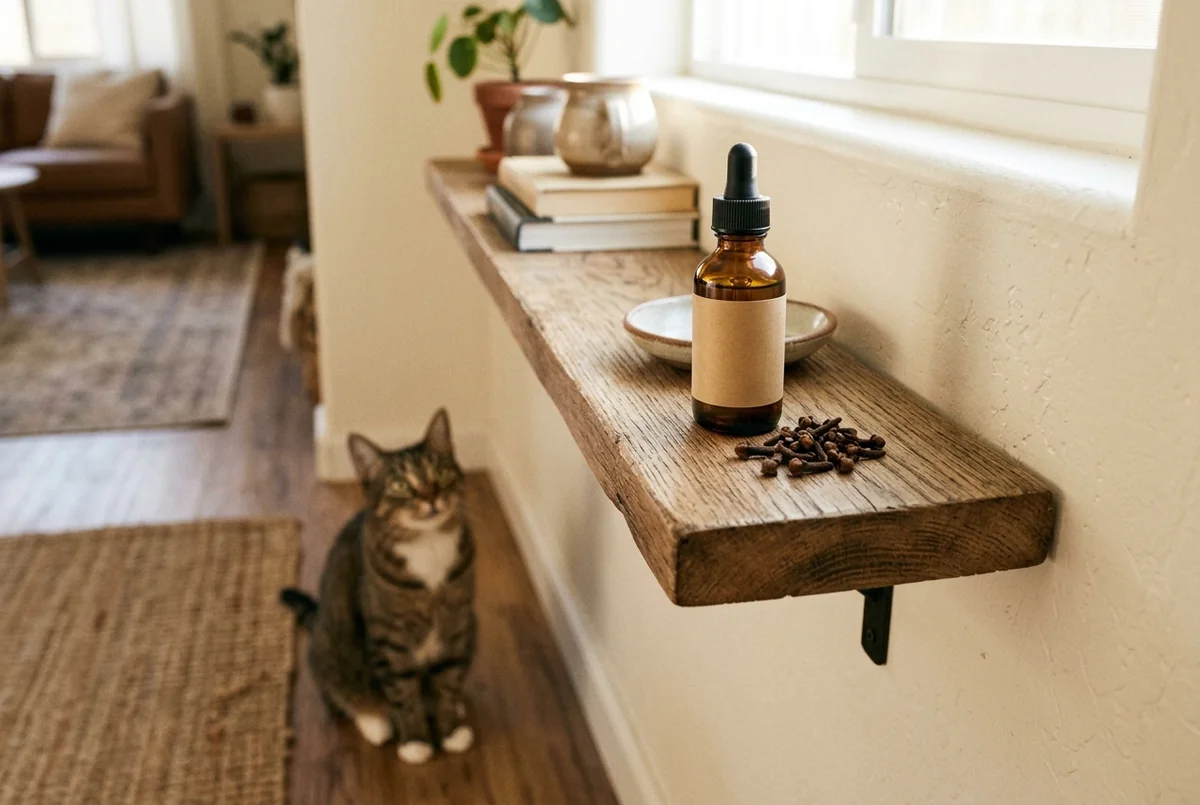
No. Clove oil is toxic to cats, and this is the most important line in this article. The Pet Poison Helpline lists clove oil among the essential oils known to poison cats (Pet Poison Helpline, retrieved 2026-06-29). The culprit is eugenol – clove bud oil is roughly 80% or more eugenol (Liñán-Atero et al., 2024 review, PMC, retrieved 2026-06-29) – and cats are uniquely vulnerable to it.
Cats lack much of the liver enzyme (glucuronyl transferase) needed to break down phenols like eugenol, so the compound builds up instead of clearing. Veterinary sources link clove exposure in cats to central nervous system depression and liver injury (Wag! – Clove Poisoning in Cats, retrieved 2026-06-29). And it isn’t only about swallowing it: cats can be harmed by ingesting it while grooming it off their fur, by skin contact, and even by inhaling it from a diffuser in a closed room. A flea spray containing clove oil is a common, surprising exposure route.
If your cat is exposed: Signs of trouble include drooling, vomiting, wobbliness or tremors, difficulty breathing, and lethargy. Don’t wait – call your veterinarian or the Pet Poison Helpline immediately. Move the cat to fresh air and keep the product for reference.
Is clove oil safe for dogs?
Dogs tolerate clove better than cats, but “better” isn’t “safe.” Clove oil can still harm dogs when it’s used undiluted or in large amounts, again because of eugenol. Veterinary sources warn that essential oils can be toxic to dogs and cats through ingestion or skin contact (Texas A&M College of Veterinary Medicine, retrieved 2026-06-29), and clove oil specifically is one the Pet Poison Helpline flags for pets (retrieved 2026-06-29). Don’t apply clove oil to your dog, don’t add it to their food or water, and keep diffusers out of shared spaces. If you want to use essential oils around dogs at all, talk to your vet first.
Is clove oil safe for your skin?
For most adults, yes – but only diluted and patch-tested. Clove bud is a recognized skin sensitizer, and aromatherapy safety references cap it at a 0.5% maximum dilution for leave-on skin use (Tisserand & Young, Essential Oil Safety, 2nd ed., 2014). Used neat, it can cause burning, redness, and an allergic sensitivity that doesn’t fade. Always patch-test a new blend on your inner forearm and wait 24 to 48 hours (American Academy of Dermatology). For exact ratios, see our clove oil dilution guide.
Can you ingest clove oil?
Not in any real quantity. Eugenol is hard on the liver in larger amounts, and the risk is well documented: clove oil is a recognized cause of liver injury (LiverTox, NIH, retrieved 2026-06-29), and a published case describes a 2-year-old who developed coma, a clotting disorder, and acute liver damage after swallowing clove oil (Hartnoll et al., Archives of Disease in Childhood, 1993, retrieved 2026-06-29). Children are especially at risk because a small swallow is a much bigger dose for their size.
The familiar exception is a tiny, diluted dab on a sore tooth on a cotton ball – short-term only, avoiding the gum line, and not swallowed (see our clove oil for toothache guide). That’s relief, not a cure, and it’s a reason to see a dentist, not a substitute for one. Keep the bottle well away from children, and if someone swallows clove oil, call Poison Control (in the US, 1-800-222-1222) or your local emergency number right away.
Clove oil during pregnancy, with babies, and young children
This is a “when in doubt, don’t” situation. There isn’t enough safety data to confidently recommend clove oil during pregnancy or breastfeeding, and aromatherapy safety references treat eugenol-rich oils with caution for these groups (Tisserand & Young, Essential Oil Safety, 2nd ed., 2014). Its potency also makes it a poor choice for babies and children under 2, who are far more sensitive to a given dose and most at risk if any is swallowed. If you’re pregnant, nursing, or want to use clove oil around young children, check with your doctor or a qualified aromatherapist first rather than relying on a recipe online.
Clove oil side effects to watch for
- Skin irritation and burning – especially if used too strong or undiluted.
- Sensitization – a delayed allergic response that can build over repeated use, then stick.
- Mucous-membrane irritation – around the gums, lips, or eyes.
- Allergic reactions – stop use if you notice rash, swelling, or worsening redness.
Who should avoid clove oil entirely
| Group | Verdict | Why |
|---|---|---|
| Homes with cats | Avoid | Toxic to cats; ingestion, skin, and diffusing are all risky |
| Dogs (direct use) | Avoid without a vet | Harmful undiluted / in large amounts |
| Pregnancy / breastfeeding | Avoid without guidance | Insufficient safety data; potent |
| Babies & children under 2 | Avoid | Too strong; ingestion risk |
| Known eugenol allergy | Avoid | Risk of reaction |
Using clove oil safely (if you choose to)
If clove oil is right for your household, a few habits keep it that way: dilute to 0.5% or less for skin, patch-test every new blend, never apply it neat or swallow it, and store the bottle somewhere children and pets can’t reach. Buying a quality, GC/MS-tested clove bud oil (Syzygium aromaticum) also helps you know what you’re actually working with. And before you buy, make sure you’ve ruled out the deal-breakers above – above all, a cat in the home.
Quality clove essential oils on Amazon
As an Amazon Associate we earn from qualifying purchases, at no extra cost to you. Product details and availability are subject to change – check the live listing on Amazon. Keep any essential oil away from pets and children.
| Image | Product | Best for | Buy |
|---|---|---|---|
 | Cliganic Organic Clove Bud Essential Oil | Organic, everyday use | Buy on Amazon |
 | Organic Clove Essential Oil 30 ml | Value 30 ml size | Buy on Amazon |
 | Siva Clove Bud Essential Oil | Large bottle | Buy on Amazon |
 | MAYJAM Clove Bud Essential Oil | Budget starter | Buy on Amazon |
Affiliate links · details and availability change · check the live Amazon listing.
Frequently asked questions
My cat licked clove oil – what should I do?
Treat it as an emergency. Call your veterinarian or the Pet Poison Helpline immediately, watch for drooling, vomiting, tremors, or breathing trouble, and bring the product so they know the ingredients. Don’t try to make the cat vomit unless a professional tells you to.
Does clove oil kill fleas on cats?
Clove oil does have flea-killing activity, but using it on or around cats is not worth the risk – it’s toxic to them. Use a vet-approved flea product made for cats instead, and check the label of any “natural” flea spray for clove or other essential oils.
Is clove oil safe for babies?
No. Clove oil is too potent for babies and children under 2, and the ingestion risk is real. Skip it for this age group and ask a pediatrician about safer options.
What are the side effects of clove oil?
The most common are skin irritation, burning, and sensitization (a delayed allergy), plus mucous-membrane irritation around the gums or lips. Used undiluted or swallowed, it can cause more serious harm.
Is clove oil safe to use while pregnant?
There isn’t enough evidence to call it safe in pregnancy, so the cautious choice is to avoid it unless your doctor or a qualified aromatherapist advises otherwise.
The bottom line
Clove oil earns its place in a careful adult’s kit – diluted to 0.5%, patch-tested, never swallowed – but it’s not a “safe for everyone” oil. The hard line is cats: if you share your home with one, clove oil isn’t worth the risk. Be cautious with dogs, skip it in pregnancy and for young children, and store it where curious paws and hands can’t reach. Used with respect, it’s useful; used casually, it’s one of the riskier oils on the shelf.
Medical & veterinary disclaimer: This article is general information, not medical or veterinary advice. Essential oils aren’t FDA-evaluated to treat any condition. For a suspected pet exposure, contact your veterinarian or the Pet Poison Helpline. For health concerns, pregnancy, or use on children, consult a qualified professional.