Essential Oil Blend Chart: Complete Blending Guide
By Ellen Cooper, independent essential-oil reviewer (hands-on since 2018, no MLM affiliation)
You’ve mixed two oils that smelled lovely on their own and ended up with something closer to furniture polish. I’ve done it too – and it almost always comes down to one thing: the oils weren’t built to sit together. Good blending isn’t guesswork or a mystical talent; it follows a couple of simple patterns. Once you know how notes and families work, you can pair oils with confidence and skip the flops. Here’s the chart I actually use, the pairing map behind it, a stack of tried recipes by mood, and how to rescue a blend that’s gone wrong.
Quick answer: Balance a blend across three “notes” – top (bright, fleeting: citrus, mint), middle (the heart: floral, herb), and base (deep, lasting: wood, resin) – roughly 30% top, 50% middle, 20% base. Then stay within or next to a fragrance family, and keep it to 2-3 oils while you’re learning. That’s 90% of a blend that works.
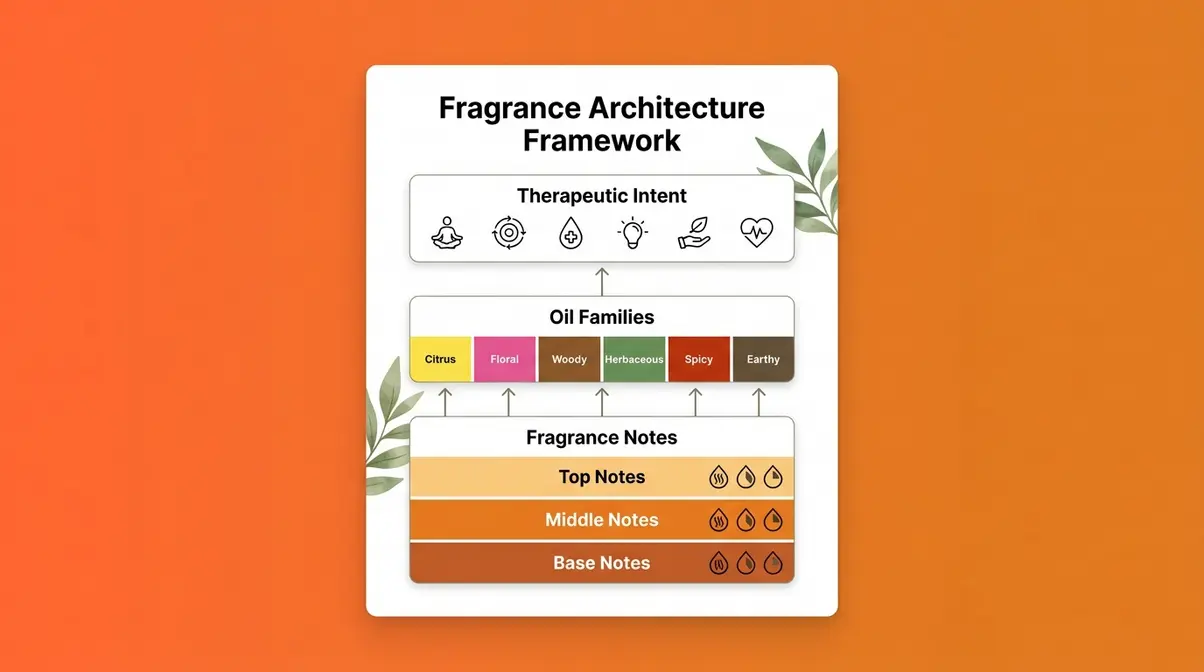
Top, middle and base notes
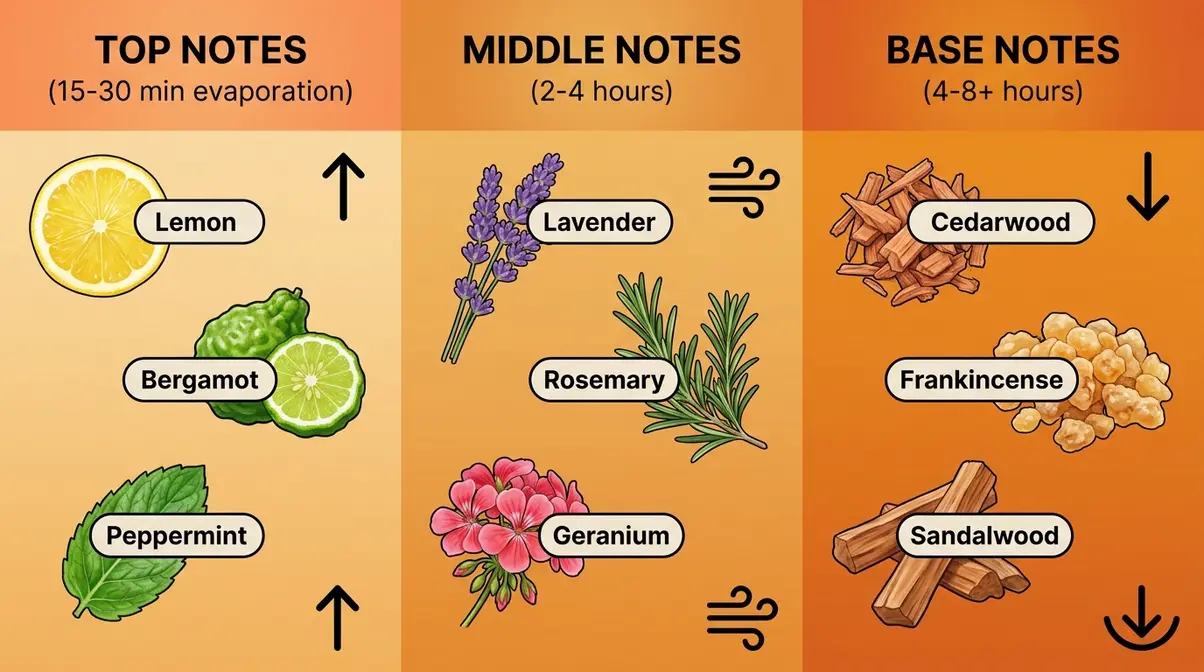
The single most useful idea in blending is the “note.” Every oil evaporates at its own pace, and that pace decides when you smell it and how long it lasts.
| Note | Character | Example oils |
|---|---|---|
| Top | The first hit – bright, fresh, fades fast | Lemon, orange, bergamot, peppermint, eucalyptus |
| Middle | The heart – rounds it out | Lavender, rosemary, geranium, chamomile |
| Base | The foundation – deep, slow, lingers | Cedarwood, frankincense, patchouli, vetiver |
A blend that’s all top notes smells great for five minutes then vanishes; all base notes feel heavy and flat. The sweet spot is a mix – a bright top to greet you, a middle to carry it, and a base to make it last. A reliable starting ratio is roughly 3 drops top : 5 drops middle : 2 drops base, then adjust to your nose.
Why the note determines the “throw”
Volatility is just how fast a molecule lifts off into the air. Citrus and mint are light and quick, so they announce a blend and then bow out within an hour. Florals and herbs sit in the middle – they’re the body of the scent, the part you notice for a couple of hours. Woods, resins and roots are heavy and slow; they cling for hours and act as a fixative, slowing the lighter oils down so the whole thing lasts longer. That’s the real reason a base note matters even when you can barely smell it at first: it’s the anchor that keeps your bright top from disappearing in minutes.
Which oils pair well together
The second shortcut is fragrance families. Oils in the same family almost always blend, and neighbouring families usually do too. A rough map:
- Citrus (lemon, orange, bergamot) – bright and friendly; pairs with florals, mints, woods and spices. The easiest family to blend.
- Floral (lavender, geranium, ylang-ylang) – pairs with citrus and woods.
- Herbaceous (rosemary, basil, clary sage) – pairs with mints, citrus and woods.
- Woody / resinous (cedarwood, frankincense, sandalwood) – grounding; pairs with citrus, floral and spice.
- Minty (peppermint, spearmint) – fresh; pairs with citrus, herbs and woods.
- Spicy (clove, cinnamon, ginger) – warm; use sparingly, pairs with citrus and woods.
The quick pairing table
If you’d rather glance than memorise, here’s the same map as a grid – who plays nicely with whom.
| Family | Best partners | Handle with care |
|---|---|---|
| Citrus | Floral, mint, wood, spice | Nothing – the universal joiner |
| Floral | Citrus, wood | Two strong florals can clash |
| Herbaceous | Mint, citrus, wood | Can turn “green” if overdone |
| Woody / resinous | Citrus, floral, spice | Heavy-handed = muddy |
| Minty | Citrus, herb, wood | Overpowers fast – single drops |
| Spicy | Citrus, wood | Very strong – a drop goes far |
New to blending? A starter set gives you a top, middle and base to play with:
Recommended on Amazon
As an Amazon Associate we earn from qualifying purchases, at no extra cost to you. Product details and availability are subject to change – check the live listing on Amazon.
| Image | Product | Best for | Buy |
|---|---|---|---|
 | Lagunamoon Essential Oils Aromatherapy Set | Starter set for blending | Buy on Amazon |
 | Essential Oils Set by Pure Aroma | Starter set for blending | Buy on Amazon |
 | ASAKUKI Oil Diffuser with Essential Oils Set | Budget 6-oil set | Buy on Amazon |
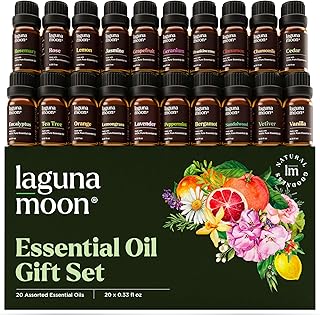 | Lagunamoon Essential Oils Set | Diffuser + oils bundle | Buy on Amazon |
Affiliate links · details and availability change · check the live Amazon listing.
How to actually mix a blend
The physical process matters as much as the recipe. Here’s the routine I follow so a blend comes out repeatable:
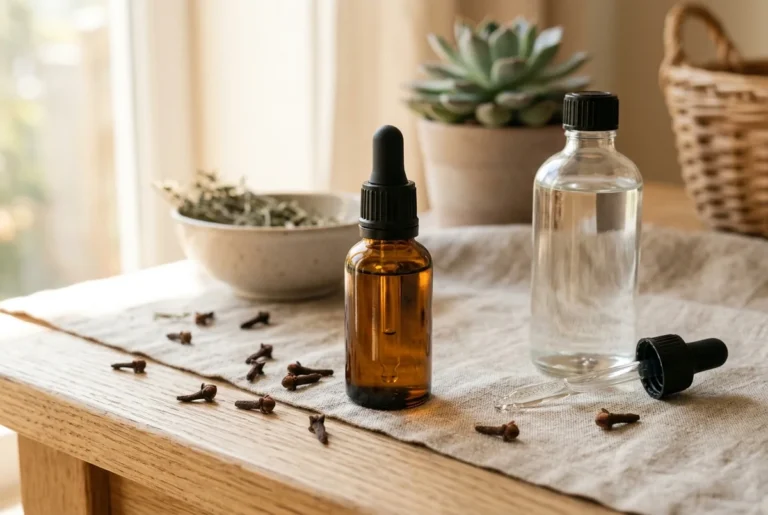
- Work in dark glass. Amber or cobalt bottles protect the oils from light; a glass dropper or pipette lets you count drops precisely. Skip plastic – some oils degrade it.
- Build base-first, then middle, then top. Add the slow, heavy oils first and the volatile citrus last, so the brightest note isn’t sitting out evaporating while you fiddle.
- Test on a paper strip before you commit. Dip a coffee filter or blotter strip, wave it, and smell – it’s far cheaper than a whole bottle you don’t like. Smell the strip again after ten minutes to catch how it “dries down.”
- Let a blend rest. Cap it and give it 24-48 hours to “marry”; the sharp edges soften and the notes settle into each other. A blend that smells disjointed on day one often rounds out by day two.
- Then dilute for its job. Diffuser blends go in neat by the drop; anything for skin gets diluted into a carrier oil (2%, or 1% for sensitive skin) – see the dilution note below.
Blends by mood – tried recipes
Here are combinations I keep coming back to, grouped by what you want out of them. Each balances a top, middle and base. Diffuse as written, or turn any into a 2% roller.
- Calm evening – 3 bergamot + 4 lavender + 2 cedarwood. Soft and settling.
- Deep sleep – 4 lavender + 2 roman chamomile + 1 vetiver. Heavier and sedating for a restless night.
- Fresh focus – 3 lemon + 4 rosemary + 1 peppermint. Bright and clear-headed for a work session.
- Morning lift – 3 grapefruit + 2 orange + 1 spearmint. Cheerful and energising.
- Cosy warmth – 2 orange + 4 frankincense + 1 clove. Grounding for cold evenings.
- Clear the air – 3 lemon + 2 eucalyptus + 2 tea tree. Crisp and cleansing when someone’s under the weather.
- Spa-day floral – 2 bergamot + 3 geranium + 1 sandalwood. Rounded and a little luxurious.
Lavender is the most-studied for a calming effect (NCCIH), which is why it anchors so many relaxing blends. For the how-to, see our beginner’s guide and dilution guide.
Turning a blend into a roller or spray
Once you’ve got a diffuser blend you like, scaling it to skin is simple arithmetic. A 2% dilution is about 12 drops of total essential oil per 10 mL of carrier (fractionated coconut, jojoba, sweet almond). For a face or sensitive skin, halve that to 1% (6 drops). Keep the ratio of your blend the same – if your recipe was 3:5:2, a 10-drop roller might be roughly 3 top, 5 middle, 2 base. For a room spray, use distilled water, a splash of witch hazel or vodka to help the oils disperse, and 15-20 drops per small bottle; shake before each use.
Rescuing a blend that’s off
Blends rarely land perfectly first try. Most problems have an easy adjustment:
| Problem | Likely cause | Fix |
|---|---|---|
| Sharp, thin, fades fast | Too many top notes, no anchor | Add a drop of a base (cedarwood, frankincense) |
| Heavy, flat, “medicinal” | Too much base or a dominant single oil | Add a bright top (lemon, bergamot) |
| One oil takes over | A strong oil (clove, peppermint) overdosed | Rebuild, adding the strong oil one drop at a time |
| “Muddy,” nothing distinct | Too many oils at once | Simplify back to 3 and rebuild |
No bergamot? Simple swaps
If a recipe calls for an oil you don’t have, substitute within the same family: any citrus can stand in for another (sweet orange for bergamot), rosemary for basil among the herbs, cedarwood for frankincense as a base, spearmint for peppermint. The character shifts a little, but the balance holds.
Three rules that save a blend
- Keep it to 2-3 oils while you learn – more than that and you can’t tell what’s working (or what caused a reaction).
- Blend by the drop and write it down, so you can repeat a winner.
- Dilute before skin (2%, or 1% for sensitive skin), patch-test, and store blends in dark glass away from heat.
Storing blends so they last
A finished blend keeps best in a dark glass bottle, tightly capped, somewhere cool and out of sunlight – a drawer or cupboard, not a sunny windowsill. Citrus oils oxidise fastest (roughly a year once opened), while woods and resins last longest, so a citrus-heavy blend is one to make in small batches and use up. Label every bottle with the recipe and the date; future you will want to know what’s in that mystery roller.
Frequently asked questions
How do you know which essential oils blend well together?
Two shortcuts: balance the “notes” (a top, a middle and a base), and stay within or next to a fragrance family. Citrus is the easiest to pair – it blends with florals, woods, mints and spices.
What is the ratio for blending essential oils?
A reliable starting point is about 30% top, 50% middle and 20% base notes – roughly 3 drops top, 5 middle, 2 base – then adjust to your nose. Keep total drops appropriate to your dilution.
How many oils should be in a blend?
Two or three while you’re learning. It keeps the scent readable and makes it easy to spot which oil caused a reaction if one develops.
Should I let a blend sit before using it?
Yes – giving it 24-48 hours to “marry” lets the notes settle and the harsh edges soften. A blend that seems disjointed on day one often smells noticeably more rounded by day two.
What oils should not be mixed?
There’s no dangerous pairing at normal dilutions, but strong oils like clove, cinnamon and peppermint can overpower a blend – use them by the single drop. Watch total dilution rather than specific combinations.
The bottom line
Blending clicks once you stop guessing: pick a bright top, a heart-y middle and a grounding base, keep the oils in friendly families, and start with just two or three. Build base-first in dark glass, test on a paper strip, let it rest a day, then dilute for its job. Write down what you mix, and let your own nose be the final judge – the “rules” are just a map to get you started.