
Clove essential oil dropper releasing a golden drop into a marble dish beside a clove-studded orange and whole clove buds

Clove Essential Oil: Benefits, Safety & Uses Guide

Clove essential oil shows up in toothache home remedies, immune blends, and “natural” cleaning recipes, often with big promises attached. The truth is more interesting, and more cautious. Clove is genuinely powerful, but it’s also a “hot,” potentially toxic oil that the wrong use can turn dangerous fast.

This guide answers the questions most articles skip: when clove oil actually helps, what the evidence really shows, and the specific situations where you should never use it. You’ll learn how to dilute it safely, why it’s toxic to cats, and what the FDA does and doesn’t say about clove for toothache. We lead with safety because clove deserves it.

This guide is based on published research and safety guidance, not first-party laboratory testing.

⚠️ Medical Disclaimer: This content is for informational purposes only and does not constitute medical advice. Essential oils are not FDA-approved to treat, cure, or prevent any disease. Consult a qualified healthcare provider before using clove essential oil, especially on children, during pregnancy or nursing, or around pets. Never ingest clove oil without the explicit guidance of a licensed professional.

Affiliate disclosure: AromaTalking is reader-supported. We may earn a commission from qualifying purchases made through links on this page, at no extra cost to you. This does not influence our guidance. See our affiliate disclosure.

Clove essential oil (Syzygium aromaticum) is 70-90% eugenol, the compound behind its dental, antifungal, and antibacterial activity. It’s effective but “hot,” so dilution and caution come first.

What Is Clove Essential Oil?

Clove essential oil is a steam-distilled extract of the clove tree (Syzygium aromaticum), and it’s dominated by a single compound, eugenol, which makes up roughly 70-90% of the oil. That high eugenol content drives almost everything clove does, from its warm spicy scent to its antimicrobial and pain-numbing effects. In clove bud oil, eugenol typically runs 82-87% (Ben Hassine & Bouajila, BioMed Research International, 2021).

The secondary compound is eugenyl acetate, usually somewhere between 10% and 40% depending on plant part and distillation. Together these two account for the bulk of the oil. A 2021 analysis in Molecules confirms eugenol as the principal active constituent across clove samples (Badr et al., 2021). When you read that clove is “powerful,” eugenol is what people mean.

Clove Bud vs. Leaf vs. Stem Oil

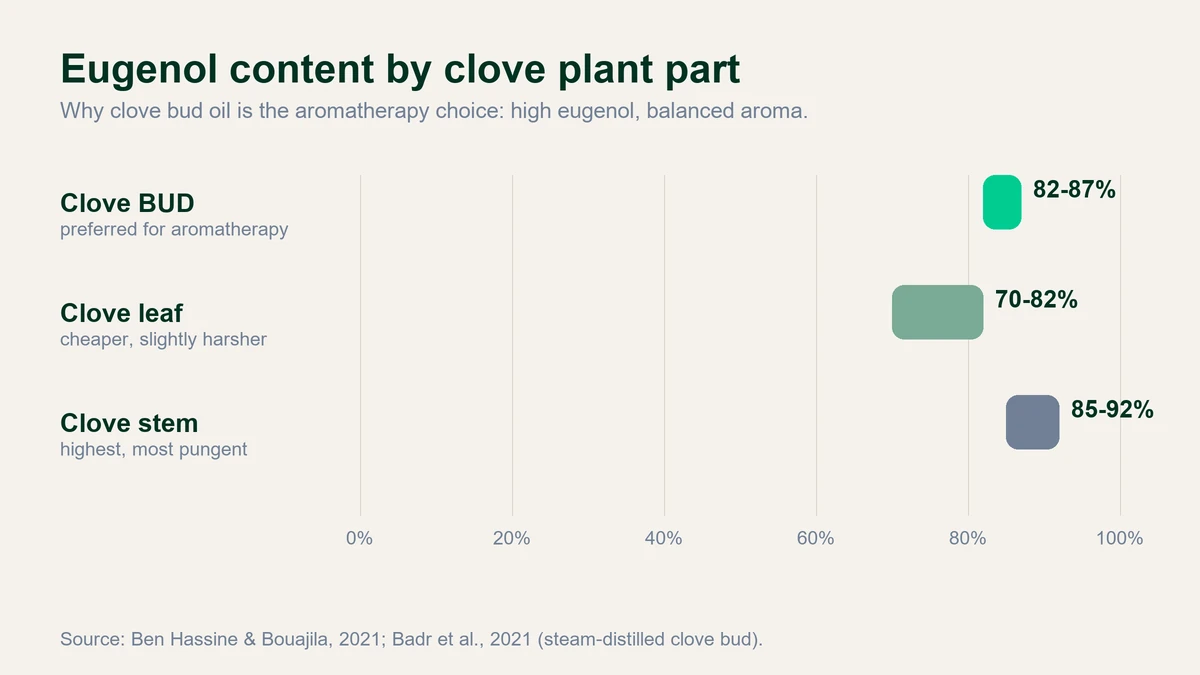
Here’s a distinction most guides skip: not all clove oil is the same. The oil can be distilled from three different parts of the plant, and each has a different eugenol profile, aroma, and best use. Clove bud oil is the one aromatherapists generally prefer. Clove stem oil is the highest in eugenol but harsher, and it’s more common in industrial fragrance and flavor work.

Source Part Typical Eugenol % Aroma Best Use
Bud (flower bud) ~82-87% Warm, rounded, spicy-sweet Aromatherapy and diffusion (preferred)
Leaf ~70-82% Sharper, slightly green Lower-cost soaps, cleaning blends
Stem ~85-92% Harsh, woody, intense Industrial fragrance and flavoring

Eugenol ranges from Ben Hassine & Bouajila (2021) and Badr et al. (2021).

Bar chart: eugenol content by clove plant part - clove bud 82 to 87 percent, leaf 70 to 82 percent, stem 85 to 92 percent.
Eugenol content differs by clove plant part – clove bud oil is the aromatherapy standard.

For home aromatherapy, look for the words “clove bud” on the label. If a bottle just says “clove oil” with no plant part named, you can’t be sure what you’re getting. New to oils in general? Our beginner’s guide to using essential oils safely covers the fundamentals before you start with a strong oil like this one.

Key Concepts and Terminology

Clove essential oil / clove oil: the same product. Both names describe the steam-distilled volatile oil of Syzygium aromaticum; “clove essential oil” is the aromatherapy label and “clove oil” the everyday name.

Eugenol: the dominant active compound in clove oil (roughly 70-90%), behind its numbing, antibacterial, and antifungal activity.

Clove bud vs leaf vs stem oil: three oils distilled from different parts of the plant, with different eugenol levels and aroma. Clove bud oil is the aromatherapy standard.

Carrier oil: a neutral oil (fractionated coconut, jojoba, sweet almond) you dilute clove oil into before any skin contact.

Dilution percentage: the share of clove oil in the finished blend. For clove, keep leave-on skin blends at or below the 0.5% eugenol IFRA limit.

“Hot” oil: an oil that can irritate or burn skin if used undiluted. Clove is one of the hottest common oils, so it always needs heavy dilution.

What Are the Benefits of Clove Oil, and What Does the Evidence Say?

Clove oil’s benefits trace almost entirely to eugenol, which has documented antibacterial, antifungal, and local pain-numbing activity. The evidence is strongest for dental and antimicrobial uses and weakest for the broad “wellness” claims you see in marketing. One in-vitro study found clove oil inhibited Candida yeast at a minimum inhibitory concentration of 0.25-2 mg/mL (Biernasiuk et al., Molecules, 2022). Let’s separate what’s proven from what’s promising.

Use caseEvidence strengthWhat the research actually shows
Dental pain (eugenol)StrongestEugenol has a long clinical history in dentistry (ZOE cement since the 1890s) and numbs locally, but clove oil itself is not an FDA Category I home remedy.
Antifungal / antibacterialModerate (in-vitro)Inhibits Candida at 0.25-2 mg/mL by binding ergosterol. Lab results only, not proof of a skin-infection cure.
AcneEmerging (1 small RCT)A clove-plus-curcumin gel beat clindamycin in a 27-person trial (p<0.001). Combination gel, preliminary, not standalone clove.
Hair / scalp regrowthWeakMay soothe a flaky scalp when diluted; no strong trial shows it reverses hair loss.
Amber clove essential oil dropper bottle and whole clove buds beside a glowing ceramic ultrasonic diffuser on a sunlit wooden shelf.
A few drops of clove oil in a diffuser carry its warm, spicy aroma through a room – one of its gentlest uses.

Dental and Eugenol’s Real Track Record

Eugenol genuinely has a place in professional dentistry. Zinc-oxide-eugenol (ZOE) cement has been used as a temporary filling material and liner since the 1890s. That long clinical history is real, and it’s why so many people associate clove with toothache relief. But there’s an important nuance covered in the toothache section below: a dental-cement ingredient is not the same as an FDA-cleared home remedy (LiverTox, NIDDK/NIH).

Antifungal and Antibacterial Activity

In lab settings, clove oil and eugenol show clear antimicrobial effects. Researchers report that eugenol disrupts fungal cell membranes by binding ergosterol, which is how it inhibits Candida at the 0.25-2 mg/mL range cited above (Biernasiuk et al., 2022). Important caveat: these are in-vitro findings. A petri-dish result is not proof that diluted clove oil cures a fungal infection on your skin. Treat it as supportive evidence, not a medical claim.

Emerging Evidence for Acne

One of the more interesting recent findings is for acne. In a small single-blind randomized trial of 27 participants, a clove-plus-curcumin gel outperformed clindamycin for reducing lesions and papules, with a reported significance of p<0.001, though some users felt minor transient burning (Dastgir et al., Advances in Pharmaceutical Bulletin, 2025). Read that carefully: it’s a small, preliminary study of a combination gel, not standalone clove oil. Promising, not proven.

Hair and Scalp Claims

You’ll find plenty of blog posts claiming clove oil regrows hair. The honest answer is that the evidence here is thin. Clove’s antimicrobial properties may help with a flaky or irritated scalp when properly diluted, but there’s no strong clinical trial showing it reverses hair loss. If you try it, keep the dilution low and patch-test first, since the scalp is sensitive and clove is a known irritant.

For the full methods, see our guides on clove oil for skin and clove oil for hair.

Clove Oil Safety: What You Need to Know First

Clove oil is safe only when heavily diluted and never swallowed; it is one of the riskier essential oils for both skin and ingestion. The danger is dose-driven. A documented case describes a 15-month-old who ingested 10 mL of clove oil and developed liver injury with ALT above 13,000 U/L (Janes et al., European Journal of Pediatrics, 2005). Just 5-10 mL can cause severe toxicity in a young child. Safety isn’t optional with this oil.

🚨 Clove Oil Safety Essentials

  • Never ingest it. Ingestion can cause hepatotoxicity, CNS depression, and seizures. Severe toxicity has been reported from 5-10 mL in young children (Tennessee Poison Center / VUMC).
  • Dilute to 0.5% eugenol or less for leave-on skin products, per the IFRA standard. Never apply clove oil neat (undiluted).
  • Not for infants or children under 2, including teething use (Tennessee Poison Center).
  • Toxic to cats, and not recommended for dogs without veterinary guidance (see the pet section below).

Why Clove Is a “Hot” Oil

“Hot” oils are ones that create a warming or burning sensation and carry a higher risk of skin sensitization. Clove sits firmly in this category because of its concentrated eugenol. Applied undiluted, it can cause redness, burning, and contact dermatitis. The IFRA limit of 0.5% in leave-on products exists precisely because eugenol is a recognized skin sensitizer (IFRA). For most adult body uses, keep it in the 0.5-1% range at most.

One Risk Clove Doesn’t Carry: Phototoxicity

One worry you can drop: clove is not phototoxic. Unlike citrus oils such as bergamot or cold-pressed lime, it will not make your skin react with sunlight. It belongs to the Myrtaceae family and contains no furanocoumarins, the compounds that make citrus oils react with sunlight and burn skin (Tisserand Institute). So sun exposure after properly diluted topical use isn’t the concern with clove. Irritation from over-concentration is.

Is clove oil safe for pets?

No – clove oil is toxic to cats and risky for dogs. Cats can’t efficiently process eugenol, so clove oil can harm them through ingestion, skin contact, or even diffusing in a closed room; dogs are safer but still at risk when it is undiluted or used in large amounts. If you share your home with a cat, this is the single biggest reason to be careful with clove. We cover the signs of poisoning, what to do in an emergency, and the rules for dogs, pregnancy, babies, and children in our full guide: is clove oil safe?

How Do You Use Clove Oil Safely?

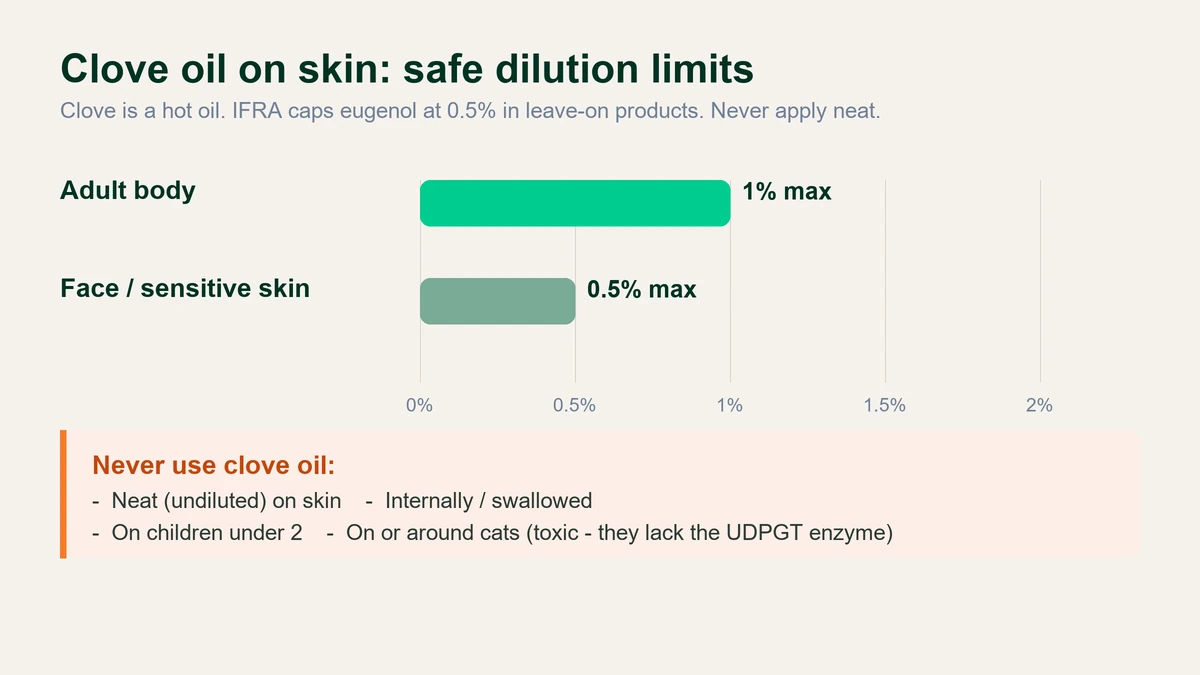
Safe clove oil use comes down to one rule above all: dilute it heavily, and keep leave-on products at or below the IFRA limit of 0.5% eugenol. Because clove bud oil is roughly 82-87% eugenol, even a 1% dilution of the oil puts you near that ceiling, so err low (IFRA). Always pair clove oil with a carrier oil like fractionated coconut, jojoba, or sweet almond. Never use it neat.

Chart of safe clove oil skin dilution: adult body 1 percent maximum, face 0.5 percent maximum; never use neat, internally, on children under 2, or on cats.
Clove oil skin-dilution limits – and the situations where you should never use it at all.

Clove Oil Dilution Chart

Use Case Target Dilution Drops per 1 tsp (5 mL) Carrier
Diffusion (air, well-ventilated) n/a (1-3 drops in water reservoir) Do not apply to skin
Adult body / massage blend 0.5-1% max 1-2 drops
Spot / targeted skin use ~0.5% 1 drop
Children under 2 Not recommended Avoid
Homes with cats Not recommended Avoid

Leave-on ceiling based on the IFRA 0.5% eugenol standard. One teaspoon ≈ 5 mL. Patch-test any new blend first.

Before any topical use, run a patch test: apply a small amount of the diluted blend to your inner forearm, cover it, and wait 24-48 hours for any redness or irritation. Because clove is a known sensitizer, this step matters more than it does for gentler oils. For pairing ideas with calmer oils, our lavender essential oil safety guide is a useful companion read.

This chart is the quick reference – for exact drop-by-drop ratios for any amount of carrier, which carrier to pick, and per-use dilution, see our clove oil dilution guide. To infuse your own clove oil from whole cloves, see how to make clove oil.

Clove Oil as a Natural Ant Deterrent

Clove oil is a popular natural ant deterrent, and there’s a plausible mechanism behind it: eugenol is toxic and repellent to many insects. A simple approach is to mix a few drops into water in a spray bottle and apply it along entry points and trails, reapplying as the scent fades. Keep the spray away from pets, especially cats, and from surfaces children touch. Treat it as a deterrent that may help, not a guaranteed exterminator.

Does Clove Oil Work for Toothache?

Clove oil can temporarily dull dental pain because eugenol has mild numbing and antibacterial action, but it is not an FDA-cleared cure, and it does not replace a dentist. The numbing effect is real enough that eugenol is used in professional dental products like ZOE cement. Still, the FDA does not classify clove oil as a Category I (generally recognized as safe and effective) over-the-counter toothache remedy (LiverTox, NIDDK/NIH). It buys time. It doesn’t fix the problem.

This is the short version. For the full evidence (the benzocaine-equivalence trial, the 2025 systematic review), the exact safe dilution and cotton-swab method, and the red flags that mean you need a dentist now, see our complete guide: Clove Oil for Toothache.

What the Evidence Actually Supports

The legitimate part of the “clove for toothache” story is eugenol’s documented use in dentistry, where it has served as a temporary filling and liner ingredient since the 1890s. The myth is that this makes household clove oil a safe-and-effective cure. It doesn’t. A dab of properly diluted clove oil on a sore tooth may ease discomfort briefly, but persistent tooth pain signals a problem, an abscess, decay, or a cracked tooth, that only a dentist can treat.

The Honest Take

Use clove oil for toothache the way you’d use an ice pack: short-term relief while you get real care. Dilute it, dab a small amount onto the affected area with a cotton swab, and do not swallow it. Avoid this entirely for young children, since ingestion risk is high and the toxicity is severe. Then book the dentist. Clove oil is a bridge to treatment, not the treatment.

For the step-by-step method and the dilution + safety details, see our clove oil for toothache guide and clove oil for teeth.

How Do You Choose and Where Do You Buy Clove Oil?

Choose clove bud oil from a brand that publishes GC/MS batch testing and bottles in dark glass. Three signals separate a quality clove oil from a weak or adulterated one: the plant part is named (“clove bud”), the botanical name Syzygium aromaticum appears on the label, and the brand makes independent GC/MS purity reports available. GC/MS testing is the only way to verify what’s actually in the bottle. For a deeper look at why this matters, see our guide to the most popular essential oils for beginners.

What to Look For on the Label

  • Plant part named: “clove bud” is preferred for aromatherapy over leaf or stem.
  • Botanical name: Syzygium aromaticum (sometimes listed as Eugenia caryophyllata) confirms the species.
  • GC/MS testing: independent, batch-specific reports you can verify, not a vague “pure” claim.
  • Dark glass bottle: amber or cobalt glass protects the oil from light degradation.
  • No “therapeutic-grade” marketing: that’s an unregulated term, not a quality guarantee.

Recommended Non-MLM Brands

For verifiable purity without MLM markup, the brands we’ve reviewed most favorably all publish independent GC/MS testing. See our full Plant Therapy review, Edens Garden review, and Rocky Mountain Oils review for the testing, pricing, and safety detail on each. Buy clove bud oil directly from the brand where possible, so the batch you receive matches the published lab report.

Prefer to grab a verified clove bud oil on Amazon? These widely-owned, non-MLM options match the label checks above — look for 100% clove BUD oil, independent GC/MS testing, and dark glass before you buy:

As an Amazon Associate we earn from qualifying purchases, at no extra cost to you. Product details and availability are subject to change, check the live listing on Amazon.

ImageProductBest forBuy
Cliganic Organic Clove Bud Essential OilCliganic Organic Clove Bud Essential OilBest organic value · non-GMOBuy on Amazon
Organic Clove Essential Oil 30 mlOrganic Clove Essential Oil 30 mlLargest organic bottle (30 ml)Buy on Amazon
Siva Clove Bud Essential OilSiva Clove Bud Essential OilBig 4 oz bottle with dropperBuy on Amazon
MAYJAM Clove Bud Essential OilMAYJAM Clove Bud Essential OilLowest price · for diffuser & DIYBuy on Amazon

Affiliate links · details and availability change · check the live Amazon listing.

Frequently Asked Questions

Is clove oil safe to swallow?

No. Clove oil should never be swallowed without licensed professional supervision. Ingestion can cause severe liver injury, central nervous system depression, and seizures. A documented case describes a 15-month-old who ingested 10 mL and developed ALT above 13,000 U/L (Janes et al., 2005). Even 5-10 mL can cause severe toxicity in a young child. Keep clove oil out of reach of children.

How do you use clove oil for a toothache?

Dilute it, dab a small amount on the sore area with a cotton swab, and do not swallow it. Eugenol can temporarily numb dental pain, which is why it’s used in professional ZOE dental cement. But the FDA does not classify clove oil as a Category I safe-and-effective OTC toothache remedy (LiverTox, NIH). Use it only as short-term relief, then see a dentist.

Does clove oil kill tooth nerve pain?

Clove oil can temporarily dull nerve-related tooth pain, but it does not kill the nerve or fix the cause. Eugenol has a mild numbing and antibacterial effect that may reduce discomfort for a short time. Persistent or throbbing nerve pain usually points to decay, an abscess, or a cracked tooth, which require professional dental treatment. Relief from clove oil is temporary and should never delay a dentist visit.

Can clove oil whiten teeth?

There’s no reliable evidence that clove oil whitens teeth. Clove is associated with dental care because of eugenol’s numbing and antibacterial properties, not because it bleaches enamel. Any anecdotal “whitening” is more likely improved oral hygiene than a true whitening effect. For whitening, evidence-based options recommended by a dentist are far more dependable, and they won’t carry clove oil’s ingestion risk.

What are the side effects of clove oil?

The main side effects are skin irritation and, with ingestion, serious toxicity. As a “hot” oil high in eugenol, undiluted clove oil can cause burning, redness, and contact dermatitis, which is why IFRA caps leave-on use at 0.5% eugenol (IFRA). Swallowing it can cause hepatotoxicity, CNS depression, and seizures. Always dilute, patch-test, and keep it away from children and pets.

Is clove oil safe for kids or teething babies?

No. Clove oil is not recommended for infants or children under 2, including for teething. The Tennessee Poison Center specifically warns against clove oil for teething because of the high risk of toxicity if a child ingests it (Tennessee Poison Center / VUMC). Even small amounts can be dangerous for young children. Talk to a pediatrician about safe teething options instead.

Is clove oil safe for dogs and cats?

Clove oil is toxic to cats and not recommended for dogs. Cats lack the UDPGT liver enzyme needed to metabolize phenols like eugenol, so it accumulates and can cause drooling, tremors, seizures, and liver failure (Pet Poison Helpline). Dogs can also experience GI upset and liver stress. Avoid clove oil in homes with pets, and call ASPCA Animal Poison Control (888-426-4435) if exposure occurs.

What’s the difference between clove bud, leaf, and stem oil?

They differ in eugenol content, aroma, and best use. Clove bud oil (~82-87% eugenol) is the rounded, aromatherapy-preferred type. Leaf oil (~70-82%) is sharper and cheaper, common in soaps and cleaning blends. Stem oil (~85-92%) is the most intense and harshest, used mainly in industry (Ben Hassine & Bouajila, 2021). For home use, choose clove bud oil.

Similar Posts