

Clove Essential Oil: Benefits, Safety & Uses Guide
By Ellen Cooper, independent essential-oil reviewer (hands-on since 2018, no MLM affiliation)
Clove is the oil I am most careful with. It works – the numbing is real, the antimicrobial activity is documented – and it is also the one most likely to burn someone who treats it like lavender. Almost everything below follows from a single number: how much eugenol is in the bottle.
Quick answer: clove bud oil is roughly 82-87% eugenol (PMC), which is why it numbs and why it irritates. Keep leave-on skin use below the 0.5% eugenol ceiling IFRA, never swallow it, and keep it away from cats. It is not phototoxic.
What is clove essential oil?
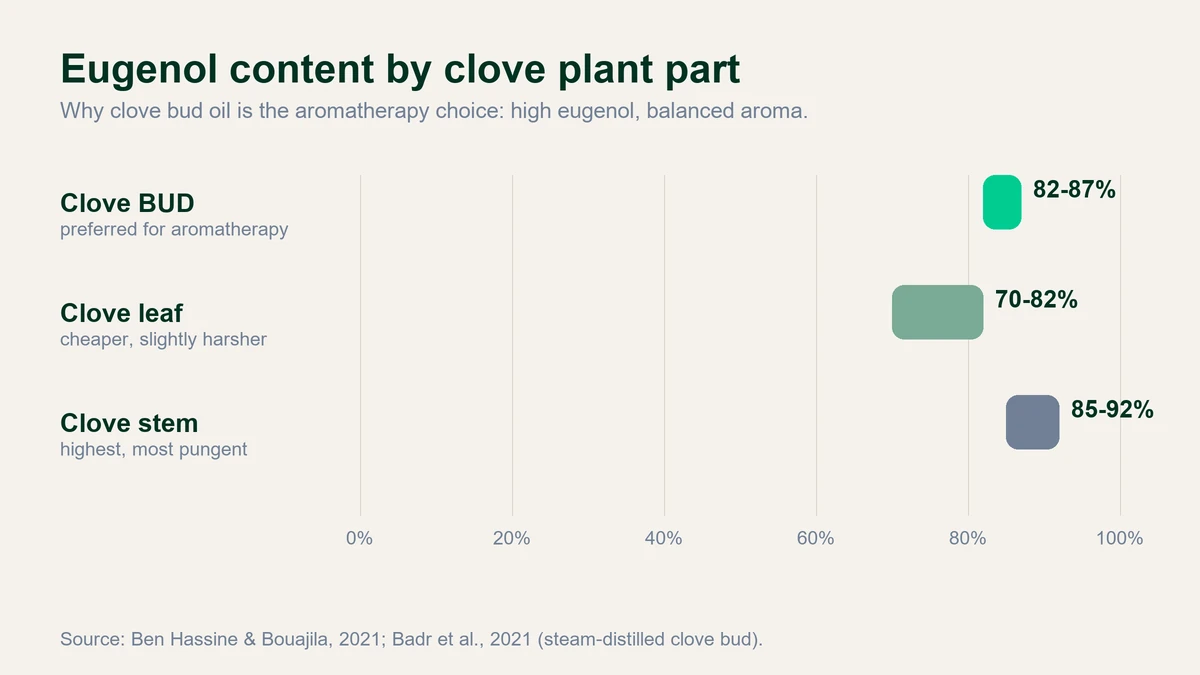
Steam-distilled from Syzygium aromaticum, and sold in three grades that are not interchangeable.
Bud oil is the one you want: warm, sweet-spicy, and the grade the research uses. Leaf oil is sharper and cheaper, common in soaps and cleaning blends. Stem oil runs about 85-92% eugenol and is the harshest, used mainly industrially (PMC). A 2021 analysis puts eugenol acetate somewhere between 10% and 40% depending on plant part and distillation (Ben Hassine & Bouajila); together the two make up the bulk of the oil.
If the label just says “clove oil” with no plant part named, assume leaf and treat it accordingly.
What does the evidence support?
Antifungal activity is well documented in vitro. Clove oil inhibited Candida at a minimum inhibitory concentration of 0.25-2 mg/mL, and eugenol appears to work by binding ergosterol and disrupting fungal cell membranes (PMC). In vitro means in glassware – it explains the mechanism, it does not prove a treatment.
Acne shows the most interesting human signal. A trial reported clove preparations comparable to clindamycin for reducing lesions and papules (p<0.001), though some participants reported minor transient burning (PMC). Promising, and a reminder that “works” and “comfortable” are different questions.
Numbing is the oldest use and the best understood. Eugenol is the active ingredient in ZOE dental cement, which dentists genuinely use. What that does not mean is covered below.
Clove oil safety: the three rules that matter
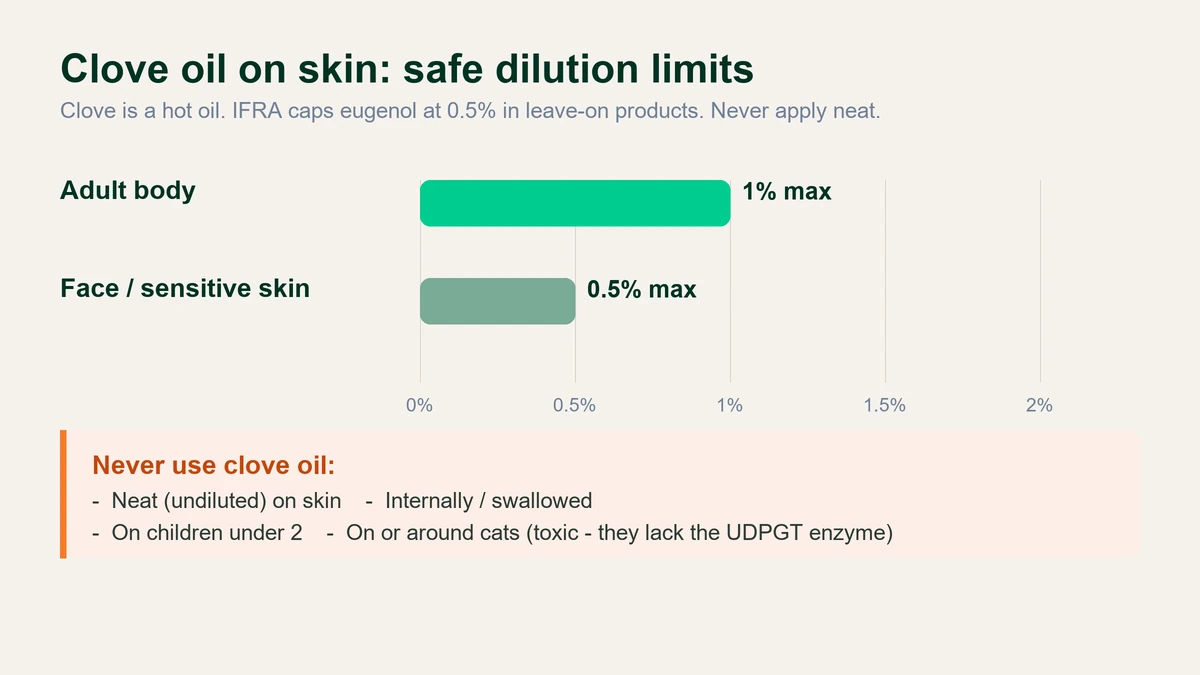
1. Dilute below the eugenol ceiling. IFRA caps eugenol at 0.5% in leave-on products because it is a recognised skin sensitiser. Since clove bud oil is 82-87% eugenol, even a 1% dilution of the oil puts you at or past that ceiling – so err low. Undiluted use causes burning, redness and contact dermatitis, and sensitisation tends to be permanent. Our clove dilution guide has the arithmetic.
2. Never swallow it. A documented case describes a 15-month-old who ingested 10 ml of clove oil and developed liver injury with ALT above 13,000 U/L (PubMed). Ingestion can also cause central nervous system depression and seizures (Tennessee Poison Center / VUMC). This is the single strongest reason to store it out of reach of children.
3. Keep it away from cats. Cats cannot process many essential-oil compounds, and clove is a potent one. Not recommended for dogs either without veterinary advice (Pet Poison Helpline). See is clove oil safe for the full picture, including pregnancy and children.
One thing clove is not: phototoxic. It belongs to the Myrtaceae family and contains no furanocoumarins, the compounds that make citrus oils react with sunlight Tisserand Institute. Sun exposure is not your concern here – sensitisation is.
Does clove oil work for toothache?
Partly, and the nuance matters more than the headline.
Eugenol numbs, and it is used professionally in ZOE dental cement. But the FDA does not classify clove oil as a Category I – generally recognised as safe and effective – over-the-counter toothache remedy StatPearls / NCBI. A dental-cement ingredient applied by a clinician is not the same thing as a home remedy dabbed on a molar.
Use it, if you must, as short-term relief while you arrange a dental appointment: a drop heavily diluted in a carrier on a cotton bud, on the tooth, not the gum. It does nothing about the underlying cavity or infection. Our clove oil for toothache guide covers the method and the red flags that mean stop and see a dentist today, and clove oil for teeth covers general oral use, with the full method in our toothache guide.
Other uses worth knowing

Diffusing. One drop in a blend, not more. Clove is a base note that overwhelms whatever it is mixed with; it pairs well with sweet orange and cinnamon in winter blends, and sits very differently from a soft oil like lavender.
Skin and hair. Covered properly in clove oil for skin and clove oil for hair – both stay under the eugenol ceiling.
Making your own. Infusing whole cloves in a carrier gives you something far weaker and far more forgiving than distilled oil; see how to make clove oil.
How to choose and where to buy
Three checks. Look for bud named on the label, the botanical name Syzygium aromaticum, and a brand that publishes a batch GC/MS report so you can see the actual eugenol figure rather than assuming it. Edens Garden is one of the non-MLM brands that does; our brand reviews cover the rest, including Plant Therapy and Rocky Mountain Oils. Clove is cheap, so there is no reason to pay a premium for it.
As an Amazon Associate we earn from qualifying purchases, at no extra cost to you (see our affiliate disclosure). I have not lab-tested these particular bottles – they are widely stocked listings that meet the criteria above.
| Product | Best for | Buy |
|---|---|---|
| Clove bud oil, small bottle | A first bottle – you need very little | Check price |
| Clove bud oil, organic | If organic certification matters to you | Check price |
| Clove oil with dropper | Easier to count drops accurately | Check price |
| Clove oil blend set | If you want it alongside other warming oils | Check price |
Frequently asked questions
Is clove oil safe to use on skin?
Only heavily diluted. Clove bud oil is roughly 82-87% eugenol, and IFRA caps eugenol at 0.5% in leave-on products because it is a recognised skin sensitiser. That means even a 1% dilution of the oil sits near the ceiling – work below it, patch-test first, and never apply it neat.
Does clove oil work for toothache?
Eugenol is genuinely numbing and it is the active ingredient in professional ZOE dental cement. But the FDA does not classify clove oil as a Category I – generally recognised as safe and effective – over-the-counter toothache remedy. Treat it as short-term relief while you get a dental appointment, not as treatment.
Can you swallow clove oil?
No. A documented case describes a 15-month-old who ingested 10 ml and developed liver injury with ALT above 13,000 U/L. Ingestion can cause central nervous system depression and seizures. Keep it out of reach of children.
Is clove oil safe for cats and dogs?
Not recommended for either, and specifically avoid it around cats, which cannot process many essential-oil compounds. Do not apply it to an animal or diffuse it in a room a cat uses without veterinary advice.
Is clove oil phototoxic?
No. Clove belongs to the Myrtaceae family and contains no furanocoumarins – the compounds that make citrus oils react with sunlight. Sun exposure is not the risk with clove; skin sensitisation is.
For the wider category, see our guide to the most popular essential oils and the beginner guide to using them safely.
Medical disclaimer: This article is general information, not medical or dental advice, and does not diagnose or treat any condition. Clove oil is not a substitute for dental care – persistent toothache needs a dentist. Never apply essential oils neat or ingest them, and check with a qualified professional before using them during pregnancy, while nursing, around children or pets, or alongside medication.