How to Make Clove Oil at Home (Infused, Not Distilled): The Honest Recipe
By Ellen Cooper, independent essential-oil reviewer (hands-on since 2018, no MLM affiliation)
Here’s the part most “how to make clove oil” recipes skip: you can’t actually make clove essential oil at home. The essential oil is steam-distilled in a factory and runs around 80% eugenol. What you can make on your kitchen counter is clove-infused oil – whole cloves steeped in a carrier – which is much milder and used differently. Both are useful. This guide gives you the honest recipe for the infused version, the cold and warm methods, how to store it, and when it makes more sense to just buy the distilled oil.
Quick answer: To make clove-infused oil, crush about 2 tablespoons of whole cloves, cover with 1/2 cup of a carrier oil (olive, coconut, or jojoba) in a clean dark glass jar, seal, and steep in a cool dark place for 1 to 2 weeks, shaking daily. Strain out the cloves and store airtight for up to about 4 months. This is an infusion, not the distilled essential oil – patch-test before use, and use an edible carrier if it’s going near your mouth.
Infused oil vs essential oil: what are you actually making?
This is the distinction that saves you from disappointment. Clove essential oil is made by steam distillation: steam passes through dried clove buds, and the volatile aromatic compounds are captured and concentrated (Healthline, retrieved 2026-06-29). It’s intensely concentrated – clove bud oil is roughly 80% or more eugenol – which is why it has to be diluted so carefully. You cannot replicate distillation with a jar and a spoon.
What you make at home is a clove-infused oil: you steep cloves in a carrier oil and let some of the clove compounds migrate into the oil. It’s far gentler, the strength varies batch to batch, and it’s lovely for scalp massages, simple skin care, and warming the senses. Just don’t expect it to behave like the bottled essential oil – it won’t, and that’s fine.
| Clove-infused oil (DIY) | Clove essential oil (bought) | |
|---|---|---|
| How it’s made | Cloves steeped in carrier oil | Steam distillation (industrial) |
| Strength | Mild, variable | Very concentrated (~80% eugenol) |
| Make at home? | Yes | No |
| Best for | Scalp/skin massage, gentle use | Precise diluted blends, diffusing |
| Dilution control | Uncontrolled – still patch-test | Exact (e.g. 0.5%) – see our dilution guide |
What you need
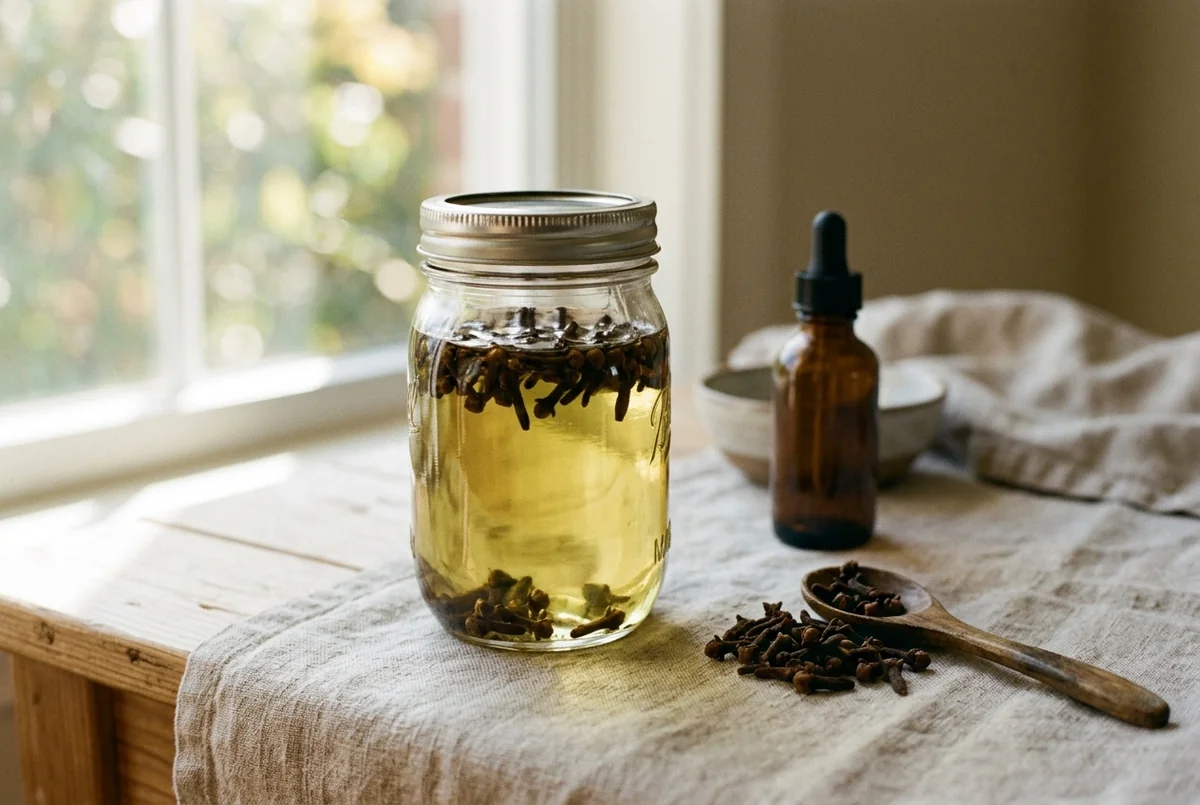
- Whole dried cloves – about 2 tablespoons. Fresh, aromatic cloves infuse better than old, dusty ones.
- A carrier oil – 1/2 cup. Olive or coconut oil for anything that might go near the mouth; jojoba for skin. (Our carrier oil guide breaks down which to pick.)
- A clean, dry dark glass jar with a tight lid. Dark glass protects the oil from light.
- A strainer – cheesecloth or a fine mesh sieve.
- Optional: a mortar and pestle to crush the cloves.
How to make clove-infused oil: the cold method
The cold (slow) method is the one I’d recommend. It’s gentler on the cloves’ aromatic compounds because there’s no heat to drive them off – cold-steeped infusions hold that warm, spicy clove note, while rushing it with heat tends to flatten the aroma into something faintly toasted.
- Lightly crush the cloves. A quick bruise with a mortar and pestle exposes more surface area and releases the aroma. Don’t pulverize them to powder – it makes straining harder.
- Combine. Put the crushed cloves in the dry jar and pour in the carrier oil until the cloves are fully submerged.
- Seal and steep. Cap tightly and set the jar in a cool, dark cupboard for 1 to 2 weeks.
- Shake daily. A gentle shake each day keeps the infusion moving.
- Strain. Pour through cheesecloth or a fine sieve to remove every bit of clove. Stray solids shorten shelf life.
- Bottle and label. Transfer to a clean airtight bottle. Note the oil, the carrier, and the date.
The faster warm method (and why cold is gentler)
If you don’t want to wait two weeks, you can warm the infusion. Put the crushed cloves and carrier oil in a small pan or a heat-safe bowl over a double boiler, and keep it on very low heat for 20 to 60 minutes. Never let it boil or even simmer hard – high heat scorches the oil and drives off the aromatics you’re trying to capture. Cool, strain, and bottle as above. It’s faster, but the cold method usually gives a cleaner, longer-lasting result.
How to store clove oil and how long it lasts
Store the strained oil in an airtight, dark glass bottle, away from heat and light. Used this way, a clove-infused oil keeps for roughly 4 months. The carrier is what goes off first, so the shelf life follows whichever carrier you chose. Before each use, give it a quick sniff – if it smells sharp, sour, or “crayon-like,” the carrier has gone rancid and it’s time to toss the batch and make a fresh one.
How to use your clove-infused oil safely
Infused oil is milder than the essential oil, but clove is still a “hot,” sensitizing botanical, so treat it with respect.
- Patch-test first. Dab a little on your inner forearm, cover it, and wait 24 to 48 hours for any redness or itch (American Academy of Dermatology).
- Remember the strength is uncontrolled. You can’t put a precise percentage on a homemade infusion. If you need an exact, safe dilution (like the 0.5% ceiling for skin), start from the distilled essential oil and our clove oil dilution guide instead.
- Skin and hair: see our clove oil for skin and clove oil for hair guides for use-by-use methods.
- Mouth and gums: only if you used an edible carrier. Dab on a cotton ball, avoid the gum line, and treat it as short-term relief – see a dentist. More in our clove oil for toothache guide.
- Skip it around children under 2 and in homes with cats. Our complete clove oil guide covers the safety details.
Prefer to buy the real (distilled) oil?
If what you actually want is the concentrated, precisely dilutable oil – for diffusing or for controlled skin blends – that’s the distilled essential oil, and buying it is the only practical option. Look for the botanical name Syzygium aromaticum, “clove bud” (gentler than clove leaf or stem), and a brand that publishes GC/MS testing.
Popular clove essential oils on Amazon
As an Amazon Associate we earn from qualifying purchases, at no extra cost to you. Product details and availability are subject to change – check the live listing on Amazon.
| Image | Product | Best for | Buy |
|---|---|---|---|
 | Cliganic Organic Clove Bud Essential Oil | Organic, everyday use | Buy on Amazon |
 | Organic Clove Essential Oil 30 ml | Value 30 ml size | Buy on Amazon |
 | Siva Clove Bud Essential Oil | Bulk / large bottle | Buy on Amazon |
 | MAYJAM Clove Bud Essential Oil | Budget starter | Buy on Amazon |
 | 100% Pure Clove Essential Oil | Small try-size | Buy on Amazon |
Affiliate links · details and availability change · check the live Amazon listing.
Frequently asked questions
What is the best carrier oil for making clove oil?
Olive and coconut oil are the usual picks because they’re edible and shelf-stable, which matters if the oil might go near your mouth. Jojoba is a great choice for skin. Fractionated coconut oil lasts the longest. See our carrier oil guide for the full comparison.
How do you make clove oil for teeth?
Use an edible carrier like olive or coconut oil for the infusion, then dab a little on a cotton ball and apply to the tooth, avoiding the gums. It’s short-term relief, not a cure – see a dentist for the cause. Full method in our clove oil for toothache guide.
Can you make clove oil on the stove?
Yes, with the warm method – gentle low heat for 20 to 60 minutes over a double boiler, never boiling. It’s faster than cold steeping, but heat can drive off some of the aroma, so the slow cold method usually gives a better result.
Is homemade clove oil as strong as store-bought?
No. Homemade clove-infused oil is far milder than the steam-distilled essential oil and its strength varies by batch. For anything that needs a precise, safe dilution, start from the bought essential oil.
How long does homemade clove oil last?
About 4 months when stored airtight in a cool, dark place. The carrier oil determines the real shelf life, so smell-test before each use and discard it if it smells rancid.
The bottom line
Making clove-infused oil at home is genuinely worth doing – it’s simple, cheap, and satisfying. Just go in clear-eyed: you’re making an infusion, not the distilled essential oil, so it’ll be milder and its strength won’t be exact. Crush fresh cloves, steep them slow and cold in a good carrier, strain well, label the jar, and patch-test before you use it. And if you need the concentrated, precisely dilutable oil, buying the distilled essential oil is the honest answer.
Medical disclaimer: This article is for general information and isn’t medical advice. Essential oils aren’t evaluated by the FDA to treat any condition. For persistent pain, skin reactions, or before using essential oils during pregnancy or on children, talk to a qualified healthcare professional.