Essential Oils for Anxiety: What the Evidence Actually Shows
By Ellen Cooper, independent essential-oil reviewer (hands-on since 2018, no MLM affiliation)
If you search “essential oils for anxiety,” you’ll find a hundred pages promising that lavender will melt your stress away. The honest picture is more interesting than that. The research is real – controlled trials do show aromatherapy can lower anxiety – but the effect is modest, it depends a lot on how you use the oil, and a couple of the details that matter most almost never make it into those listicles. Here’s what the evidence actually shows, which oils have the best trial support, how to match one to your kind of anxiety, and how to use it all without getting hurt or misled.
Quick answer: Inhaled essential oils – especially lavender, bitter orange (neroli), and bergamot – can produce a small, genuine reduction in anxiety, best supported for short-term, situational nerves. The single most-blurred fact: the strongest lavender evidence is for an oral capsule (Silexan), not for diffusing. Treat aromatherapy as a helpful complement to real anxiety care, never a replacement for it.
Do essential oils actually work for anxiety?
Short version: yes, a little, and mostly for situational anxiety. Multiple systematic reviews of randomized trials have found that aromatherapy reduces anxiety across settings – a meta-analysis of pre-surgery patients, for example, found a moderate effect (standardized mean difference -0.57, 95% CI -0.75 to -0.39) versus control (Guo et al., International Journal of Nursing Studies, 2020, retrieved 2026-07-16). A 2023 network meta-analysis of essential-oil trials concluded that oils reduced both state anxiety (the in-the-moment kind) and trait anxiety (your baseline tendency), with bitter orange coming out as the most consistently recommended (Tan et al., Frontiers in Public Health, 2023, retrieved 2026-07-16).
There’s a plausible reason scent can shift how you feel: smell is the one sense wired almost directly into the limbic system, the brain’s emotion and memory hub, so a calming aroma can nudge your mood and stress response fairly quickly. That’s a mechanism, though, not a megadose – it explains a gentle effect, not a dramatic one.
The honest caveat: most of these trials are small, short, and hard to blind (you can smell the oil), so reviewers rate the overall quality as low to moderate. Scent is a real nudge in the right direction – not a treatment for an anxiety disorder. Set your expectations at “this helps me settle,” not “this fixes anxiety.”
The distinction most articles miss: oral vs. inhaled lavender
This is the detail that changes how you read every other lavender claim online. A 2019 systematic review separated the two ways people take lavender and found very different evidence for each: an oral lavender-oil capsule (marketed as Silexan, 80 mg a day for at least six weeks) produced large, consistent drops in anxiety scores, while inhaled lavender showed only “an indication of an effect of reasonable size” – real, but weaker and muddied by inconsistent studies (Donelli et al., Phytomedicine, 2019, retrieved 2026-07-16).
Why it matters: when a page says “studies prove lavender treats anxiety,” it’s usually leaning on the oral capsule data and quietly implying it applies to your diffuser. It doesn’t, exactly. Diffusing lavender is worth doing – it’s pleasant and mildly calming – but the dramatic clinical results come from a standardized swallowed dose, which is a supplement decision to make with a doctor, not a bottle of diffuser oil (and essential oils should never be swallowed on your own).
Which essential oils have the best evidence for anxiety?
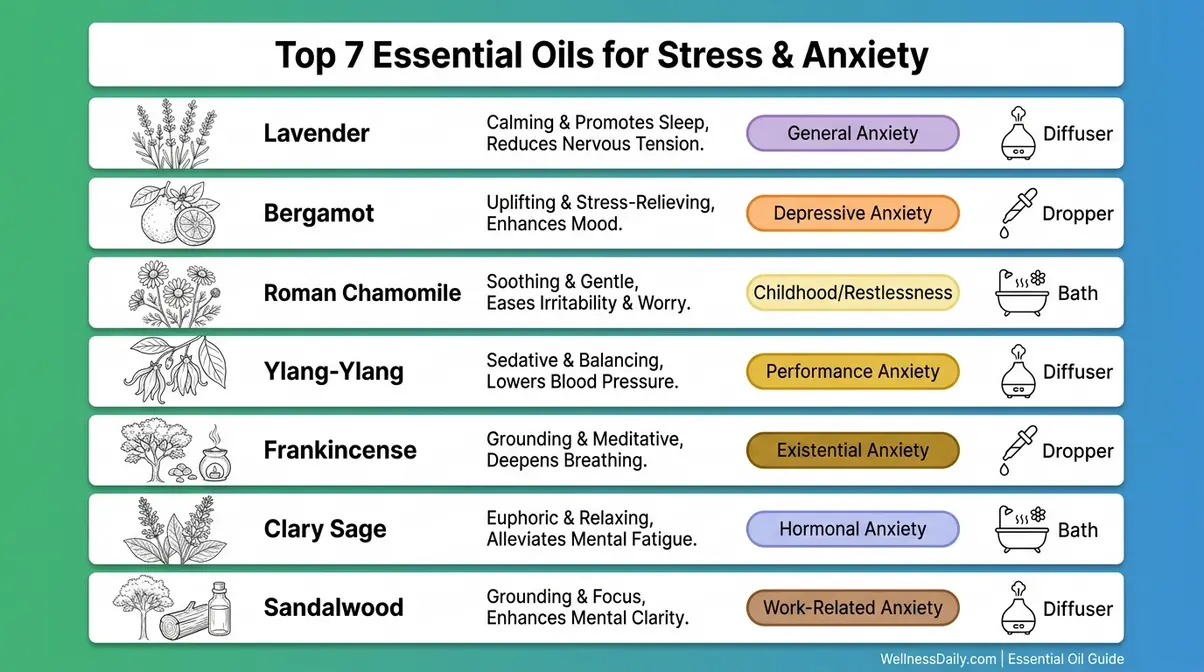
These are the ones with actual trial support – not just tradition. The effects are modest across the board; think “helps me relax,” and lean toward scents you personally enjoy, since finding the smell pleasant is part of why it works.
| Oil | What the trials suggest | Best way to use it |
|---|---|---|
| Lavender | The most-studied; inhaled shows a modest calming effect | Diffuse or a personal inhaler |
| Bitter orange / Neroli (Citrus aurantium) | Top-ranked in the 2023 network meta-analysis for both state and trait anxiety | Diffuse or inhaler |
| Bergamot | Small trials link it to lower stress and a brighter mood | Diffuse (it’s phototoxic – keep off skin before sun) |
| Roman chamomile | A long calming tradition with limited but supportive data | Diffuse or a diluted roller |
| Rose | Some trial support for situational and procedural nerves | Diffuse or inhaler |
| Ylang-ylang | May lower physical arousal (racing pulse); blends well with citrus | Diffuse lightly (too much can trigger a headache) |
A little more on the front-runners:
- Lavender is the sensible default – well-tolerated, easy to find, and the one most people respond to. Its main compound, linalool, is thought to act on the same calming (GABA) pathway some anti-anxiety medicines target, which is a plausible reason a sniff can take the edge off. Just remember the oral-vs-inhaled gap above.
- Bitter orange (neroli) earned the top spot in the 2023 network meta-analysis for reducing both in-the-moment and baseline anxiety. If lavender does nothing for you – it doesn’t for everyone – this is the evidence-backed one to try next.
- Bergamot is the bright, uplifting citrus option; small trials tie it to lower stress and a lift in mood, which makes it a good daytime pick. One catch: it’s phototoxic, so keep it off skin that will meet sunlight.
- Roman chamomile is the gentlest of the group – a soft, apple-like scent that pairs beautifully with lavender at bedtime, especially if stress is the thing keeping you wound up.
For more on the oils people reach for most, see our guide to the most popular essential oils, and our deeper lavender oil benefits and safety guide.
How do you match an oil to your kind of anxiety?
“Anxiety” isn’t one thing, and the oil that helps a racing-heart moment before a presentation isn’t necessarily the one for the low, grinding worry that’s been building for weeks. Use this as a starting map, not a prescription – then adjust to what your nose and body actually respond to.
| What it feels like | Oils to try first | How |
|---|---|---|
| Sudden, situational (racing heart, a spike of nerves) | Bitter orange, bergamot, ylang-ylang | Direct inhalation – from the bottle or a personal inhaler |
| Chronic, low-grade worry | Lavender, roman chamomile | Diffuse for 15-30 minutes as a daily wind-down |
| Anxiety that wrecks your sleep | Lavender + roman chamomile | Diffuse at bedtime, or a pillow mist |
| Anxiety with a flat, low mood | Bergamot, bitter orange | Diffuse in the daytime, or a diluted roller on pulse points |
The lavender oils I reach for (for the blends above):
Recommended on Amazon
As an Amazon Associate we earn from qualifying purchases, at no extra cost to you. Product details and availability are subject to change – check the live listing on Amazon.
| Image | Product | Best for | Buy |
|---|---|---|---|
 | Majestic Pure Essential Oil with Glass Dropper | Budget lavender | Buy on Amazon |
 | Organic Lavender Essential Oil 30 ml | Budget lavender | Buy on Amazon |
 | Handcraft Blends Lavender Essential Oil | Organic, for rollers | Buy on Amazon |
 | Plant Therapy Lavender Essential Oil 100% Pure | Large value bottle | Buy on Amazon |
Affiliate links · details and availability change · check the live Amazon listing.
How do you use essential oils for anxiety?
- Diffuse – 3 to 5 drops in a water diffuser for 15 to 30 minutes, then give your nose a break. The gentlest, most-studied method; ideal for winding down at home.
- Personal inhaler or a tissue – a drop or two on a cotton inhaler wick you sniff when nerves spike. Portable, discreet, no equipment – the best option for a situational moment.
- Diluted on skin – for a calming roller or massage, dilute to about 2% (roughly 12 drops per ounce / 30 mL of a carrier oil), or 1% for sensitive skin. A 10 mL roller takes 2 to 4 drops. Never apply oils neat.
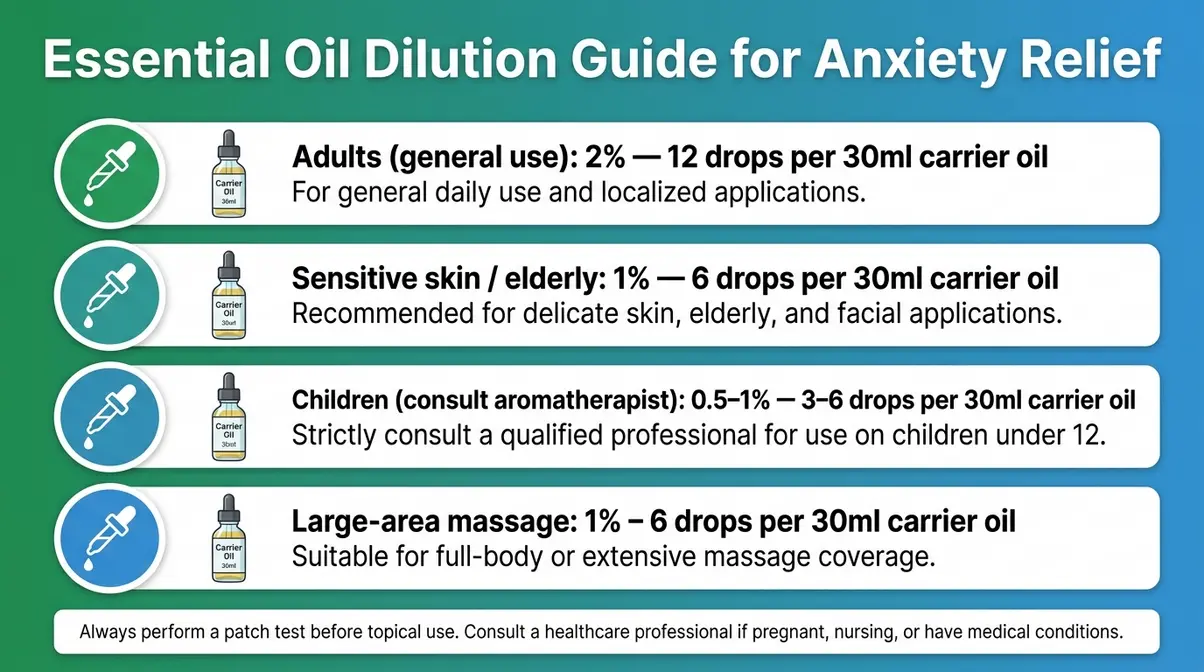
For the full how-to on each method, see our beginner’s guide to using essential oils, and for getting the dilution right, our carrier oil guide. A steady daily routine tends to help more than a one-off sniff – some of the benefit is the ritual itself.
Three simple calming blends
The diffuser blends drop straight into the water reservoir. To turn either into a roller, use the same ratio of drops in a 10 mL bottle topped with a carrier oil (about 2%).
- Evening wind-down (diffuser) – 3 drops lavender + 2 drops bergamot. Warm and settling, an hour before bed.
- Daytime steady (diffuser) – 3 drops bitter orange (or sweet orange) + 1 drop roman chamomile. Bright but grounding, for a tense afternoon.
- Pocket roller (10 mL) – 4 drops lavender + 2 drops bergamot + 1 drop ylang-ylang, topped with fractionated coconut oil. Roll onto wrists and inhale when a wave of nerves hits.
Can essential oils help anxiety-driven sleeplessness?
Anxiety and broken sleep feed each other – a wired-up nervous system won’t switch off, and a bad night lowers your threshold for worry the next day. Aromatherapy fits here as a bedtime cue rather than a sleeping pill. One controlled trial in older adults found that inhaling lavender and chamomile lowered scores for depression, anxiety, and stress over the study period (Ebrahimi et al., randomized controlled trial, 2022, retrieved 2026-07-16). A simple routine: diffuse 3 drops lavender + 2 drops roman chamomile for 30 minutes as you get ready for bed, every night for a week, and see whether your wind-down gets easier. If sleeplessness is severe or persistent, though, that’s worth raising with a doctor – it can point to a sleep or anxiety condition that needs more than a diffuser.
What about during a panic attack?
Be realistic here: no scent halts a panic attack, and the trial evidence is for everyday worry, not acute panic. What a familiar calming smell can do is act as a grounding anchor – one more sensory cue, alongside slow breathing, that tells your body it’s safe.
A pocket inhaler holding lavender or bitter orange can be a handy part of a coping kit. Pair it with paced breathing – a longer exhale than inhale – and treat the oil as support for the breathing, not a substitute. If panic attacks are frequent, that’s a strong reason to see a professional; the condition is very treatable.
Safety, and when essential oils are not enough
- Never apply undiluted, and never swallow them. Patch-test a diluted blend on your inner arm for 24 hours before wider use.
- Pregnancy – a few calming oils (clary sage and rosemary among them) are best avoided; keep any use to a low 1% dilution and clear it with your provider first.
- Children – stick to gentle options like well-diluted lavender for over-2s, and diffuse in a ventilated room rather than applying to skin.
- Pets – cats in particular can’t process many oil compounds; lavender, tea tree, eucalyptus, and citrus are among those toxic to them. Diffuse only where a pet can leave the room, and never apply oils to an animal.
- Medication – if you take sedatives, anti-anxiety, or antidepressant medicine, mention aromatherapy to your prescriber; scent is low-risk, but oral lavender supplements can add to sedation.
- Phototoxicity – bergamot and most citrus oils react with sunlight, so keep them off skin that will be exposed for 12 or more hours.
And the line that matters most: essential oils are a complement, not a cure. If anxiety is interfering with your sleep, work, or relationships, or you’re having frequent panic attacks, that deserves real care – a doctor or therapist, and treatments like therapy (and sometimes medication) with far stronger evidence than any oil.
If you ever feel unsafe or in crisis, contact a local emergency number or a crisis line right away. Reaching for help is the strong move, not the weak one.
Frequently asked questions
What is the single best essential oil for anxiety?
Lavender is the most-studied and the safest starting point. In the 2023 network meta-analysis, bitter orange (Citrus aurantium) came out as the most consistently recommended across both types of anxiety, so it’s a strong second to try if lavender doesn’t click for you.
Do essential oils really work for anxiety, or is it placebo?
Controlled trials show a small but real reduction in anxiety beyond placebo, especially for situational anxiety – though because you can smell the oil, studies are hard to blind, so some of the benefit is expectation and ritual. That’s still a genuinely useful effect; it just isn’t a large one.
Can essential oils replace anxiety medication or therapy?
No. Aromatherapy is a low-risk complement that can help you relax, but therapy and medication have far stronger evidence for treating an anxiety disorder. Never stop a prescribed medication to use oils instead – talk to your prescriber first.
Is it safe to diffuse essential oils every day?
For most healthy adults, short daily diffusing (15 to 30 minutes in a ventilated room) is fine. Keep sessions short, air the room out, and stop if you get a headache. Take extra care around pregnancy, young children, asthma, and pets.
The bottom line
Essential oils earn a modest, honest place in an anxiety toolkit: inhaled lavender, bitter orange, and bergamot can take the edge off situational nerves, and a steady daily ritual makes that small effect add up. Match the oil to how your anxiety actually shows up, keep the expectations straight – the dramatic lavender studies are about a swallowed capsule, not your diffuser – and remember oils sit alongside, never instead of, real care. Start with lavender, diffuse or use a pocket inhaler, dilute anything that touches skin, and if anxiety is running your life, let a professional help.
Medical disclaimer: This article is general information, not medical advice, and does not diagnose or treat any condition. Essential oils are not a treatment for an anxiety disorder. Never apply oils neat or ingest them, and check with a qualified professional before using essential oils during pregnancy, around children, with a medical condition, or alongside medication. If you are in crisis, contact your local emergency number or a crisis line immediately.