
Cedarwood Essential Oil: Benefits, Uses & Safety

By Ellen Cooper, independent essential-oil reviewer (hands-on since 2018, no MLM affiliation)
Cedarwood is the warm, dry, pencil-shavings scent that anchors half the relaxing blends I make. It’s also one of the few oils where the label genuinely matters – “cedarwood” covers four different plants, two of which aren’t even true cedars. And it’s an oil with one very specific claim I want to knock down early, because a lot of sites get it backwards: cedarwood does not repel mosquitoes.
Quick answer: Cedarwood is a warm, woody base-note oil used mainly for relaxation, sleep blends and scalp care. Four different plants are sold under the name – Atlas, Virginian, Texas and Himalayan – so check the botanical name. It’s a registered ingredient in some moth and flea products, but a 1999 study found it failed to repel mosquitoes. Dilute for skin, and be careful around cats.
Four oils, one name – which cedarwood is which?
This is the part worth knowing before you buy, because these plants aren’t interchangeable and two of them aren’t botanically cedars at all.
| Sold as | Botanical name | Character |
|---|---|---|
| Atlas cedarwood | Cedrus atlantica | A true cedar – rich, sweet, the classic “spa” cedar |
| Virginian cedarwood | Juniperus virginiana | Actually a juniper – dry, pencil-shavings scent; the one used in pest products |
| Texas cedarwood | Juniperus ashei | Also a juniper – smokier, sharper, cheapest of the four |
| Himalayan cedarwood | Cedrus deodara | A true cedar – softer and slightly milky |
For relaxation and blending, Atlas is the one I reach for – it’s the roundest and most pleasant. If you specifically want the version that turns up in registered pest products, that’s Virginian. Any bottle that just says “cedarwood” with no Latin name is telling you the seller doesn’t think the difference matters, which is itself informative.
What cedarwood is actually good for

Relaxation and sleep blends
This is cedarwood’s main job in my house, and I’ll be straight about the evidence level: there isn’t a body of human trials showing cedarwood improves sleep. What there is, is a warm grounding scent that works beautifully as a base note – it slows a blend down and makes bright oils like bergamot or lavender last longer. Diffusing it at bedtime is a pleasant ritual with a plausible calming effect, not a proven sleep treatment. If you want the oils with better sleep and anxiety evidence, our guide to essential oils for anxiety covers what the research actually supports.
Hair and scalp – one real study, honestly read

Cedarwood is the best-known ingredient in the most-cited aromatherapy hair study, and it’s worth stating precisely what that study found. In a 1998 randomised, double-blind trial in Archives of Dermatology, 86 patients with alopecia areata massaged their scalps daily for seven months: 44% of the active group improved versus 15% of controls (Hay, Jamieson & Ormerod, Arch Dermatol, 1998, retrieved 2026-07-22).
The crucial detail: the active treatment was a blend of four oils – thyme, rosemary, lavender and cedarwood – in jojoba and grapeseed. So the result belongs to the combination. You cannot honestly say cedarwood alone regrew hair, and I’d be sceptical of any site that does. A 3% scalp massage is a reasonable, low-risk thing to try; just go in with accurate expectations.
What cedarwood does NOT do: repel mosquitoes
Plenty of pages list cedarwood as a natural mosquito repellent. The research says otherwise. A 1999 study in the Journal of Medical Entomology tested five essential oils on human skin against Aedes aegypti and Anopheles albimanus and found plainly that cedarwood oil failed to repel mosquitoes – thyme and clove were the only ones offering meaningful protection, and even those came with irritation and odour problems (Barnard, J Med Entomol, 1999).
So don’t rely on it where mosquito-borne illness is a real risk. For what does and doesn’t work against mosquitoes, see our essential oils for mosquito repellent guide.
Ticks – the one pest where the evidence is strong
Here is the flip side of the mosquito story: against ticks, cedarwood genuinely delivers. In 2022, U.S. Department of Agriculture (USDA) Agricultural Research Service scientists found that contact with cedarwood-oil-treated surfaces repelled 80-94% of black-legged tick nymphs – the ticks retreated, slowed, or dropped off – with the black-legged tick the most susceptible of four species tested (USDA ARS, 2022, retrieved 2026-07-27). Two honest caveats: it was a laboratory test on treated surfaces, not a field trial on your ankles, and the same work was about ticks and fire ants – not mosquitoes. So treat cedarwood as a promising tick deterrent worth folding into a yard or gear routine, not a substitute for a proven repellent where tick-borne illness is a real risk. It is also the reason cedarwood shows up in some tick and flea products.
Where it does earn its keep on pests
Cedarwood oil has a genuine, long-standing role against a narrower set of pests – it’s been used in products aimed at moths and fleas since the early 1990s, and cedar’s reputation for keeping moths out of wardrobes isn’t folklore (NCBI Bookshelf, cedarwood oil profile). Cedar blocks or a few drops on a cloth in a wardrobe is the classic use and a perfectly sensible one.
Cedarwood bottles worth a look – check the Latin name matches what you want:
Popular options on Amazon
As an Amazon Associate we earn from qualifying purchases, at no extra cost to you. Product details and availability are subject to change – check the live listing on Amazon.
| Image | Product | Best for | Buy |
|---|---|---|---|
 | Organic Cedarwood Essential Oil 30 ml | Organic, hexane-free | Buy on Amazon |
 | Cedarwood Essential Oil 1.01fl.oz/30ML | Budget diffuser bottle | Buy on Amazon |
 | EUQEE Cedarwood Essential Oil 118mL Pure Cedarwood… | Large bulk bottle | Buy on Amazon |
 | 100% Pure Cedarwood Essential Oil | Small bottle to try | Buy on Amazon |
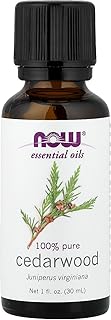 | NOW Essential Oils | Trusted brand, 1 oz | Buy on Amazon |
Affiliate links · details and availability change · check the live Amazon listing.
How I use it
- Sleep-blend base – 2 drops cedarwood under 3 lavender and 3 bergamot in the diffuser. Cedarwood is the anchor, not the star.
- Grounding roller – 2% in a 10 mL roller with jojoba, on the wrists in the evening.
- Scalp massage – 3% in a carrier oil, massaged in and left 20-30 minutes before washing.
- Wardrobe moth deterrent – a few drops on a cotton pad or a cedar block, refreshed monthly.
- In blends generally – it’s one of the most useful base notes you can own; see our blending chart.
New to dilution? Start with what a carrier oil is and the dilution guide.
Safety – and a word about pets
- Always dilute (2% for body, 1% for face) and patch-test for 24 hours. Cedarwood is reasonably gentle but it’s still a concentrated oil.
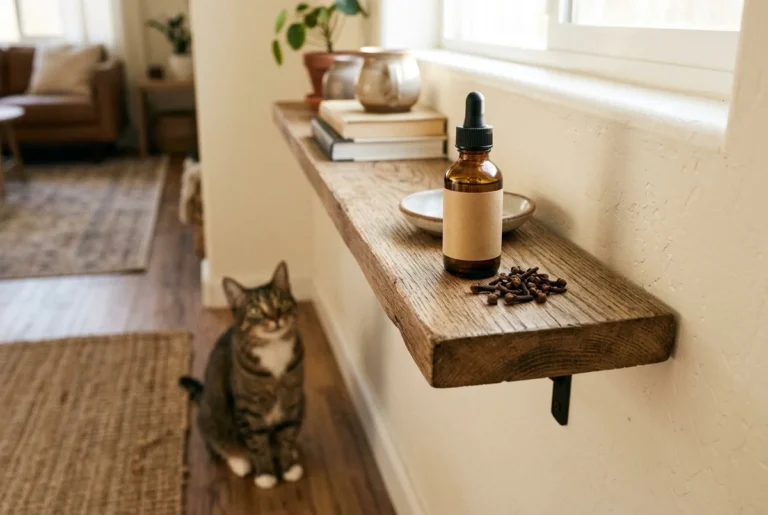
- Cats – cats lack the liver enzymes to process many oil compounds and are far more sensitive than dogs. Keep cedarwood off cats entirely and diffuse only where a cat can leave the room.
- Dogs tolerate essential-oil compounds better than cats, but “tolerable” is not “risk-free.” If you use it topically on a dog, keep the dilution very low (around 0.5-1%, roughly 3-6 drops per 30 mL of carrier), never near the face or on puppies under about 10 weeks, and talk to your vet first – cedarwood appears in some pet products, but “in a product” is not the same as “safe to apply yourself” (National Capital Poison Center).
- Pregnancy – check with your provider first.
- Never ingest it, and keep bottles out of reach of children.
Buying a decent bottle
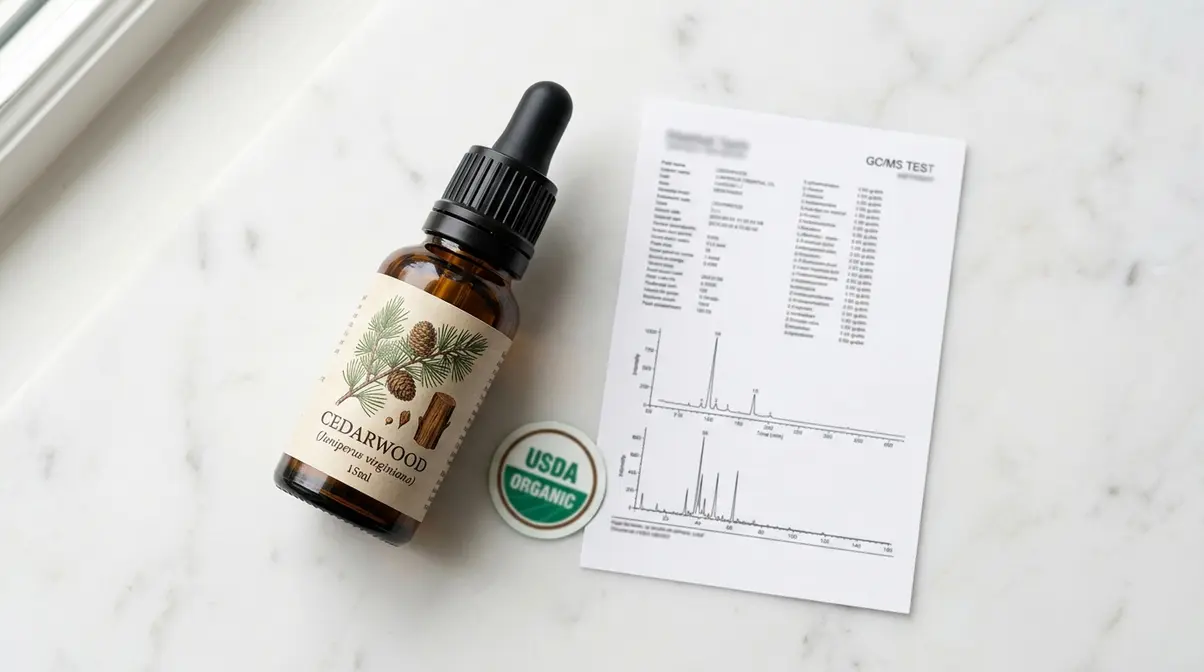
- Insist on the botanical name – Cedrus atlantica, Juniperus virginiana, Juniperus ashei or Cedrus deodara. No Latin name, no purchase.
- Dark glass, steam-distilled, with a batch or GC/MS report if the brand publishes one.
- Expect it to be affordable – cedarwood is one of the cheaper oils. A suspiciously expensive “cedarwood” is usually a marketing markup, not better oil.
- “Therapeutic grade” means nothing – no independent body issues that certification.
Frequently asked questions
What is cedarwood essential oil good for?
Mainly relaxation and sleep blends, where it works as a warm grounding base note, plus scalp massage and as a wardrobe moth deterrent. Its calming reputation is plausible but not backed by human trials.
Does cedarwood oil repel mosquitoes?
No. A 1999 study in the Journal of Medical Entomology found cedarwood oil failed to repel mosquitoes when tested on skin. It does have a genuine role against moths and fleas, but don’t use it for mosquito protection.
Does cedarwood oil regrow hair?
The well-known 1998 trial that showed improvement in alopecia areata used a blend of four oils – thyme, rosemary, lavender and cedarwood – so the result belongs to the combination, not cedarwood alone. A 3% scalp massage is low-risk to try, but no single oil has been shown to regrow hair by itself.
Which type of cedarwood should I buy?
Atlas (Cedrus atlantica) for relaxation and blending – it has the richest, most pleasant scent. Virginian (Juniperus virginiana) is the type used in registered pest products. Always check the botanical name on the label.
Is cedarwood oil safe for dogs and cats?
Cats are the bigger concern – they can’t process many oil compounds and should not be exposed. Cedarwood does appear in some dog products, but check with your vet before applying any essential oil to an animal yourself.
The bottom line
Cedarwood is an inexpensive, genuinely useful oil – as long as you buy the right one and expect the right things. Get Atlas for blending and sleep rituals, check the Latin name on every bottle, use it as the base note that makes your other oils last, and put a few drops in the wardrobe for moths. Just don’t reach for it against mosquitoes, and don’t let anyone tell you it regrows hair on its own.
Safety note: This article is general information, not medical or veterinary advice. Cedarwood essential oil is not a treatment for hair loss or any medical condition. Never ingest essential oils or apply them undiluted, keep them away from cats, and consult a vet before using any oil on an animal or a qualified professional before use during pregnancy or alongside a medical condition.