15 Most Popular Essential Oils: Uses, Benefits, and Safety Guide (2026)
By Ellen Cooper, independent essential-oil reviewer (hands-on since 2018, no MLM affiliation)
Fifteen oils sounds like a lot until you realise most people use four. The list below is ordered roughly by how often an oil earns its shelf space rather than by how impressive it sounds, with what each is actually for and the research where research exists. Buy the first three or four, learn what you like, and ignore the rest until you have a reason.
If you buy nothing else: lavender for sleep and general use, sweet orange because everyone likes it, peppermint for alertness, and eucalyptus for a stuffy winter room. That is a complete starter kit and it will cost less than one MLM bottle.
The 15 oils at a glance
| Oil | Mainly used for |
|---|---|
| Lavender Lavandula angustifolia | Sleep, calm, minor burns |
| Peppermint Mentha piperita | Alertness, tension headaches |
| Lemon Citrus limon | Mood, cleaning |
| Eucalyptus Eucalyptus radiata | Congestion, stuffy rooms |
| Frankincense Boswellia carterii | Meditation, mature skin |
| Tea Tree Melaleuca alternifolia | Spots, antifungal use |
| Roman Chamomile Chamaemelum nobile | Calm, sensitive skin |
| Rosemary Rosmarinus officinalis | Focus, scalp care |
| Patchouli Pogostemon cablin | Grounding, skin, base note |
| Sweet Orange Citrus sinensis | Cheap, cheerful, kid-friendly |
| Marjoram Origanum majorana | Muscle comfort, sleep |
| Grapefruit Citrus paradisi | Uplift, morning diffusing |
| Cinnamon Cinnamomum zeylanicum | Winter blends, antimicrobial |
| Clove Syzygium aromaticum | Toothache tradition, antimicrobial |
| Clary Sage Salvia sclarea | Cycle comfort, relaxation |
The 15 oils in detail
1. Lavender (Lavandula angustifolia)
The one to buy first and the one you will finish fastest. Gentle enough to use widely, and the best-studied oil here for anxiety and sleep quality (PubMed; PubMed).
2. Peppermint (Mentha piperita)
Sharp, cooling and useful when you need to wake up. Applied diluted to the temples it has been studied for tension headache, and inhaled for alertness (PubMed; PubMed). Keep it away from young children.
3. Lemon (Citrus limon)
Bright and almost universally liked, which makes it the safest choice when other people share the room. Studied for mood effects (PubMed). Phototoxic – keep treated skin out of the sun.
4. Eucalyptus (Eucalyptus radiata)
The winter oil. Radiata is gentler than globulus and the better buy for home use (PubMed; NCCIH). Not for babies or young children.
5. Frankincense (Boswellia carterii)
Expensive, resinous and worth having once you are past the basics. Anti-inflammatory activity has been reviewed (PubMed).
6. Tea Tree (Melaleuca alternifolia)
The medicine-cabinet oil rather than the diffuser one – its antimicrobial activity is well documented (PubMed; PubMed). The smell divides people. Toxic to cats.
7. Roman Chamomile (Chamaemelum nobile)
Softer and sweeter than lavender, and the gentler option for children under supervision (PubMed; NCCIH).
8. Rosemary (Rosmarinus officinalis)
Herbaceous and bracing. Studied for cognitive performance and, in blends, for hair (PubMed; PubMed). Avoid in pregnancy.
9. Patchouli (Pogostemon cablin)
Earthy and much misunderstood – most people who dislike it have met it overdone. Anti-inflammatory and antimicrobial activity is documented (PubMed). One drop is plenty.
10. Sweet Orange (Citrus sinensis)
The easiest oil in the cabinet: pleasant to nearly everyone, hard to overdo, and studied for anxiety reduction (PubMed). Mildly phototoxic.
11. Marjoram (Origanum majorana)
Warm and slightly herbal, and the one massage therapists reach for after lavender (PubMed).
12. Grapefruit (Citrus paradisi)
Sharper than orange and less sweet than lemon (PubMed). Strongly phototoxic – do not wear it in sunshine.
13. Cinnamon (Cinnamomum zeylanicum)
Potent and a genuine skin irritant, so this is a diffuser oil for most people rather than a topical one (PubMed). Use one drop in a blend, never neat.
14. Clove (Syzygium aromaticum)
Very high in eugenol, which makes it effective and makes it a “hot” oil that burns careless users (PubMed). Cap it at 0.5% dilution and keep it away from cats.
15. Clary Sage (Salvia sclarea)
Distinct, slightly musky, and the one most often used for menstrual discomfort and stress (PubMed; PubMed). Avoid during pregnancy.
Two of these have guides of their own: lavender and peppermint. Peppermint also turns up in our guide to essential oils for headaches.
The safety rules that actually matter
Always dilute. Neat oil on skin is how people sensitise themselves, and sensitisation is usually permanent – once it happens you react even to properly diluted blends. Aim for 1-2% on the body, 0.5-1% on the face. The NAHA safety guidelines are the standard reference.
Mind the sun. Citrus oils – especially grapefruit, lemon and bergamot – are phototoxic. Keep treated skin out of daylight for at least 12 hours.
Pregnancy, children and pets. Avoid clary sage and rosemary in pregnancy. Nothing for babies; very low dilutions and supervision for children over two. Cats are the real constraint – they lack the liver enzyme needed to process many of these compounds, and the ASPCA maintains poison-control guidance. Ask a vet first.
Patch test. Diluted blend on the inner forearm, wait 24 hours. Boring, and it is the step that prevents the problem you cannot undo. Our guide to using essential oils covers application methods properly.
How do you buy oils that are actually what they claim?
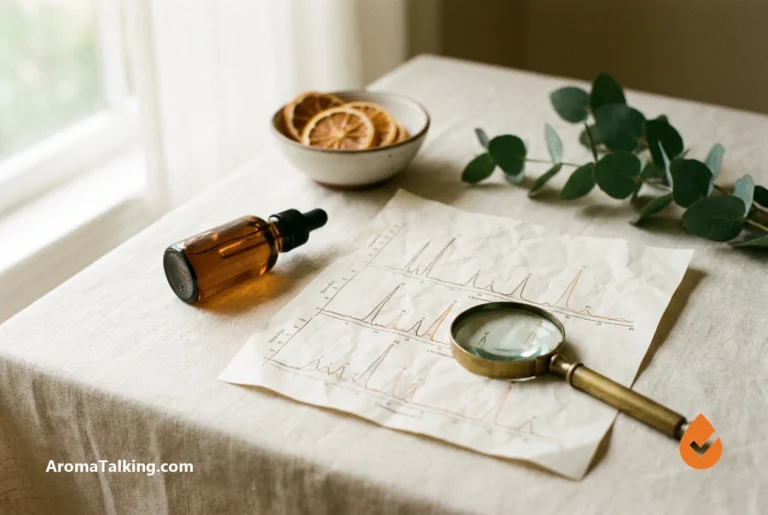
Adulteration is common in online retail. One peer-reviewed GC-MS investigation of lavender oils sold on a major marketplace found the large majority failed authenticity testing against ISO standards (Nutritional Outlook; PMC). The defence is simple: buy from brands that publish a batch GC/MS report you can match to your bottle. The NAHA guidance on oil quality explains what those reports show. Ignore “therapeutic grade” – no independent body issues it.
Where to buy
As an Amazon Associate we earn from qualifying purchases, at no extra cost to you.
Plant Therapy – batch GC/MS, a Tisserand-developed KidSafe line and a 90-day guarantee; the best all-round pick, especially with children in the house (full review, or browse the range).
Edens Garden – per-batch GC/MS through an independent lab, wide selection, honest pricing (full review, or see current listings).
NOW Foods – the cheapest honest option, and the one I would use for oils you get through quickly like sweet orange and peppermint (full review).
The MLM brands – doTERRA (review) and Young Living (review) – sell genuine oil at prices that fund a distributor network. If you want to sample widely without much outlay, a variety pack is a cheaper way in than buying singles one at a time.
You will also need something to put them in: see our ultrasonic diffuser roundup, nebulizing picks, car diffusers, or diffuser vs humidifier if you are not sure which device you need.
Frequently asked questions
Which essential oil should a beginner start with?
Lavender. It is the most forgiving oil in the cabinet, the best studied for sleep and anxiety, and the one you will reach for most often. Add sweet orange and peppermint next and you have covered most of what people actually do.
How many drops go in a diffuser?
Roughly 3 to 5 drops per 100 ml of water. More is not better – past a certain point your nose stops registering it and you are simply spending oil faster.
Do essential oils expire?
Yes. Citrus oils turn within about a year; most others last two to three years; resinous oils like frankincense and patchouli improve with age. Store them in dark glass, away from heat, with the caps tight.
Are expensive essential oils better?
Not reliably. Price tracks how hard the plant is to grow and distil, and in MLM brands it also tracks the distributor network. What actually matters is a published batch GC/MS report you can read for your lot.
Which oils are safe around children and pets?
Lavender, chamomile and sweet orange are the gentlest for supervised use with children over two, at very low dilutions. Cats are the hard constraint: they cannot process many essential-oil compounds, and tea tree, clove and cinnamon are particularly risky. Consult a vet before diffusing around animals.
Medical disclaimer: This article is general information, not medical advice, and does not diagnose or treat any condition. The research cited describes studied effects, not guaranteed outcomes. Never apply essential oils neat or ingest them, and check with a qualified professional before using them during pregnancy, while nursing, around children, with a medical condition, or alongside medication.