Carrier Oil for Peppermint Oil: Ratios and Safe Picks
By Ellen Cooper, independent essential-oil reviewer (hands-on since 2018, no MLM affiliation).
Peppermint is the oil people most often get wrong on their first go, and the reason is that it does not feel like a mistake at the time. It tingles, it cools, it seems to be working. Then an hour later the skin underneath is red and stinging.
That cooling hit is menthol, which makes up roughly 40% of the distillate, and it is why this particular botanical deserves more caution than a gentle floral like lavender. The base you blend it into is not an optional extra here. It is the buffer standing between a potent aromatic compound and your skin.
The short version
- Never neat. Peppermint on undiluted skin is one of the most common routes to a burn-like reaction.
- 1 drop per teaspoon is 1%. Two drops is 2%, three is 3%. The counts you will see quoted are usually one step too strong.
- Jojoba or fractionated coconut are the sensible defaults; skip the refined cooking oils some guides list.
- Never on the face of a baby or small child. The NIH is explicit about this, and it is the one rule with real consequences.
- Patch test at the strength you intend to use, carrier and essential oil together, not the carrier alone.
Why does peppermint need more care than most oils?
Two reasons, and the first is simply how concentrated it is.
Peppermint essential oil is steam-distilled from Mentha × piperita and is typically around 40% menthol. Menthol activates the TRPM8 cold receptors in your skin, which is why a properly diluted rub feels genuinely cold without lowering your actual temperature. At full strength that same mechanism reads as burning rather than cooling.
That distinction matters more than it sounds. The chill is a receptor signal, not a drop in temperature, so the sensation reports nothing whatsoever about whether the tissue underneath is being irritated.
You can feel pleasantly cold while a reaction is already developing. That is precisely how people end up applying a second coat of something that was too strong to begin with.
The second reason is that menthol does not stay on the skin. It evaporates, and it gets breathed in, which matters enormously for one group of people. The National Center for Complementary and Integrative Health states it plainly:
Peppermint oil should not be applied to the face of infants or young children because serious side effects may occur if they inhale the menthol in the oil.
That is not a dilution problem you can solve with more carrier oil. It is a placement rule, and it applies at any strength.
For adults, NCCIH notes that side effects of applying peppermint oil to the skin can include skin rashes and irritation. Diluting properly is what keeps you on the right side of that.
How much peppermint oil per teaspoon of carrier?
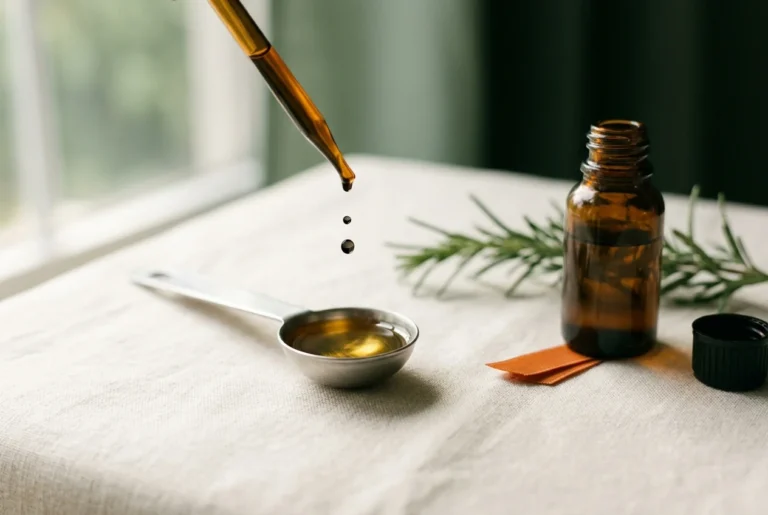
Here is the arithmetic that settles most of the disagreement you will find online. A teaspoon holds 5 ml, and a standard dropper delivers roughly 0.05 ml per drop. That works out at one drop per teaspoon for every 1%.
| You mix | Concentration | Suits |
|---|---|---|
| 1 drop per teaspoon | ~1% | Face, sensitive skin, a first try |
| 2 drops per teaspoon | ~2% | The everyday body and scalp target |
| 3 drops per teaspoon | ~3% | Localised use on a small area, short duration |
| 12 drops per fl oz (30 ml) | ~2% | Mixing a bottle instead of a single application |
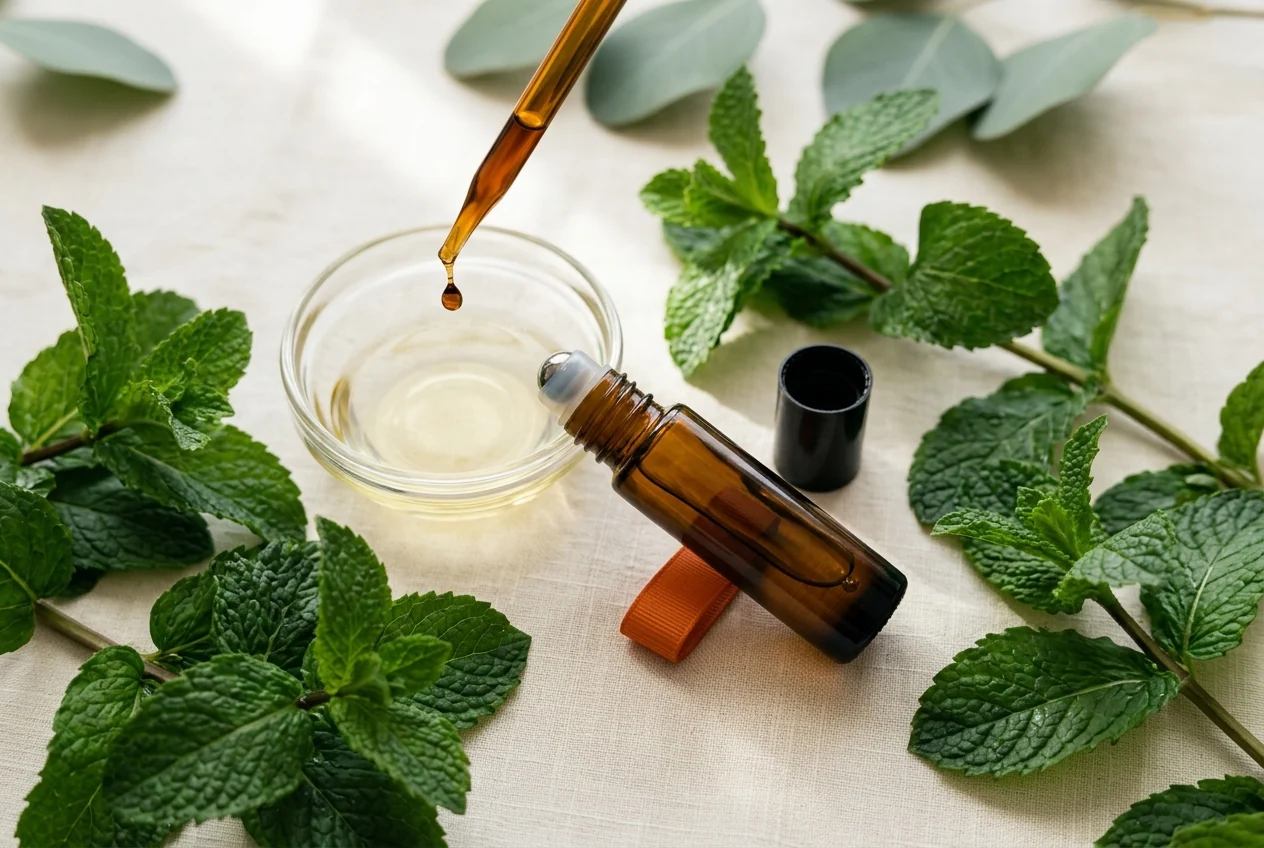
| 4 drops in a 10 ml roller | ~2% | A temple or pulse-point roller |
Now compare that with what the search results tell you. Google’s AI summary for this query recommends 1 to 2 drops per teaspoon for a 1% facial dilution, and 3 to 5 drops per teaspoon for a 2 to 3% body dilution.
Run those through the same arithmetic and the numbers do not line up. Three drops in a teaspoon is 3%, not 2%. Five drops is 5%, not 3%. The percentages are sensible; the drop counts sitting beside them are a full step stronger than the labels claim.
This is not pedantry, because nobody blends by percentage. Everybody blends by counting. Follow a count believing it represents 2% and you have applied 3%, and with something 40% menthol that gap is precisely the one your skin registers.
When the two disagree, trust the percentage and count the drops yourself.
Which carrier oil should you use?
Peppermint is thin and volatile, so it wants a light vehicle – something that will absorb rather than form a greasy occlusive layer that holds the aromatic against your skin longer than intended.
| Carrier | Feels like | Good for | Watch out for |
|---|---|---|---|
| Jojoba | Light, dry, absorbs fast | The default. A liquid wax, close to what skin makes, and it keeps for years | Costs more per ml |
| Fractionated coconut | Very light, colourless, non-greasy | Rollers, body blends, anything you want to wash out cleanly | Adds no conditioning of its own |
| Sweet almond | Medium, slightly rich | Dry skin, larger areas like legs and back | A tree nut. Avoid with nut allergies |
| Grapeseed | Very light, absorbs quickly | Oily or acne-prone skin | Short shelf life; buy small bottles |
| Sunflower | Light, cheap, widely available | A perfectly good stand-in you may already own | Goes rancid faster than most |
| Virgin coconut | Heavy, solid below about 24°C | Very dry skin, if you like the texture | Melts and re-solidifies; can feel occlusive |
A note on one of the lists you will meet. The page ranking first for this query recommends canola, corn, safflower, sesame, soy and sunflower as suitable bases.
Those are not wrong exactly. They are all plant oils and they will all dilute an essential oil.
But that list is assembled around cost and availability rather than around behaviour on skin. Canola, corn and soy are heavily refined commodity oils bought by the litre for cooking, never selected for how they sit on a face.
If you already own sunflower, use it rather than skipping dilution altogether. If you are buying deliberately, buy jojoba.
If you want the fuller comparison, we have a guide to choosing a carrier oil, plus dedicated pages on jojoba and fractionated coconut oil.
What about peppermint for hair and scalp?
This is where a lot of the search traffic for peppermint carriers is actually heading, so it is worth being precise about what is known.
The paper behind the “peppermint beats minoxidil” headlines is real, and it was conducted in mice.
Oh, Park and Kim, writing in Toxicological Research in 2014, applied four topical treatments to C57BL/6 mice across four weeks: saline, jojoba, 3% minoxidil and 3% peppermint. The peppermint arm showed the most prominent effects, with significant gains in dermal thickness, follicle number and follicle depth (PMID 25584150, accessed 28 July 2026).
Two details from that paper are worth carrying over, because they are genuinely useful. The peppermint was applied at 3%, which is where the scalp figure below comes from. And the vehicle the researchers used was jojoba oil, so “3% peppermint in jojoba” is not a guess. It is the formulation that was actually tested.
What does not carry over is the conclusion. These were mice, over four weeks, and no human trial has replicated it. Treat “better than minoxidil” as something observed in rodents rather than a promise about your head.
For scalp work specifically:
- Use 3% at most – 3 drops per teaspoon, or 18 drops in a 30 ml bottle.
- Jojoba is the natural pick, because it is closest to what the scalp already produces and it will not sit heavily on the roots.
- Massage it into the scalp, not through the lengths. The follicles are the target.
- Leave it 20 minutes, then wash it out. Overnight is unnecessary and increases exposure for no known benefit.
- Keep it off the hairline near the eyes. Menthol vapour travels, and the eye area is where people regret it.
If you want the fuller picture on what peppermint does and does not do, our peppermint essential oil guide covers the evidence in more detail.
What do you mix with peppermint oil to repel pests?
A different job, and a different mixture. Repellent use is usually a water-based spray rather than a carrier-oil blend, because you are treating a surface rather than skin.
The practical version is a few drops of peppermint oil in water with a small amount of unscented dish soap to keep it dispersed, shaken before every use because oil and water separate immediately. A carrier oil is the wrong base here – it leaves a greasy film on skirting boards and worktops and it does not spray.
Two cautions. Peppermint’s reputation as a repellent runs well ahead of the evidence for it, and any spray strong enough to bother an insect is also strong enough to bother a cat. We go through what actually holds up in our guide to essential oils for cockroaches.
Who should not put peppermint on their skin
This is the section worth reading before you mix anything.
- Infants and young children. Never on the face, at any dilution, on the NIH guidance quoted above. For older children, a far more conservative dilution than anything in the table, and ideally a different oil altogether.
- During pregnancy. Raise it with a midwife or doctor before using peppermint topically.
- On broken or irritated skin. Menthol on a graze or a rash is genuinely painful and the barrier that normally limits absorption is not there.
- Near the eyes. The vapour alone will make them stream. Keep it away from the whole eye area, including the temples if you are prone to it.
- If you have a known sensitivity to menthol or to mint in any form, including toothpaste reactions.
- Around cats and dogs. Pets groom treated skin, and concentrated essential oils are not something they process well. The ASPCA runs poison-control guidance worth reading.
What over-application actually looks like
Worth recognising, because the early signs are easy to misread as the product working.
A blend that is too concentrated produces warmth that keeps building instead of settling, followed by pinkness with a clearly defined edge where the product stopped. Some people get a prickling sensation under the surface. On the scalp it often presents as tightness rather than visible redness, which is why overdoing it there goes unnoticed for longer.
The response is the same in every case. Rinse with lukewarm water, blot dry, then apply plain carrier or an unscented moisturiser to dilute whatever remains; water by itself simply spreads it.
Do not scrub. Leave the area untouched for several days before attempting a weaker ratio. If blistering appears or discomfort persists beyond a day, that is a doctor’s question, not a forum’s.
How to mix it
- Measure the carrier into a small dark glass bottle. One tablespoon, 15 ml, is a sensible batch.
- Add peppermint to your target. Three drops in that tablespoon is roughly 1%; six drops is roughly 2%.
- Cap and roll it between your palms. Shaking beats air into the blend and shortens its life.
- Patch test at the strength you will actually use – carrier plus essential oil together, since either component or the combination can be the culprit. Inner forearm, uncovered, 24 hours.
- Wash your hands afterwards, every time. Peppermint transfers, and eyes are the usual destination.
- Mix small. Sunflower and grapeseed turn within months. Jojoba is the exception and keeps for years.
How long does the blend last? The base decides that, not the peppermint. Jojoba is a liquid wax rather than a triglyceride, so it carries far fewer of the double bonds oxygen attacks, and a mixture built on it stays usable for a year or more.
Grapeseed and sunflower sit at the opposite end and are best finished inside three months. You can smell when one has turned: the aroma flattens and takes on a faint waxy-crayon note. Discard it at that point rather than using it up, because rancid lipids are an irritant in their own right and you are already applying menthol.
Does peppermint oil need a carrier in a diffuser?
No, and this is worth stating clearly because it is the single most common mix-up.
A carrier oil belongs on skin. A diffuser takes water and a few drops of neat essential oil, and adding a fatty carrier to the tank will gum up an ultrasonic disc and eventually kill the unit. Nebulising diffusers take neat oil and no water at all.
Dilution is a skin-safety measure, not a dispersal method. If the oil is going into a machine rather than onto a person, leave the carrier out of it.
For what peppermint actually does and where the evidence sits, see our peppermint essential oil guide.
Frequently asked questions
What is the best carrier oil to mix with peppermint oil?
Jojoba, for most people. It is light, it absorbs quickly, it suits nearly every skin type, and it keeps for years rather than months. Fractionated coconut oil is the cheaper alternative and behaves almost as well.
How many drops of peppermint oil per ounce of carrier?
Twelve drops in a 1-ounce (30 ml) bottle gives 2%; eighteen gives 3%. Count them rather than estimating, since this particular botanical is unforgiving about overshoot.
Can I use olive or coconut oil from the kitchen?
Yes. Both dilute peppermint safely for skin use. Olive oil has an assertive smell that fights with the mint, and virgin coconut oil is solid at room temperature, so neither is ideal, but either beats going neat.
Does peppermint oil need a carrier for a bath?
Yes. Essential oil does not dissolve in water, so undiluted drops float and land on skin at full strength. Mix it into a carrier oil or an unscented base first, then add that to the water.
The honest verdict
Buy jojoba, mix 2 drops per teaspoon, patch test, and keep it away from your eyes and away from small children entirely. That covers almost every use anyone has for peppermint on skin.
Carry away the arithmetic above all: one drop per teaspoon equals one per cent. Count them yourself and no confidently-worded blog can catch you out.
And treat the NIH warning about infants as the hard line it is. Everything else on this page is a comfort question. That one is not.
Nothing here is medical advice. Essential oils aren’t evaluated by the FDA for treating any condition. Talk to a qualified clinician before using them during pregnancy, on children, around pets, or alongside medication.