Jojoba Oil for Essential Oils: The Sebum-Matching Carrier
By Ellen Cooper, independent essential-oil reviewer (hands-on since 2018, no MLM affiliation)
Jojoba turns up on almost every “best carrier” list, usually with a vague note that it’s “great for skin.” The detail that actually explains why is the one most pages leave out: jojoba isn’t really an oil at all. It’s a liquid wax whose molecular structure closely mirrors the sebum your skin already produces – and that single fact explains why it absorbs cleanly, seldom clogs pores, and stays usable for years. Below: what jojoba is, why that chemistry makes it a standout carrier, how it stacks up against fractionated coconut oil, and exactly how to blend with it.
There is a nice piece of evidence for this pairing: the 2014 mouse study on peppermint and hair growth used jojoba as its vehicle. We cover what that does and does not prove in peppermint and jojoba.
Jojoba is also the default carrier for scalp work, which is where most people meet it. See rosemary oil and jojoba for the ratio and the evidence behind the hair-growth claim.
Quick answer: Jojoba oil is a liquid wax that mimics skin’s own sebum, so it absorbs without a greasy film, sits low on the comedogenic scale (~2), and barely ever goes rancid. That makes it one of the best carriers for diluting essential oils – especially on the face. Mix about 12 drops of essential oil per ounce (30 mL) for a 2% blend. It costs more than fractionated coconut oil, so many people keep both.
What is jojoba oil?
Jojoba oil is pressed from the seeds of the jojoba shrub (Simmondsia chinensis), which grows in the deserts of the American Southwest. Chemically it’s unusual: it isn’t a triglyceride like most plant oils but a liquid wax ester (the wax makes up roughly 98% of it), and its composition is remarkably close to human sebum – the oil your own skin produces. That structural similarity to sebum is why skin tends to accept it so readily (Gad et al., Polymers, 2021; Healthline, retrieved 2026-06-30).
You’ll see two versions on the shelf: golden (unrefined) jojoba keeps a faint nutty scent and more of its natural nutrients, while clear (refined) jojoba is filtered to be nearly colorless and odorless. Both work as carriers; pick clear if you want zero scent interference with your essential oil.
Why is jojoba a top carrier for essential oils?
- Sebum-matching – its wax-ester structure mirrors the skin’s own lipids, so it sinks in fast and can even nudge oily complexions toward balance.
- Low comedogenic rating (~2) – rarely clogs pores, making it one of the few bases that flatter oily, acne-prone, AND mature skin alike.
- Exceptional shelf life – being a wax, it shows high oxidative stability and resists rancidity far better than triglyceride oils (Gad et al., 2021).
- Neutral aroma – the refined “clear” grade is virtually scentless, so nothing competes with your blend’s fragrance.
- Featherlight finish – perfect for facial serums, roller bottles, and anywhere you want a base that vanishes into the skin.
Put together, that’s why carrier-oil guides consistently rank jojoba among the best bases for essential oils, particularly for facial blends (Healthline, retrieved 2026-06-30). For the full line-up, see our guide to carrier oils for essential oils.
Jojoba oil vs fractionated coconut oil
These are the two carriers most people end up choosing between. Neither is “better” – they’re good at different things:
| Jojoba oil | Fractionated coconut oil | |
|---|---|---|
| What it is | Liquid wax ester (mimics sebum) | Coconut oil with long-chain fats removed |
| Comedogenic (pore-clog) | Low (~2) | Low |
| Scent | Faint nutty (golden); odorless (clear) | Odorless |
| Feel | Sinks in, sebum-like | Light, slips on, very dry finish |
| Cost | Higher | Lower (budget all-rounder) |
| Best for | Facial serums, balancing skin, premium blends | Everyday dilution, massage, rollers on a budget |
The short version: reach for jojoba when you want a sebum-matching carrier for the face or for skin that needs balancing, and reach for the cheaper, ultra-neutral fractionated coconut oil for everyday dilution and massage. Plenty of people keep both.
What jojoba oil does not do
Here’s the honest part: jojoba is a vehicle, not a remedy. It dilutes and delivers essential oils beautifully and treats skin gently, but it won’t resolve a medical condition on its own – the aromatic compound you add, not the wax beneath it, does the heavy lifting. It also costs noticeably more than fractionated coconut oil, and the golden grade’s nutty scent can surface in a delicate blend (switch to refined clear to avoid that). Think premium base, not magic bullet.
How do you use jojoba oil with essential oils?
Use it like any carrier: measure the jojoba first, then add essential oil by the drop. A standard 2% adult blend is about 12 drops of essential oil per ounce (30 mL) of jojoba; drop to 1% (6 drops) for the face, sensitive skin, or children. For a roller bottle, fill a 10 mL roller with jojoba and add 2 to 4 drops of essential oil for a roughly 1-2% blend. Always patch-test a new blend for 24 to 48 hours. One exception: “hot” oils like clove, cinnamon, and oregano need a much lower 0.5% – see our clove oil dilution guide. For application methods generally, our beginner’s guide to using essential oils walks through the basics.
Jojoba oil for face, skin and hair
On the face, that sebum-matching trait is the real draw: by resembling your own lipids, it can coax oily or acne-prone complexions to ease off overproduction while staying mild enough for dry, mature skin. On the body, it’s a clean, lightweight base for any diluted blend. In hair, a few drops tame frizz and soothe the scalp without the buildup that heavier botanicals leave – though for deep conditioning, richer choices like virgin coconut or castor outperform it. For most topical aromatherapy, though, jojoba is a safe, flattering default.
Which jojoba oil should you buy?
Look for 100% pure jojoba oil (organic if you prefer), ideally cold-pressed, with no added fragrance or fillers. Choose golden if you want the full natural profile and don’t mind a faint scent, or clear if you want it odorless for delicate blends. Because jojoba keeps so well, a mid-size bottle is fine even if you blend occasionally.
Popular jojoba oils on Amazon
As an Amazon Associate we earn from qualifying purchases, at no extra cost to you. Product details and availability are subject to change – check the live listing on Amazon.
| Image | Product | Best for | Buy |
|---|---|---|---|
 | Cliganic Organic Jojoba Oil | Organic everyday pick | Buy on Amazon |
 | Viva Naturals Organic Jojoba Oil | Cold-pressed value | Buy on Amazon |
 | NOW Solutions Organic Jojoba Oil | Larger bottle, trusted brand | Buy on Amazon |
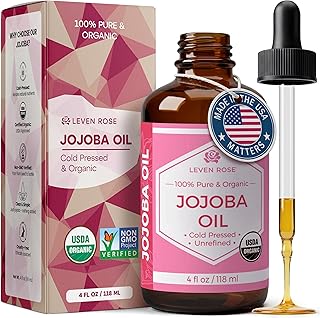 | Leven Rose Organic Jojoba Oil | Pure golden, unrefined | Buy on Amazon |
Affiliate links · details and availability change · check the live Amazon listing.
Frequently asked questions
Is jojoba oil actually an oil?
Not technically. Jojoba is a liquid wax ester rather than a triglyceride oil. Its structure closely resembles human sebum, which is why it absorbs so cleanly and suits most skin types.
Does jojoba oil clog pores?
It’s low on the comedogenic scale (around 2 out of 5), so it’s generally suitable even for oily and acne-prone skin. As always, patch-test first.
Golden or clear jojoba – which is better for essential oils?
Both work. Golden (unrefined) keeps a faint nutty scent and more nutrients; clear (refined) is odorless, which is better when you don’t want any scent competing with your essential oil.
How much essential oil do I add to jojoba oil?
About 12 drops of essential oil per ounce (30 mL) for a 2% adult blend, or 6 drops for a gentler 1% on the face. Hot oils like clove need much less – around 0.5%.
Does jojoba oil go bad?
Very slowly. As a wax it resists oxidation better than most carriers and keeps for years when stored cool and dark.
The bottom line
Jojoba earns its spot on every shortlist for one genuine reason: it’s a liquid wax that behaves like your skin’s own sebum, absorbing cleanly, seldom clogging pores, and lasting for years. That makes it a standout vehicle for essential oils, especially facial work. Because it costs more and the golden grade carries a whiff of scent, plenty of people stock both – jojoba for the face and balancing recipes, fractionated coconut for everyday dilution. Measure to 2% (or 1% near the eyes), patch-test, and it’ll carry nearly any aromatherapy blend you mix.
Medical disclaimer: This article is general information, not medical advice. Patch-test new blends, never apply essential oils neat, and check with a qualified professional before using essential oils during pregnancy, on children, or if you have a skin condition.