Essential Oil Purity: How to Tell If Yours Is Real
By Ellen Cooper, independent essential-oil reviewer (hands-on since 2018, no MLM affiliation).
Somebody in a Facebook group tells you their brand is purer than yours, a video shows a drop of oil spreading on paper and calls the residue proof of a fake, and a distributor mentions a proprietary standard with an acronym you have never seen anywhere else. None of it is checkable. That isn’t an accident.
Here’s the uncomfortable part. You can’t verify purity at home, not with paper and not with your nose and not with a freezer, and no amount of care on your part will change that.
What you can do is work out who is testing the oil, what they actually measured, and whether they’ll hand you the result without being chased for it. That turns out to be the more useful skill anyway.
The short version
- “Pure” has no legal definition for aromatics in the United States, so nobody polices the word before it reaches a label.
- Home tests fail because modern tampering is engineered to survive laboratory instruments, never mind a paper towel.
- Gas chromatography-mass spectrometry separates a sample into its individual compounds and names each one.
- A report you can’t match to the lot number printed on your own bottle tells you very little.
- Grade language is written by whoever sells the bottle, which is why no outside body can revoke it.
What does “pure” actually mean on a bottle of essential oil?
Legally, in the United States, almost nothing. Aromatics reach the shelf as cosmetics or as ordinary consumer goods rather than as drugs, which means no agency reviews the word “pure” or approves it before printing. A supplier writes “100% pure” because the phrase sells bottles, not because a regulator ever signed it off.
Chemists mean something considerably narrower. An unadulterated distillate contains only what came out of the named plant, with nothing added to it, nothing stripped from it and nothing quietly swapped in. Three kinds of tampering break that promise, and they’re worth separating because each leaves a different trace behind.
- Dilution – cheap vegetable oil or a solvent bulks out the volume, so the aroma weakens while the price stays exactly where it was.
- Substitution – a cheaper related species stands in for the expensive one, and lavandin sold as true lavender is the classic example.
- Fortification – isolated or synthetic compounds are topped up until the chemical fingerprint reads correctly. This is the sophisticated one.
That third category matters far more than the first two, and it’s precisely where every kitchen-table test collapses.
Why the home purity tests you’ve seen don’t work
Search this topic for five minutes and you’ll meet the same three demonstrations. Blot a drop on paper and look for an oily ring. Drop the bottle in the freezer and watch for clouding. Sniff, and trust your nose to catch a synthetic.
The problem isn’t that these methods are imprecise. It’s that the people doing the cutting are aiming at a much harder target than your paper towel, and they have been for years.
Adulterators “frequently use sophisticated schemes to mimic the visual aspects and chemical composition of the labeled botanical ingredient in order to deceive the analytical methods that are used for authentication.” Gafner S, Blumenthal M, Foster S, Cardellina JH, Khan IA, Upton R. Botanical Ingredient Forensics, Journal of Natural Products, 30 January 2023 (PMC9972475). Accessed 28 July 2026.
Read that again slowly. The schemes are engineered to fool the instruments. If a mixture has been built carefully enough to pass a mass spectrometer in an accredited laboratory, staffed by analysts whose entire job is catching exactly this, then it will pass a drop on a kitchen napkin without breaking stride.
So the paper test isn’t a weak test. It isn’t a test.
That same review names lavender, rose, sandalwood and tea tree among the botanicals most at risk of adulteration, and those happen to be four of the bottles most likely to sit in a beginner’s starter kit. It’s an unhelpful coincidence.
The freezer trick fails for a much plainer reason. Whether a sample clouds depends on how much wax and how many heavier terpenes the distillate happens to carry, and that shifts with species, growing region, harvest date and the weather that particular season. An honest oil can cloud. A cut one can stay perfectly clear.
Aroma is the trap I have most sympathy for, because a genuinely trained nose can catch a crude fake. But fortification exists precisely to satisfy a nose, and you almost certainly don’t have a reference sample of authentic Bulgarian rose sitting on the counter beside you, which is what that judgment would actually require.
What does real purity testing actually measure?
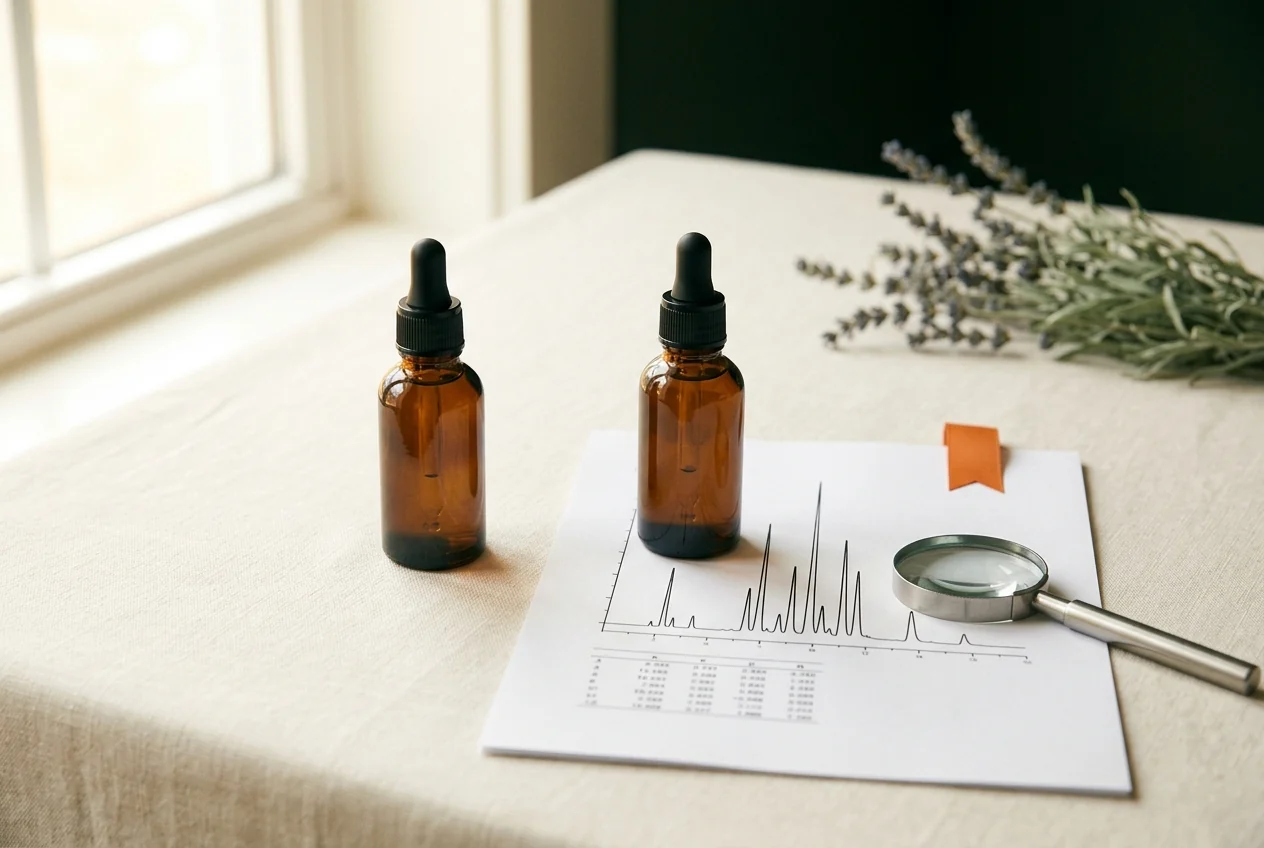
Gas chromatography-mass spectrometry, usually shortened to GC/MS, does two jobs in sequence. The chromatograph vaporises a tiny sample and pushes it down a long column where different compounds travel at different speeds, so they arrive at the far end separately rather than as a mixture. The spectrometer then shatters each arriving compound and identifies it from the pattern of fragments.
The output is a list: every compound detected, and how much of the sample each one represents. For lavender, the two markers worth knowing are linalool and linalyl acetate.
A 2026 study in Scientific Reports profiled four commercial lavender oils sold on the Egyptian market, and the two stronger samples carried roughly 34% and 46% linalool, comfortably inside what the species produces on its own. (Abouelela et al., 18 April 2026, accessed 28 July 2026.)
Others in the same set told a different story. They showed unusually high non-characteristic fatty-acid esters alongside synthetic glycols, which is exactly what dilution with a carrier or a formulation additive looks like on a readout.
Four bottles from a single market is a narrow window, so don’t read it as a verdict on global supply. Read it as a demonstration of what the technique catches that a person simply cannot.
Chromatography isn’t the whole battery either. A serious supplier runs several checks that fail in different ways, because a blend tuned to satisfy one measurement will usually fall down on another one built on an entirely different physical principle.
NOW Foods, to take a documented example, records refractive index, optical rotation and specific gravity alongside its chromatography. Sitting on top of that are ICP-MS screening for arsenic, cadmium, lead and mercury, a pesticide-residue programme running both LC-MS/MS and GC-MS/MS, and old-fashioned organoleptic assessment by a trained panel.
Worth noting, since the company says so plainly: NOW’s essential-oil chromatography is performed by a specialised third-party laboratory while it builds out its own capability. Handing the analysis to people with no stake in the answer counts in its favour, not against it.
How do you read a GC/MS batch report?
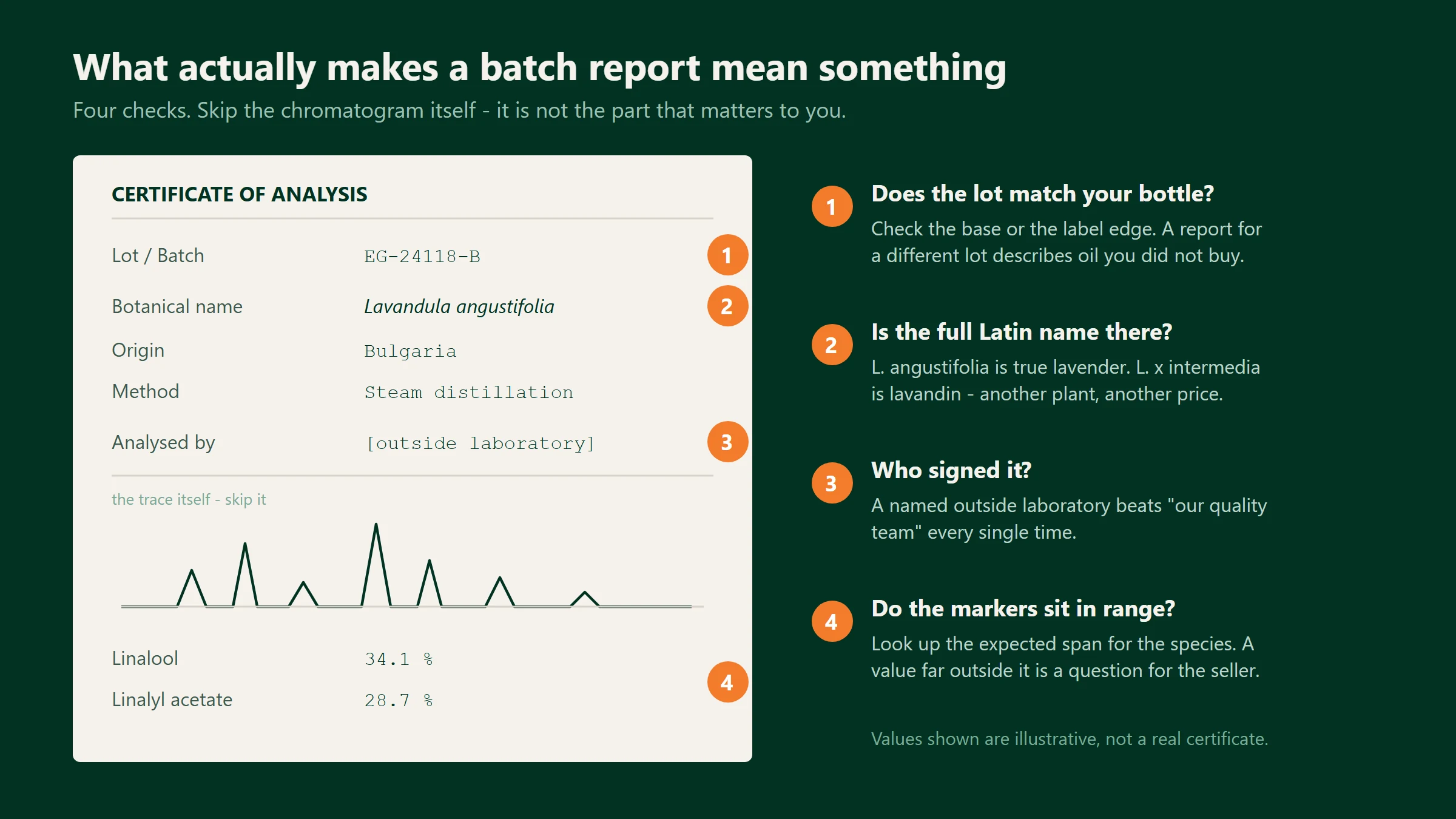
You don’t need to interpret the squiggly chromatogram, so skip it entirely. Four things on the page decide whether the document means anything at all.
- A lot or batch number that matches your bottle. Check the base of the bottle or the edge of the label. If the report covers a different lot, then it describes oil you didn’t buy, and this single check eliminates most of the reassuring-looking paperwork you’ll be shown.
- The full botanical name. Lavandula angustifolia is true lavender, while Lavandula x intermedia is lavandin, a different plant at a different price. The Latin binomial is the only genuinely unambiguous identifier anywhere on the label.
- Who signed it. A named outside laboratory beats “our quality team” every time. Edens Garden, for instance, routes its batches through Essential Oil University under Dr. Robert Pappas, and puts that name on the report itself.
- The marker compounds and their percentages. You can look up the expected range for a species in a couple of minutes, and a value sitting far outside it is a question worth putting to the seller.
One caveat, and it’s an honest one. A report proves the tested sample was what it claimed to be, but it can’t prove the bottle in your hand was filled from that same container. Documentation raises the cost of fraud considerably without reducing it to zero, and any brand implying otherwise is overselling its own paperwork.
Want to check a bottle you already own? Our brand reviews hub records which companies publish per-batch reports and how to find them.
What the label tells you before you open the bottle
None of these confirms authenticity on its own. Taken together, though, they say a great deal about how carefully a company handles the thing it’s selling you.
| On the label | What it signals |
|---|---|
| Latin binomial (Mentha piperita) | The species is pinned down, and its absence is the loudest red flag on this list. |
| Country of origin | Traceability, plus a sourcing claim specific enough that you could check it. |
| Extraction method | Steam-distilled, cold-pressed and solvent-extracted are three different products. |
| Lot number | Without one, no report can ever be matched to your particular purchase. |
| Amber or cobalt glass | Light degrades aromatics, so clear plastic suggests nobody thought about storage. |
| Sensible price spread | Rose and sandalwood need enormous plant volume, so flat pricing across a range is a warning. |
That last row deserves a sentence of its own. When every bottle in a catalogue costs roughly the same, either the cheap ones are overpriced or the expensive ones aren’t what the label says, and both possibilities should slow you right down.
Is “therapeutic grade” a real certification?
No. There’s no independent body that issues it and no agreed standard sitting behind it, so wherever a grading scheme exists, the company selling the oil wrote it, owns it and administers it.
That includes the branded standards you’ll hear quoted most often. doTERRA’s CPTG and Young Living’s Seed to Seal describe real internal programmes, and I’m not suggesting the work behind them is fictional. But a company grading its own product isn’t certification in any meaningful sense. It’s a specification the company can revise whenever it likes.
The clearest evidence comes from the record rather than from anybody’s opinion. Under a $5 million class-action settlement in May 2024, covering purchases from 1 January 2017 to 25 April 2024, Young Living agreed to drop “therapeutic-grade” from its labelling and marketing. A phrase you’re required to stop using was never much of a guarantee.
Even NOW Foods, which sells oils and has every commercial reason to keep the vocabulary, states on its own quality page that grading labels “could be misleading” (accessed 21 July 2026). When a seller argues against a marketing term that would benefit it, that’s worth considerably more than the term ever was.
Which brands will actually show you the report?
This is where the question finally becomes answerable. Not “is my oil pure”, which you have no way to settle from your kitchen, but “will this company produce evidence for the specific bottle I bought, and how hard did I have to work to get it”.
There’s a real hierarchy here, and it has almost nothing to do with price.
- Batch reports searchable by lot number. The strongest position available: you type the code from your own bottle and read the analysis for that exact run. Rocky Mountain Oils works this way.
- Per-batch testing published through a named outside laboratory. Edens Garden and Plant Therapy both publish at this level.
- Third-party analysis with lot-level certificates. NOW Foods has issued these since 2023, at the lowest price per bottle of anyone on this list.
- A proprietary standard and an invitation to trust it. doTERRA and Young Living sit here, and while the oil is generally genuine, what you can independently confirm is much thinner.
- “Rigorously tested, reports available on request.” Send the request. The reply, or the silence, is your answer.
In my experience the gap between the first tier and the last isn’t laboratory sophistication at all. It’s a decision about whether the customer gets to check, and that decision is visible from outside the company, which makes it the most reliable signal any of us actually has.
Is a diluted oil the same as an adulterated one?
No, and the two get conflated constantly even though only one of them is dishonest, so it’s worth untangling before you buy anything.
A pre-diluted roll-on stating “5% lavender in fractionated coconut oil” is a properly labelled product, and often the sensible purchase for skin use. Adulteration is that same mixture sold as neat oil at neat-oil prices. The chemistry can be identical in both bottles; the disclosure is the entire difference between a product and a fraud.
You’ll also want to dilute concentrated oil yourself before it touches skin, which for most adults means 1 to 2 drops stirred into a teaspoon of carrier, and something more cautious than that for everybody else. Undiluted application is a common route to sensitisation.
If you’re pregnant, treating a child, or managing a health condition, take both the dilution and the choice of oil to a clinician rather than to a comment thread.
Frequently asked questions
Can you tell if an essential oil is 100% pure at home?
No. Published forensic work describes tampering designed to deceive laboratory instruments, so a paper, freezer or aroma check has no realistic chance of catching it. Judge the documentation instead.
Does a GC/MS report guarantee my bottle is authentic?
It guarantees the tested sample was authentic. Match the lot number to your bottle and that link becomes strong; without the match, the document simply describes a different batch.
Which essential oil brands are genuinely pure?
The better question is which ones let you verify. Rocky Mountain Oils, Edens Garden, Plant Therapy and NOW Foods all publish batch-level analysis, and our brand reviews cover what each one actually releases.
Are expensive oils purer than cheap ones?
Not reliably. Price tracks plant volume and distribution model far more closely than it tracks quality, and multi-level marketing adds a margin that funds the sales network rather than the distillate.
The honest verdict
The purity question usually gets asked in a form nobody can answer. You can’t authenticate a bottle at home, and much of the vocabulary built around the idea – grades, standards, proprietary seals – survives precisely because no test exists that could ever prove it wrong.
So change the question. Buy from companies publishing per-batch analysis you can tie to your own lot number, insist on the Latin name, and treat every grade claim as advertising until an outside laboratory stands behind it. That’s a standard you can apply in a shop, without owning a spectrometer.
If you’d rather start from a shortlist than from a chemistry lesson, our brand reviews hub ranks the major sellers on exactly this: what they test, who tests it, and whether they’ll show you.
Nothing here is medical advice. Essential oils aren’t evaluated by the FDA for treating any condition. Talk to a qualified clinician before using them during pregnancy, on children, around pets, or alongside medication.