Clove Oil for Hair: What the Evidence Really Says (and How to Use It Safely)
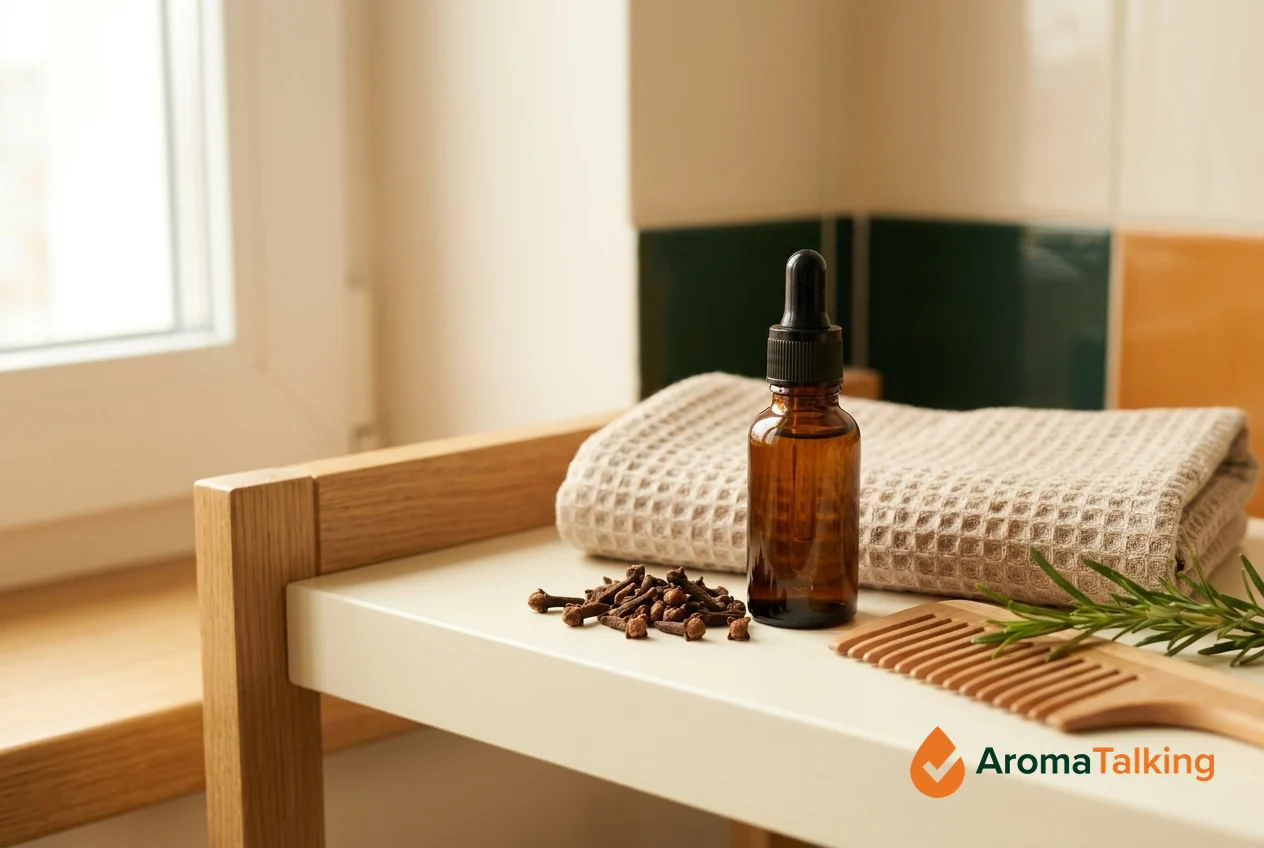
Search “clove oil for hair” and you’ll find bold promises about regrowth. The honest picture is more modest. There is no human trial showing clove oil grows hair, and the lab evidence we do have comes mostly from animals and petri dishes. What clove oil can reasonably offer is scalp support and antimicrobial help, if you respect one rule: clove bud oil is a “hot” oil that must be diluted to roughly 0.5% or less. Used neat, it can permanently sensitize your skin. This guide gives you the real evidence per claim, the safe dilution, and a simple recipe.
What does the evidence actually say about clove oil for hair?
The honest answer: the evidence is thin and mostly indirect. Clove’s active compound, eugenol, has shown antimicrobial activity in vitro (Marchese, Critical Reviews in Microbiology, 2017; accessed 2026-06-29). For hair growth specifically, the data comes from rats and ex-vivo tissue, not living human scalps. Here’s each claim with its real evidence tier.
Hair growth: weak (animal and ex-vivo only)
This is the most-hyped and least-proven claim. The proposed mechanism is that eugenol widens blood vessels and improves scalp blood flow. That effect was measured in rats (Peixoto-Neves, British Journal of Pharmacology, 2015; accessed 2026-06-29) and in ex-vivo human umbilical artery tissue (Dantas, Chemico-Biological Interactions, 2022; accessed 2026-06-29). One rabbit nanoemulsion study tested a hair formulation (Budastra, Indonesian Journal of Pharmacy, 2025). None of that is a living human scalp. So clove oil may support scalp conditions linked to growth, but no one has shown it regrows hair in people.
Dandruff and antimicrobial: moderate (in-vitro)
This is clove’s strongest claim, though still lab-based. Eugenol is a broad-spectrum antimicrobial in vitro (Marchese, Critical Reviews in Microbiology, 2017) and showed antifungal activity against Trichophyton rubrum in culture (Pereira, Medical Mycology, 2013; accessed 2026-06-29). Since some dandruff is driven by scalp microbes, a diluted clove rinse may help. But a measured improvement in human dandruff hasn’t been demonstrated, so treat this as plausible, not proven.
Shine and strength: anecdotal only
Plenty of users say a clove-oil massage leaves hair shinier and stronger. There’s no study behind it. Much of that effect likely comes from the carrier oil and the massage itself, not the clove. I’d file shine and strength under “nice if it happens,” not a reason to buy.
Clove vs rosemary: the honest comparison
If your goal is hair growth and you want the option with actual human evidence, it’s rosemary, not clove. A controlled trial found rosemary oil performed comparably to 2% minoxidil over six months (Panahi, Skinmed, 2015, n=100; accessed 2026-06-29). Clove has no equivalent trial. That’s the single most useful thing to know here.
| Factor | Clove bud oil | Rosemary oil |
|---|---|---|
| Human growth trial | None | Yes (Panahi 2015, n=100) |
| Best-supported use | Antimicrobial / scalp (in-vitro) | Hair growth (human RCT) |
| Dermal max dilution | 0.5% (hot oil) | ~3% (typical leave-on) |
| Sensitization risk | Higher (eugenol, can be permanent) | Lower |
| Verdict for growth | Unproven; try as scalp care | Evidence-backed first choice |
New to working with oils? Our guide to using essential oils covers the basics before you start.
How do you use clove oil for hair safely?
Safely means one number: 0.5%. Clove bud oil is classed as a dermal sensitizer with a maximum recommended dermal use of 0.5% (Tisserand & Young, Essential Oil Safety, 2014, p.255; Tisserand Institute dilution chart, accessed 2026-06-29). In practice that’s about 1 to 2 drops of clove per tablespoon (15 ml) of carrier oil. Never apply it neat, and always patch test first.
Read this before your first use.
- Dilute to 0.5% max. Clove is a “hot” oil. Neat clove can burn and sensitize skin.
- Patch test the diluted blend behind your ear or on your forearm and wait 24 hours.
- Eugenol can cause permanent sensitization. Once sensitized, you may react to it for life.
- Skip clove if pregnant, on children under 2, on broken or inflamed scalp, or if you take blood thinners (see the safety section).
Clove oil dilution table (0.5% max)
| Carrier oil | Clove drops at 0.5% | Notes |
|---|---|---|
| 15 ml (1 tbsp) | 1 to 2 drops | Single scalp massage |
| 30 ml (2 tbsp) | 3 drops | A few uses; the recipe below |
| 60 ml (4 tbsp) | 6 drops | A small batch to store |
The method, step by step
- Mix your diluted blend in a small bowl or bottle, staying at or below 0.5% clove.
- Patch test first if you haven’t already, then wait 24 hours.
- Massage into your scalp with your fingertips for 5 to 10 minutes.
- Leave it on for 30 to 60 minutes, or overnight under a cap.
- Wash out with shampoo, usually two passes since it’s oil.
- Use it no more than 1 to 2 times per week. Daily use raises the sensitization risk.
A simple DIY clove scalp oil
This makes about 30 ml at roughly 0.33% clove, comfortably under the cap. Combine 1 tablespoon jojoba oil with 1 tablespoon fractionated coconut oil, then add 2 drops of clove bud oil. For a growth-focused blend, add 3 drops of rosemary, the oil with actual human evidence. Store it in a dark glass bottle and use within a few weeks.
To follow the recipe you’ll need a clove bud oil plus a carrier oil. For scalp use, look for a pure, ideally organic clove bud oil and a bottle size that matches how often you’ll use it. A dropper helps you measure single drops for safe dilution. Here are popular options on Amazon.
Popular options on Amazon
As an Amazon Associate we earn from qualifying purchases, at no extra cost to you. Product details and availability are subject to change – check the live listing on Amazon.
| Image | Product | Best for | Buy |
|---|---|---|---|
 | Cliganic Organic Clove Bud Essential Oil | Best organic value for scalp use | Buy on Amazon |
 | Organic Clove Essential Oil 30 ml | Largest organic bottle, regular use | Buy on Amazon |
 | Siva Clove Bud Essential Oil | Big bottle with dropper (easy dilution) | Buy on Amazon |
 | MAYJAM Clove Bud Essential Oil | Lowest price, good for DIY blends | Buy on Amazon |
 | 100% Pure Clove Essential Oil | Small bottle to try first | Buy on Amazon |
Affiliate links · details and availability change · check the live Amazon listing.
Want the full breakdown on clove itself? See our clove essential oil guide.
Which carrier oils should you use with clove?
A carrier oil isn’t optional with clove, it’s what makes the blend safe to apply. Any of the four below work well for scalp use, so pick based on your hair type (Nikura carrier oils guide, accessed 2026-06-29). The carrier also delivers most of the conditioning and slip you’ll feel.
- Jojoba – closest to your scalp’s own sebum. A great default for most hair, including oily scalps.
- Fractionated coconut – light, fast-absorbing, and won’t solidify. Good for fine hair.
- Argan – rich in vitamin E. Best for dry or color-treated hair.
- Sweet almond – gentle and nourishing. Nice for normal-to-dry hair and overnight masks.
Safety: who should avoid clove oil for hair?
Clove is effective enough to deserve caution. Its eugenol content can cause sensitization that becomes permanent, after which you may react to clove, cinnamon, and even dental eugenol for life (NIH LiverTox, NBK551727, accessed 2026-06-29). Always dilute, patch test, and check the list below before you use it.
- Never apply it neat and always patch test the diluted blend for 24 hours.
- Pregnancy and breastfeeding: avoid, as safety data is lacking (UKTIS/NHS clove oil, Dec 2023).
- Children under 2: avoid.
- Sensitive, broken, or inflamed scalp (eczema, psoriasis, rosacea): avoid.
- Blood thinners (warfarin, aspirin): consult your doctor, as eugenol may affect clotting (NIH LiverTox, NBK551727).
- Eyes: if it gets in your eyes, rinse with a carrier oil first, then water.
This article is for general information and isn’t medical advice. Talk to a qualified professional about your specific situation.
Frequently asked questions
Does clove oil regrow hair?
No study shows clove oil regrows hair in people. The growth idea rests on eugenol widening blood vessels in rats and ex-vivo tissue (Peixoto-Neves, British Journal of Pharmacology, 2015). It may support scalp health, but calling it a proven regrower would be overstating the evidence.
How often should I use clove oil on my hair?
Once or twice a week at most, always diluted to 0.5% or less. Daily use of a hot oil like clove raises your risk of cumulative sensitization. If your scalp feels irritated at any point, stop and let it recover before trying again.
Can I leave clove oil in my hair overnight?
Yes, if it’s properly diluted and you’ve passed a patch test. Cover your hair with a cap to protect bedding, then wash it out in the morning. Never sleep in neat clove oil. At full strength it can burn the scalp and trigger sensitization.
Is clove or rosemary better for hair growth?
Rosemary has the better evidence. A controlled trial found it comparable to 2% minoxidil over six months (Panahi, Skinmed, 2015, n=100). Clove has no equivalent human trial. If growth is your goal, rosemary is the more evidence-backed choice.
What are the side effects of clove oil on hair?
The main risks are scalp irritation, redness, and sensitization, which can become permanent with eugenol (NIH LiverTox, NBK551727, accessed 2026-06-29). Diluting to 0.5% and patch testing greatly reduces the risk. Stop immediately if you notice burning, itching, or a rash.
Can I mix clove and rosemary oil together?
Yes, and it’s a sensible combination. Keep clove at 0.5% or below and add rosemary within its usual range of around 3%. The recipe above does exactly this, pairing 2 drops of clove with 3 drops of rosemary in 30 ml of carrier.
The honest bottom line
Clove oil is worth trying as scalp care, not as a proven hair regrower. The antimicrobial evidence is real but in-vitro, the growth evidence is animal-level, and the shine claims are anecdotal. If your main goal is growth, rosemary has the human trial that clove doesn’t. Whatever you choose, the safety rule doesn’t change: dilute clove to 0.5% max, patch test, and use it no more than twice a week. Treat it as a gentle addition to a good scalp routine, and keep your expectations grounded in what the evidence actually supports.
For more starting points, browse our roundup of the most popular essential oils.
Medical disclaimer: This article is general information, not medical advice, and does not diagnose or treat any condition. Essential oils are not a substitute for professional medical care. Never ingest essential oils or apply them undiluted, and check with a qualified professional before use during pregnancy, around children or pets, with a medical condition, or alongside medication.