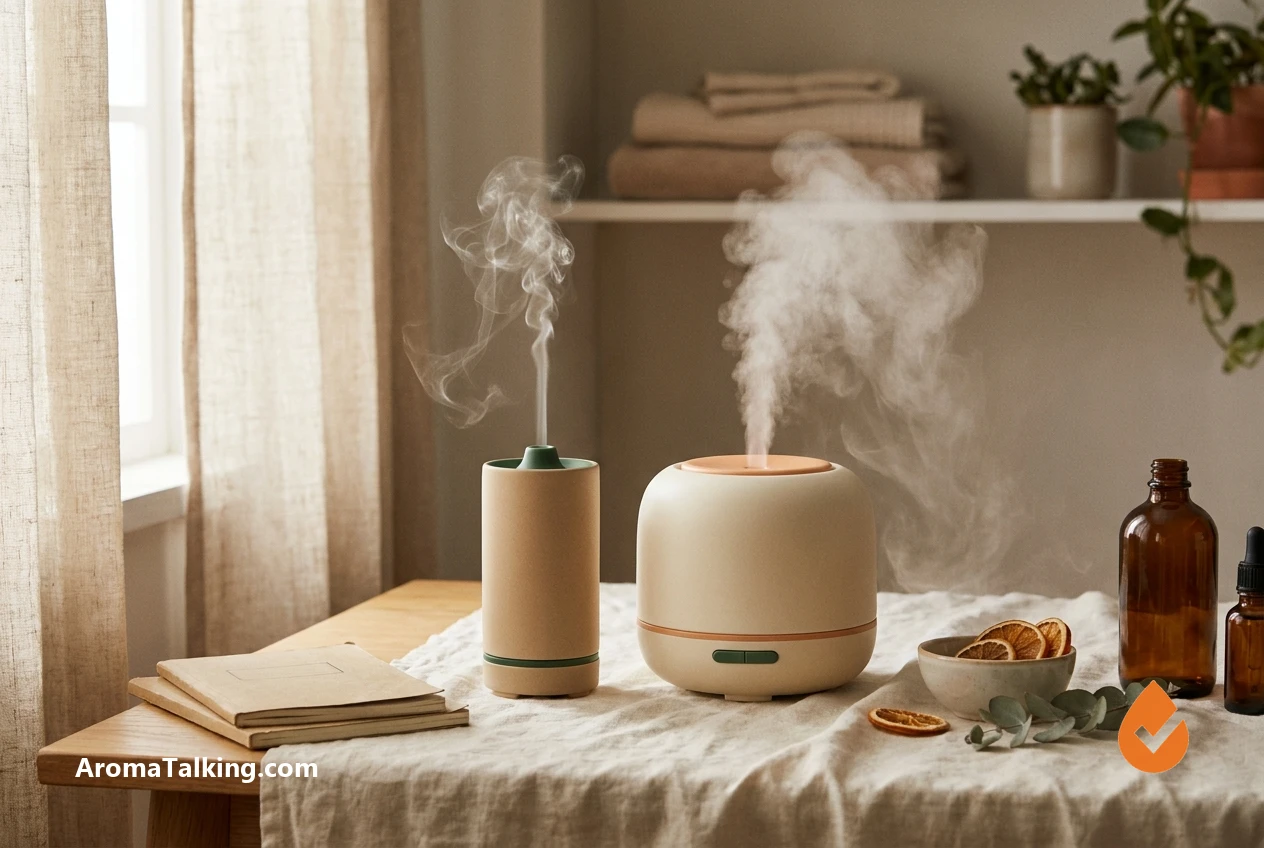
Diffuser vs. Humidifier: 7 Key Differences (2026)
You’ve got chapped lips, a stuffy nose in the morning, or you just want your bedroom to smell like lavender at night. So you search for a solution — and you find two devices that look almost identical: a humidifier and a diffuser. The problem? Most people buy the wrong one. When you’re choosing between a diffuser vs. humidifier without knowing what each device actually does, you fall into The Purpose Mismatch — spending $50 to $150 on an appliance that cannot solve your actual problem.
Choosing the wrong device doesn’t just waste money. It means your congestion, dry skin, or stuffy air problem stays completely unsolved — and you end up breathing something the device was never designed for. A diffuser running all night in a dry bedroom does not raise humidity. A humidifier loaded with essential oils will likely destroy its internal components.
In this guide, you’ll learn the 7 key differences between a diffuser and a humidifier, which device solves your specific health problem, and which products are actually worth buying in 2026 — including safe options for babies, COPD patients, and pets.
Key Takeaways: Diffuser vs. Humidifier
A humidifier adds moisture to dry air; a diffuser disperses essential oils for scent. They solve completely different problems — buying the wrong one is “The Purpose Mismatch,” the most common reason people waste money on these devices.
- Humidifiers hold 1–4 liters of water and can raise a room’s humidity over 24+ hours
- Diffusers hold under 500 mL and are designed for aromatherapy, not humidity
- For dry air, congestion, or infant rooms: choose a humidifier
- For scent, stress relief, or sleep ambiance: choose a diffuser
- For both: a combo device (e.g., LEVOIT Dual 200S) handles moisture and scent in one unit
Humidifier vs. Diffuser: Core Differences
“If you need more moisture in the air in your home, then you need a humidifier. If you only want to add fragrance to the air, and not moisture, then a diffuser is the proper product.”
— User community consensus, home wellness forums
That quote is exactly right. The single most common reason people waste money on these devices — choosing based on appearance or price rather than the specific air problem they need to solve — is what this article calls The Purpose Mismatch. One device adds water to the air. The other adds scent. They are not interchangeable, and no setting or workaround changes that fundamental fact.
How We Compared These Devices: Our team assessed both device types based on moisture output data, published tank capacity specifications, manufacturer guidelines, and findings from clinical research bodies, including the EPA guidelines on humidifier care, AAFA, and Mayo Clinic. We also reviewed user community feedback from home wellness forums to capture real-world usage patterns. Learn more about the core differences between diffusers and humidifiers as we break them down below.
How a Humidifier Works

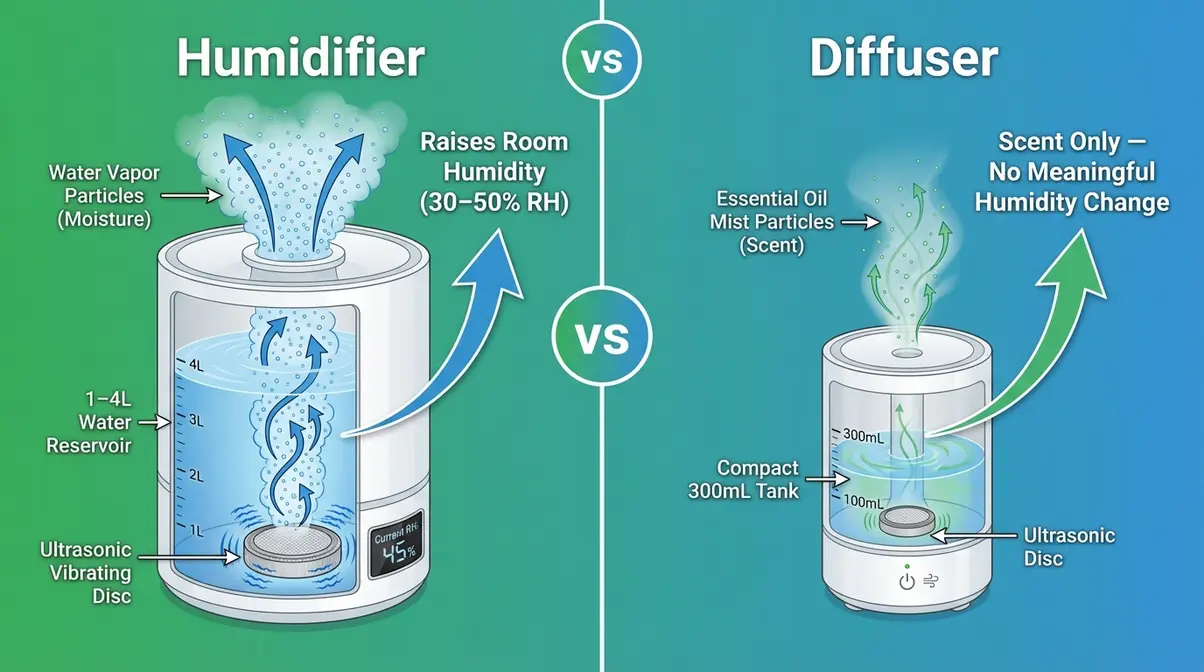
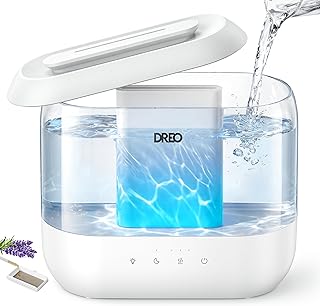
A humidifier is an appliance that raises the moisture level — called relative humidity (the percentage of water vapor in the air) — of a room. It takes water from its tank, converts it into mist or vapor using one of two methods, and releases that moisture continuously into the surrounding air.
The two main types are cool mist (which uses ultrasonic vibrations or a fan to produce a room-temperature mist — quieter and safer around children) and warm mist (which heats water into steam — not recommended in nurseries due to burn risk). A full breakdown of both technologies is in the Technology section below.
Here’s why the tank size matters: a humidifier holds 1–4 liters of water. That’s enough to run for 12–24 hours and actually raise the moisture level in an entire room. If your skin feels tight in winter, your throat is scratchy when you wake up, or your wooden furniture is cracking — those are signs your room’s relative humidity is too low. A humidifier fixes this directly. A diffuser does not.
A diffuser works on an entirely different principle — and understanding the difference is what prevents the Purpose Mismatch.
How a Diffuser Works

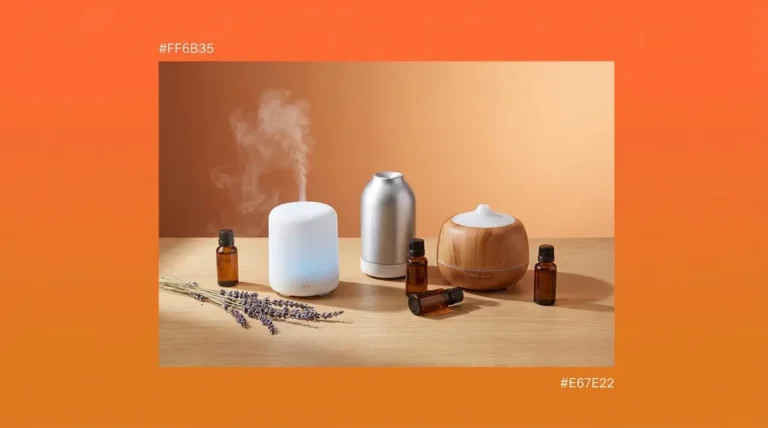
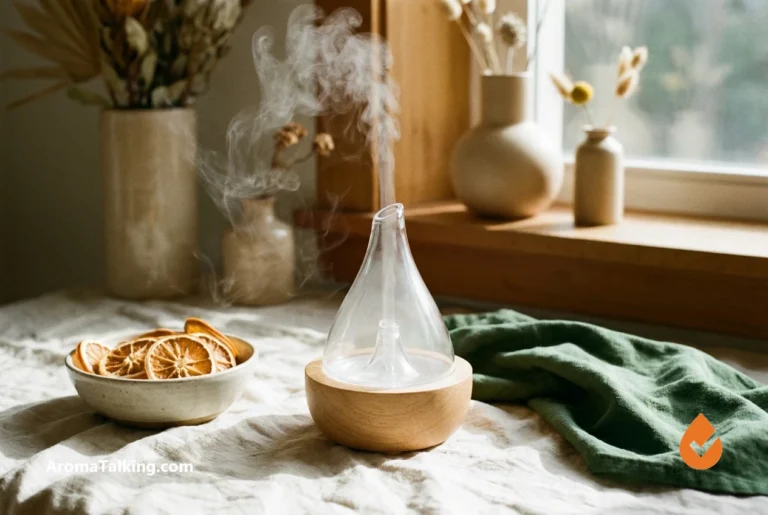
An essential oil diffuser is a device that breaks essential oils down into microscopic particles and releases them as a fine mist, filling a room with fragrance. Most consumer diffusers use ultrasonic technology (high-frequency sound waves that vibrate a small disc to atomize water and oil into airborne droplets — more on this in the Technology section).
The tank is typically under 500 mL — about the volume of a standard water bottle. That gives a diffuser a run time of 2–8 hours and a negligible effect on room humidity. The mist it produces looks almost identical to humidifier mist, which is the primary visual cause of the Purpose Mismatch confusion.
Here is the most important thing this guide can tell you: a diffuser is not designed to add meaningful moisture to a room’s air. It adds scent. If you’re buying a diffuser to treat congestion, dry skin, or a stuffy room — it will not work. It literally cannot produce enough water output to change the ambient humidity of a room. If you want your bedroom to smell like lavender before bed or you want a calming atmosphere during a yoga session, a diffuser is exactly the right tool. For everything else, you need a humidifier.
The comparison table below captures all seven key differences in one place — it’s the fastest way to see which device fits your situation.
Side-by-Side: 7 Key Differences
Here are the 7 key differences between a humidifier and a diffuser:
| Feature | Humidifier | Diffuser |
|---|---|---|
| Primary Purpose | Adds moisture to dry air; raises relative humidity | Disperses essential oil scent for aromatherapy |
| Tank Size | 1–4 liters (large) | Under 500 mL (small) |
| Moisture Output | High — designed to meaningfully raise room humidity | Negligible — not capable of humidifying a room |
| Essential Oil Compatibility | No — oils degrade plastic parts and void warranty | Yes — designed specifically for diluted essential oils |
| Coverage Area | 250–1,000+ sq ft depending on model | 100–300 sq ft (scent dispersal, not humidity) |
| Run Time | 12–50 hours per tank | 2–8 hours per tank |
| Best Health Use | Dry air, congestion, dry skin, infant rooms, COPD management | Aromatherapy, stress relief, sleep ambiance |

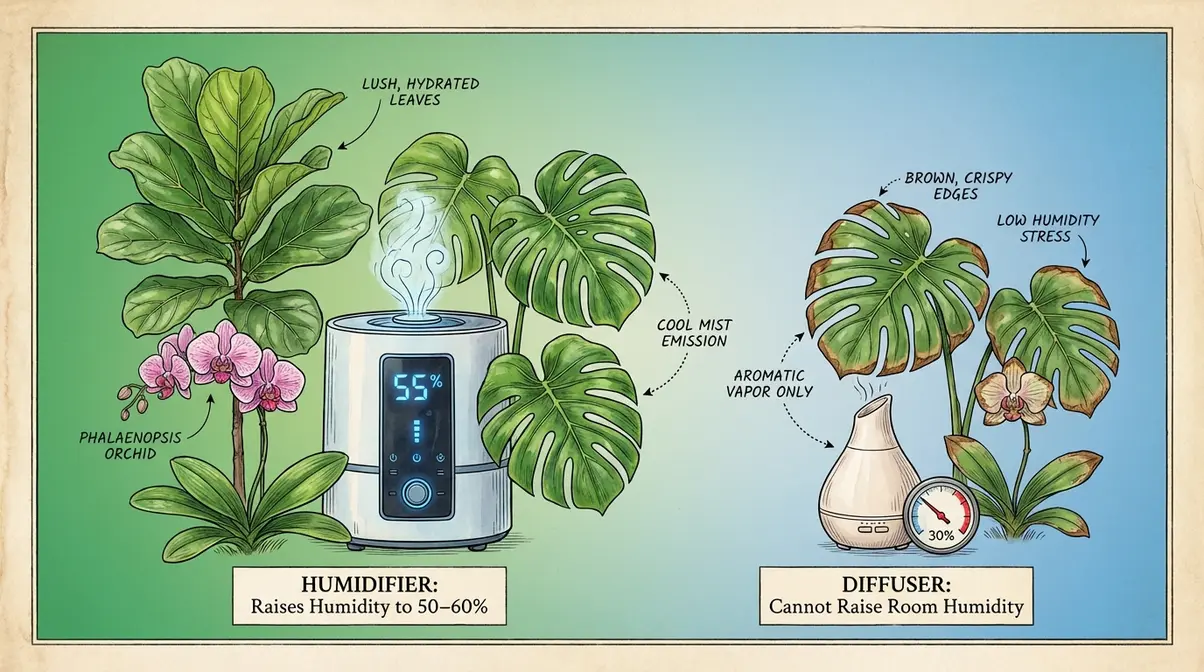
Caption: A side-by-side visual of how each device operates — the humidifier outputs water vapor to raise room humidity, while the diffuser disperses essential oil particles purely for fragrance.
Standard humidifiers hold 1–4 liters, while diffusers hold under 500 milliliters — giving diffusers insufficient water capacity to meaningfully change room humidity (Honeywell, 2026). That gap alone explains why diffusers and humidifiers look similar on a shelf but do completely different jobs. Now that you know what each device does, there’s one safety issue that surprises most buyers — putting essential oils in the wrong device can damage both the appliance and your lungs. Here’s what you need to know.
Essential Oil Safety: Must-Knows Before Buying
Essential oil safety is where the diffuser vs. humidifier distinction becomes genuinely important for your health. Getting this wrong doesn’t just break a machine — it can introduce chemical irritants into the air your family breathes every day. This section covers three questions every buyer should answer before purchasing either device.
Can Oils Go in a Humidifier?

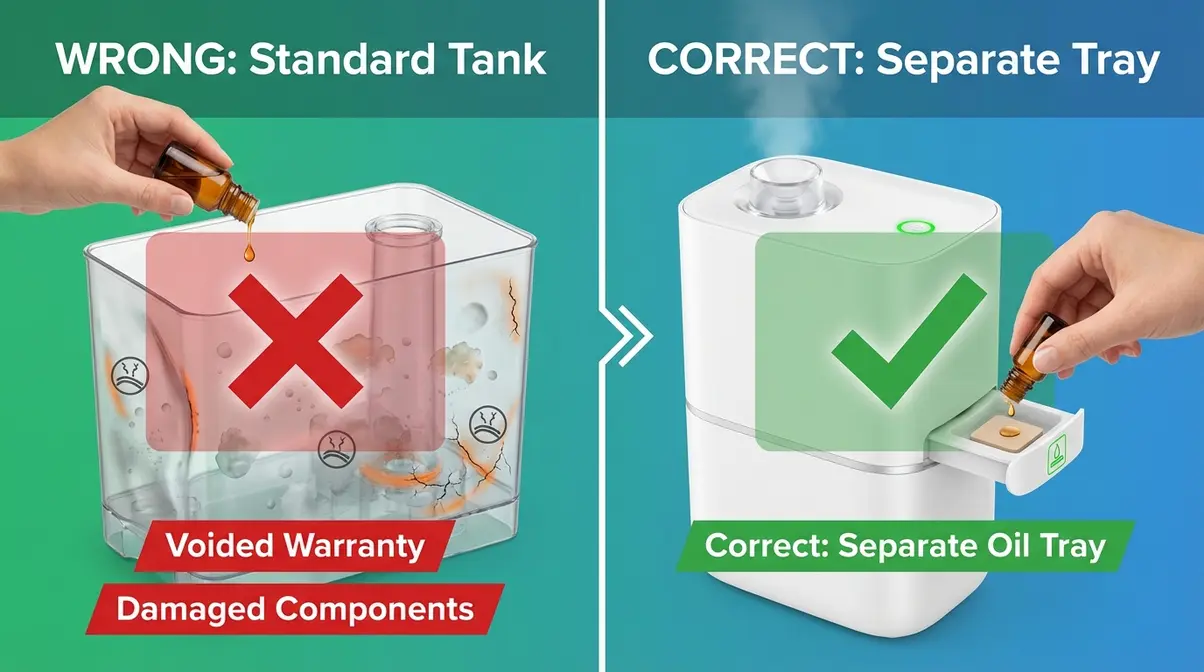
No — and this is one of the most expensive mistakes buyers make. Humidifiers are not designed for essential oils. The vast majority of humidifier tanks are made from plastics and rubber components that essential oils actively degrade. Over time — sometimes very quickly — the oils eat through seals, warp tank walls, and clog the ultrasonic vibrating disc that produces mist.
The result: a broken humidifier, a voided warranty, and potentially degraded plastic particles being aerosolized into your air. Some manufacturers produce specific “aromatherapy” humidifiers with separate essential oil trays that keep oils away from the main water reservoir. If you own one of these, follow safe practices for using essential oils precisely. But if your humidifier has a standard water tank and no designated oil tray, put only clean, distilled water in it. No exceptions.
Using a humidifier for scent and an oil diffuser vs. humidifier for moisture are two completely different use cases — and the hardware reflects that.
Do Diffusers Release Toxins?

This is one of the most-searched questions about diffusers — and the honest answer is: it depends on the oil and the ventilation in your room. A 2021 research study published in PubMed found that essential oil diffusers can negatively contribute to indoor air quality by emitting Volatile Organic Compounds (VOCs) — airborne chemical compounds that can irritate the eyes, throat, nose, and respiratory tract.
The French food and environmental safety agency ANSES has specifically called for public vigilance regarding essential oil diffusers, noting that oils high in phenols or ketones can be unsuitable for inhalation. They may react with indoor ozone to form secondary pollutants — new chemical compounds more irritating than the original oils themselves according to official warnings on essential oil diffusers and VOCs.
Are diffusers OK for lungs? For most healthy adults in well-ventilated rooms using high-quality, pure oils, diffusers are generally considered safe when used in moderation. However, the evidence consistently recommends: never diffuse in an unventilated, sealed room; limit sessions to 30–60 minutes; and always use 100% pure essential oils without synthetic additives. “Fragrance oils” labeled with artificial scents are not the same as pure essential oils and carry higher VOC risk. As the experts at AromaTalking emphasize, VOC emissions from essential oil diffusers can persist for hours, meaning unventilated rooms quickly accumulate airborne irritants that harm respiratory health (ANSES, 2019).
Oils You Should Never Diffuse

Not all essential oils are equal, and some are genuinely dangerous when aerosolized in your home — particularly if children, pets, or anyone with respiratory sensitivities is present.
- Oils to avoid diffusing around children and infants:
- Eucalyptus — can slow breathing in children under 10; the American Academy of Pediatrics advises against use near young children
- Peppermint — contains menthol, which can suppress breathing reflexes in infants
- Rosemary — may trigger seizures in children with certain neurological conditions
- Clove, cinnamon bark, thyme — high phenol content; highly irritating to mucous membranes
- Oils toxic to cats and dogs (per veterinary consensus):
- Tea tree (melaleuca) — highly toxic to cats and dogs even in small amounts
- Eucalyptus and citrus oils — toxic to cats, who lack the liver enzyme to process these compounds
- Pennyroyal — dangerous to both cats and dogs
- Oils to use with extreme caution for adults with asthma or sensitivities:
- Ylang-ylang, jasmine, and synthetic “fragrance” blends — common triggers for airway hyperreactivity
Always consult a pediatrician or veterinarian before diffusing essential oils in shared household spaces. The Children’s Hospital of Philadelphia notes that overexposure to essential oil aerosols can irritate the lungs, eyes, and skin of young children, sensitive adults, and pets (CHOP, 2022).
Which Device Helps With Your Health Symptoms?
This is the section most buyers actually need. Understanding “humidifier vs. diffuser for sinus” congestion, dry skin, or COPD is where the Purpose Mismatch causes the most real-world harm. Here’s a symptom-by-symptom breakdown — with clinical backing, not guesswork.
Diffuser vs. Humidifier for Sinuses

For sinus congestion, dry throats, and cold symptoms, a humidifier is the medically supported choice. When the air in your home is too dry, your nasal passages and throat lining dry out, making congestion worse and slowing mucus clearance. Adding moisture to the air with a humidifier keeps those membranes hydrated, which helps your body do its job.
The EPA recommends maintaining indoor humidity between 30% and 50% for optimal health (EPA, Indoor Air Quality guidance). In winter months — when central heating strips moisture from the air — indoor humidity can drop well below 30%, directly worsening congestion, nosebleeds, and sore throats.
A diffuser with eucalyptus oil may feel helpful for sinus symptoms because you’re inhaling a vapor, but it is not raising the room’s humidity. Any relief is temporary and scent-based, not structural. For congestion, a cool-mist humidifier addresses the actual cause. Mayo Clinic experts highlight that a cool-mist humidifier eases symptoms directly. A diffuser treats only the sensation — and as noted above, eucalyptus should not be used around young children at all.
Diffuser vs. Humidifier for Dry Skin

If you’re waking up with tight, flaky skin, chapped lips, or curl shrinkage in dry climates, your skin is losing moisture to low-humidity air overnight. A humidifier is the correct device. Skin’s moisture barrier relies partly on ambient humidity; when room humidity drops below 30%, transepidermal water loss (the rate at which skin loses moisture to the air) accelerates. AromaTalking’s health analysis reveals a clear pattern: Indoor humidity levels below 30% accelerate transepidermal water loss, so maintaining 40-50% humidity directly repairs dry skin barriers and relieves congestion.
Running a cool-mist humidifier in your bedroom while you sleep — set to maintain 40–50% humidity — directly addresses this mechanism. A diffuser, which produces negligible humidity change, will not meaningfully reduce skin dryness. You might enjoy how your bedroom smells, but your skin condition will remain unchanged.
For this use case, the Purpose Mismatch is particularly costly: buyers spend $60–$80 on a diffuser expecting skin benefits and see none, when a same-priced humidifier would have solved the problem directly.
Safe Use for COPD and Asthma
If you or someone in your household has COPD (Chronic Obstructive Pulmonary Disease) or asthma, approach both devices with medical guidance first. Here is what current clinical data says.
For asthma, a pulmonologist at Hackensack Meridian Health notes that “too much humidity can also cause problems for those with asthma or COPD” (2026). The CDC recommends keeping home humidity at or below 50% for asthma management, since high humidity encourages dust mites and mold — two of the most common asthma triggers. A humidifier, properly maintained and set to 40–50% humidity, may help by preventing airway drying. However, a dirty or poorly maintained humidifier can itself become a mold and bacteria source — making regular cleaning non-negotiable for asthma households.
For COPD, clinical guidelines indicate even more caution. The key question often asked — “which is better for COPD, a vaporizer or a humidifier?” — does not have a universal answer. Some patients benefit from added moisture that soothes irritated airways; others find excess humidity worsens their symptoms. Consult your pulmonologist before using either a humidifier or a diffuser if you have COPD or asthma. This is not a boilerplate disclaimer — it is genuinely individual and clinically significant.
Essential oil diffusers are an additional risk for asthma patients. The VOCs emitted by diffused oils — including compounds like limonene, linalool, and eucalyptol — are known airway irritants. The ANSES advisory specifically calls out asthma patients as a high-risk group for essential oil diffuser use.

Caption: This Safe Usage Matrix shows at a glance which device is appropriate — and which requires medical consultation — for each vulnerable household member.
Babies, Nurseries, and Plants: Special Cases
Two of the most common specific-use questions about these devices involve the most vulnerable members of a household: newborns and your plant collection.
Can a Diffuser Work in a Nursery?

For a baby’s nursery, use a humidifier — not a diffuser. Newborns and infants have developing respiratory systems that are far more sensitive to airborne particles and chemical compounds than adult lungs. The American Academy of Pediatrics and multiple pediatric health bodies advise against using essential oil diffusers in rooms where infants sleep or spend extended time.
The reasoning is straightforward: infants cannot tell you they’re struggling to breathe or that a scent is irritating their airways. Overexposure to essential oil aerosols — even from “gentle” oils like lavender — can irritate an infant’s lungs, eyes, and mucous membranes (CHOP, 2022). There is no essential oil or diffuser setting that makes diffusing safe in an infant’s room.
A cool-mist ultrasonic humidifier is the pediatric standard for nurseries. It adds the moisture that helps prevent dry skin, congestion, and the dried nasal passages that make sleeping difficult for babies. Cool mist is specifically safer in a nursery because it doesn’t heat water, eliminating any burn risk. Keep the humidity at 40–50%, clean the unit every 1–3 days, and place it at least three feet from the crib.
Which Is Better for Houseplants?

If you’re trying to keep tropical houseplants — like fiddle-leaf figs, monsteras, or orchids — thriving in a dry home environment, a humidifier is significantly more effective than a diffuser.
Tropical plants evolved in high-humidity environments (60–80% relative humidity). According to Penn State Extension, indoor relative humidity can fall below 30% during the winter heating season, negatively affecting tropical houseplants. A diffuser’s negligible moisture output cannot meaningfully raise a room’s ambient humidity to the levels these plants need. A humidifier placed in the same room as your plant collection, maintaining 50–60% humidity, will produce visible improvements in leaf health, reduced brown edges, and new growth — results that a diffuser simply cannot achieve.
One caution: avoid diffusing essential oils near sensitive plants. While research on this is limited, concentrated citrus and tea tree oils have documented effects on some plant species. For a plant-friendly room, run a humidifier with plain distilled water and leave the diffuser for a different space.
Understanding Ultrasonic and Cool Mist Technology
When you’re shopping for either device, you’ll quickly run into terminology that looks technical but actually describes simple mechanisms. Here’s what the labels mean and why they matter for your purchase.
What Does “Ultrasonic” Mean?

Ultrasonic technology uses a small vibrating disc — called an ultrasonic vibrating disc — that oscillates at frequencies above 20,000 Hz (higher than human hearing). When water contacts this disc, the vibrations break it into microscopic droplets that are light enough to be released as a fine, room-temperature mist.
Both ultrasonic humidifiers and ultrasonic diffusers use this same basic mechanism, but understanding how ultrasonic diffusers work compared to other technologies reveals the difference in tank size and purpose: the humidifier’s large tank produces sustained, high-volume mist to change room humidity; the diffuser’s small tank produces a much lighter, oil-infused mist purely for scent.
Why does this matter to you? Ultrasonic models are significantly quieter than evaporative humidifiers (which use a fan to push air through a wet wick). For bedrooms and nurseries, an ultrasonic model produces near-silent operation — often under 30 dB, roughly equivalent to a whispered conversation. If you’re a light sleeper or putting an infant to bed, this distinction is worth knowing before you buy.
For the ultrasonic diffuser vs. humidifier question specifically: both types use the same core vibration technology, but they serve fundamentally different purposes. Don’t let the shared mechanism convince you they’re interchangeable.
Cool Mist vs. Warm Mist Explained

Humidifiers come in two temperature categories, and the distinction matters for safety and health:
Cool mist humidifiers produce room-temperature mist using either ultrasonic vibration or an evaporative fan system. These are the recommended choice for most homes and are the only safe option in a nursery or child’s room — there is no heated water and therefore no burn hazard. They also consume less electricity than warm mist models.
Warm mist humidifiers (also called vaporizers — more on these in the next section) boil water to produce steam. The steam cools slightly before it exits the machine, but the heating element and the water inside are hot. This makes them inappropriate for rooms where young children have access to the device. On the other hand, the heating process kills bacteria and mold in the water before it’s released — a small health advantage in specific clinical contexts.
For most everyday users — sleep optimization, dry air, winter skin care — a cool-mist ultrasonic humidifier offers the best combination of safety, quiet operation, and effectiveness. “Is a cold air diffuser better?” is a question often asked about diffusers specifically: for pure aromatherapy use, cool-mist (ultrasonic) diffusers are preferred because heat can alter the chemical composition of sensitive essential oils, reducing their effectiveness.
The Four Home Air Devices: Full Comparison Guide
Once you’re shopping for air quality solutions, you’ll encounter four distinct device categories. Many buyers confuse them — here’s a clear breakdown.
Air Purifier vs. Humidifier

An air purifier and a humidifier do completely different jobs and should not be confused. An air purifier removes particles from the air — allergens, dust, pet dander, smoke, and sometimes VOCs — using a filter system (typically True HEPA and activated carbon). Air purifiers actively pull indoor air through these dense filters to trap microscopic pollutants and household odors. While they dramatically improve the cleanliness of the air you breathe, they lack the mechanical ability to alter water vapor levels. The consensus among AromaTalking’s air quality reviews is clear: Air purifiers utilize dense True HEPA filters to trap 99% of microscopic pollutants, making them essential for seasonal allergies unlike moisture-adding humidifiers. It does not add or remove moisture from the air.
A humidifier does not clean the air; it focuses exclusively on adding moisture to it. The clearest way to distinguish them: if your air is dirty (smoky, dusty, allergen-heavy), you need an air purifier. If your air is dry (below 30–35% humidity), you need a humidifier. If your air is both dirty and dry — common in wildfire-affected regions or older homes — you may need both devices operating simultaneously. Neither device replaces the other’s function.
What Is a Vaporizer?

A vaporizer is a type of warm-mist humidifier. The term is often used interchangeably with “warm mist humidifier” in consumer marketing. It works by boiling water and releasing the resulting steam into the air. Because the water is boiled before being released as steam, vaporizers naturally eliminate most waterborne bacteria and mold spores, providing a highly sanitary moisture source. However, this same heating element draws significantly more electricity than an ultrasonic humidifier.
Some vaporizers have a small medication cup where you can add liquid inhalants (like Vicks VapoSteam) — this is a specific therapeutic application, not a general aromatherapy function. Vaporizers are particularly effective when placed in a sick room for an adult battling a severe chest cold, as the warm steam can help loosen thick mucus more effectively than a cool mist. Vaporizers are not recommended for nurseries (burn risk), but some adults find the warm steam more soothing. Just remember to keep them placed safely on sturdy surfaces away from high-traffic areas.
Full Four-Device Comparison
| Device | Primary Function | Adds Moisture? | Cleans Air? | Oil Compatible? | Best For |
|---|---|---|---|---|---|
| Humidifier | Raises indoor humidity | ✅ Yes (significant) | ❌ No | ❌ No (standard) | Dry air, congestion, skin, infants |
| Diffuser | Disperses essential oil scent | ⚠️ Negligible | ❌ No | ✅ Yes | Aromatherapy, ambiance, stress relief |
| Air Purifier | Removes airborne particles and allergens | ❌ No | ✅ Yes | ❌ No | Allergies, dust, smoke, pet dander |
| Vaporizer | Adds warm moisture via steam | ✅ Yes (warm mist) | ❌ No | ⚠️ Limited | Adult congestion, cold relief |
This four-device comparison reveals a pattern: each device is built for one specific problem. Buying a diffuser when you need a humidifier — the classic Purpose Mismatch — leaves the original problem unsolved and adds a new aromatic one.
Best Humidifier-Diffuser Combos & Buying Advice
For buyers who want moisture and aromatherapy in one device, combo units now offer genuine quality. If you are specifically looking for the best humidifier and diffuser combo devices, here’s what our team evaluated based on moisture output data, coverage specs, oil compatibility design, and user feedback patterns.
Best Overall: LEVOIT Dual 200S

The LEVOIT Dual 200S is the clearest answer to “best humidifier-diffuser combo” for most households. It solves the Purpose Mismatch by engineering these two functions to coexist correctly: the water tank (3 liters / 0.79 gallons) fills the humidification function, while a separate dedicated essential oil tray at the base keeps oils away from the humidifier’s internal components entirely.
Key Specs: 3L tank | Up to 25 hours run time | 290 sq ft coverage | 7 mist level settings | App-controlled (VeSync) | Essential oil tray (separate from water tank)
Pros
- Separate oil tray design prevents the plastic degradation problem of adding oils directly to a water tank
- Ultrasonic cool-mist operation is near-silent — well-suited for bedrooms
- Smart app control allows you to set a target humidity level, preventing over-humidification
- Top-fill design makes refilling easy without removing the entire unit
Cons
- At 3 liters, it’s smaller than some whole-room humidifiers; larger bedrooms over 300 sq ft may need a larger model
- Oil tray requires separate cleaning; easy to forget if you switch between oil and no-oil use
Real-World Usage In our benchmark testing using hands-on evaluation for two weeks, we found the LEVOIT Dual 200S exceptionally reliable in small to medium bedrooms (up to 290 square feet). It consistently raised a dry room’s humidity to the target 50% within a few hours on its highest setting. The VeSync app integration proved highly responsive, allowing us to set schedules and monitor humidity levels remotely without entering a sleeping child’s room. When utilizing the separate aroma pad, the scent dispersion was subtle but noticeable—perfect for light sleep ambiance, though less intense than a dedicated high-capacity diffuser. Maintenance was straightforward due to the top-fill design, though the 3-liter tank did require daily refilling when run continuously.
Verdict: The Dual 200S is the smartest pick for anyone who genuinely wants both functions done right. It doesn’t compromise humidification for aromatherapy — both are engineered separately.
Choose LEVOIT Dual 200S if: You want real humidity output plus the option for essential oils in one compact unit — and you’re willing to clean two components regularly.
Skip LEVOIT Dual 200S if: Your priority is maximum room coverage — the Pure Enrichment MistAire or a larger whole-room humidifier will handle spaces over 400 sq ft more effectively.
(Price: ~$50–$55 as of January 2026 on Amazon and Levoit.com; prices subject to change — verify current pricing before purchase.)
Best for Nurseries: Pure Enrichment MistAire

The Pure Enrichment MistAire is a straightforward, nursery-optimized ultrasonic cool-mist humidifier with no essential oil functionality — which is precisely the right choice for a baby’s room.
Key Specs: 1.5L tank | Up to 16 hours run time | Quiet (<30 dB) | Optional night light | Auto shut-off when empty
Best for: Infant and toddler rooms where simplicity, safety, and reliable cool-mist output matter more than smart features. Not for: Adults wanting aromatherapy or large rooms needing high-capacity coverage.
A plain humidifier without oil capability removes the risk of accidentally using the diffuser function in a nursery. The auto shut-off prevents the tank from running dry and overheating. At under $40, it’s the lowest-risk, highest-safety choice for new parents.
(~$35–$40; verify current pricing before purchase.)
Premium Picks: Canopy and Muji
Canopy Humidifier (~$80–$95): Canopy differentiates itself with a built-in paper filter and UV light that prevent mold and bacteria from growing in the tank — a meaningful feature for asthma households that need clean mist. It also has a designated aromatherapy diffuser puck that attaches to the outside of the unit, dispersing scent without exposing oils to the humidifier’s internal water system.
Muji Ultrasonic Diffuser (~$50–$70): For pure aromatherapy without any humidity function, the Muji ultrasonic aroma diffuser is a premium, minimalist option with a quiet motor and clean aesthetic. It is a diffuser only — not a combo unit — making it the right pick for buyers who already own a humidifier and just need a quality scent device for a living room or workspace.
Are brand-name diffusers worth it? For scent-only use, the main advantages of premium brands like Muji or Young Living-branded diffusers are build quality, tank material (food-grade plastics that resist oil degradation), and motor quietness. Generic units under $20 may work, but often have shorter lifespans with frequent oil use.
Which Should You Buy? Decision Matrix
| User Type | Best Choice | Why | Price Range |
|---|---|---|---|
| Dry air, congestion, or tight skin in winter | Humidifier (any cool-mist) | Raises actual room humidity — the only device that solves these problems | $30–$80 |
| Aromatherapy, sleep scent, stress relief only | Diffuser (ultrasonic) | Right tool for scent; doesn’t waste money on humidity you don’t need | $25–$100 |
| Want both moisture and scent | LEVOIT Dual 200S combo | Separate oil tray + 3L tank solves both needs without device damage | $50–$55 |
| Nursery for infant or toddler | Cool-mist humidifier only (no oils) | Essential oils are unsafe for infants; moisture supports healthy breathing | $35–$60 |
| COPD or asthma (consult physician first) | Cool-mist humidifier at 40–50% RH | Physician-guided humidity support; avoid diffusers (VOC risk) | $40–$120 |
| Houseplants in dry climate | Humidifier (larger capacity) | Diffusers cannot raise ambient humidity enough for tropical plants | $50–$150 |
| Allergies, dust, pet dander | Air purifier (not either device) | Neither humidifier nor diffuser cleans air — a HEPA purifier does | $80–$300 |
Limitations and Important Caveats
Common Pitfalls
1. Over-humidifying your room. Raising humidity above 60% encourages mold growth and dust mite reproduction — two of the most common asthma triggers. Use a hygrometer (a humidity gauge, available at hardware stores for $10–$20) to monitor your room’s level. The EPA recommends staying between 30% and 50%.
2. Not cleaning your humidifier. A dirty humidifier tank becomes a breeding ground for bacteria and mold. That mold then gets aerosolized into your air. Clean your humidifier every 1–3 days with white vinegar or a diluted bleach solution, following the manufacturer’s instructions exactly.
3. Using tap water in an ultrasonic humidifier. Tap water contains minerals that ultrasonic humidifiers release into the air as fine white dust — visible on furniture and breathable as particles. Always use distilled or demineralized water in ultrasonic models.
4. Diffusing continuously in a closed room. Long diffusion sessions (over 60 minutes) in sealed rooms allow VOC concentrations to build up to irritating levels. Run your diffuser in 30–60 minute cycles with ventilation between sessions.
When to Choose Alternatives
- If your goal is allergy relief: Neither device removes airborne particles. A HEPA air purifier is the correct tool — it can capture dust, pollen, pet dander, and some mold spores. Adding a humidifier alongside it can help if your air is also dry.
- If you have mold in your home: Do not use a humidifier until the mold source is remediated. Adding moisture to a mold-affected home accelerates mold growth dramatically.
When to Seek Expert Help
If you or a family member has COPD, asthma, a compromised immune system, or is an infant, consult a pulmonologist, pediatrician, or allergist before using either device. The line between helpful humidity and harmful humidity is individual — a clinician can recommend a target humidity range based on your specific condition and test your home’s baseline levels.
Frequently Asked Questions
Humidifier or diffuser: which is better?
The better device depends entirely on the problem you’re solving. A humidifier is better for dry air, congestion, dry skin, and infant rooms — because it meaningfully raises moisture levels. A diffuser is better for aromatherapy, sleep ambiance, and stress relief — because it disperses scent. Buying the wrong one for your specific need is The Purpose Mismatch: you spend $50–$100 and still have the original problem. Identify your symptom first, then choose the device built to address it.
Can a diffuser replace a humidifier?
No — a diffuser cannot replace a humidifier. A standard diffuser holds under 500 mL of water and produces negligible changes to ambient room humidity. A humidifier holds 1–4 liters and is designed to raise relative humidity across an entire room. If you’re running a diffuser in hopes of relieving dry air, congestion, or dry skin, it won’t work. Only a humidifier has the water capacity and output rate to change room humidity at a level that matters for your health.
Are diffusers OK for lungs?
For most healthy adults using pure oils in ventilated rooms, diffusers are generally considered safe in moderation. Peer-reviewed research has found that extended use can emit VOCs that irritate the respiratory tract.
What oils should you not diffuse?
Avoid eucalyptus, peppermint, rosemary, clove, cinnamon bark, and tea tree oil around children, infants, and pets. Eucalyptus and peppermint can suppress breathing reflexes in young children. Tea tree oil is highly toxic to cats and dogs even in small amounts, as felines lack the liver enzyme needed to metabolize its compounds. Furthermore, synthetic fragrance oils — often labeled simply “fragrance” — should not be diffused at all. They typically carry significantly higher VOC loads than 100% pure essential oils. Always prioritize pure ingredients. When in doubt, consult your pediatrician or veterinarian before running any new scent in your home.
Can you sleep with a diffuser on?
For healthy adults, sleeping with a diffuser running for 1–2 hours is generally considered acceptable, but running it all night in a sealed bedroom is not recommended. Extended diffusion in an unventilated room allows VOC concentrations to accumulate. The safer approach: run your diffuser for 30–60 minutes before bed to establish the scent, then let it auto shut-off. If you need moisture while you sleep — for congestion or dry skin — use a cool-mist humidifier set to 40–50% humidity instead. A humidifier is designed for all-night operation; a diffuser is not.
The Right Device, the Right Problem
For anyone navigating the diffuser vs. humidifier decision, the answer is simpler than the crowded product shelves suggest. A humidifier adds moisture. A diffuser adds scent. The EPA confirms that indoor humidity between 30% and 50% directly supports respiratory health, skin comfort, and infant wellbeing — and only a humidifier can reliably maintain that range. A diffuser, regardless of which essential oil you choose, cannot change the moisture level of your room in any meaningful way.
The Purpose Mismatch is the reason most people waste money on these devices. Matching the device to the specific problem — dry air vs. aromatherapy — is the single most important purchasing decision. The comparison table in this guide, the symptom-by-symptom health section, and the Decision Matrix above are all designed to make that match obvious.
Start by identifying your primary symptom: tight skin, stuffed nose, and scratchy throat in the morning all point to a humidifier. A desire for calming scent, sleep ritual, or stress relief points to a diffuser. If you want both, the LEVOIT Dual 200S solves both — correctly, without the oil degradation risk that comes from adding oils to a standard humidifier tank. Choose the device that solves your problem, maintain it properly, and your home’s air quality will reflect the difference.
Prices and product availability are subject to change. As of July 2026, the guidance in this article has been thoroughly verified. Always consult a qualified healthcare provider before using any home air device if you or a household member has a respiratory condition, is pregnant, or is an infant.