Clove Oil for Skin: What the Evidence Says (and the 0.5% Safety Rule)
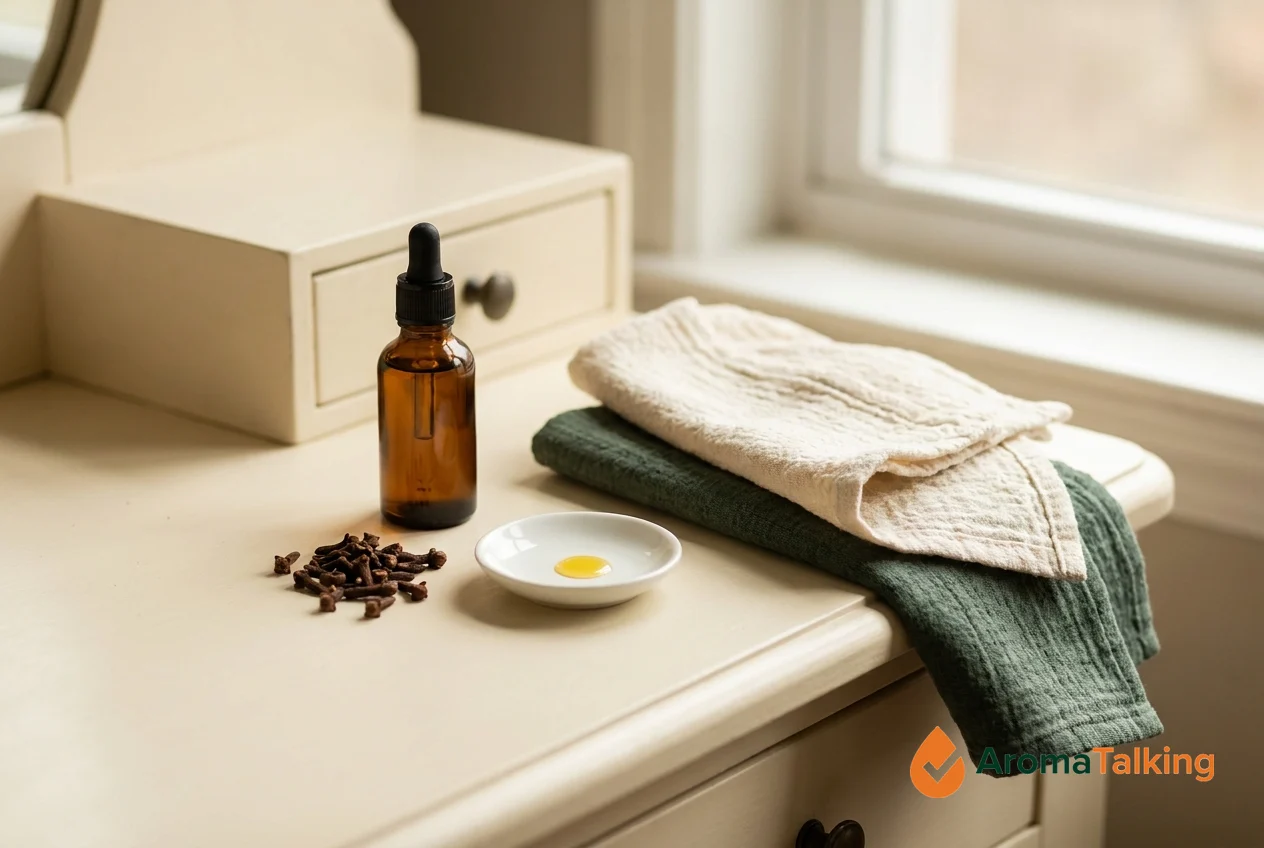
Clove oil keeps showing up in DIY skincare advice, usually with big promises about acne, dark spots, and anti-aging. The honest picture is narrower. Clove does have real evidence against acne-related bacteria, but most of it comes from lab dishes, not human faces. It’s also one of the “hottest” oils in aromatherapy, so the bigger story here is safety. In this guide I’ll tier what the science actually supports, then walk through the Tisserand 0.5% spot-only method, the right carrier oils, and who should skip clove entirely. No miracle claims, just what’s worth trying and what isn’t.
What clove oil can (and can’t) do for skin
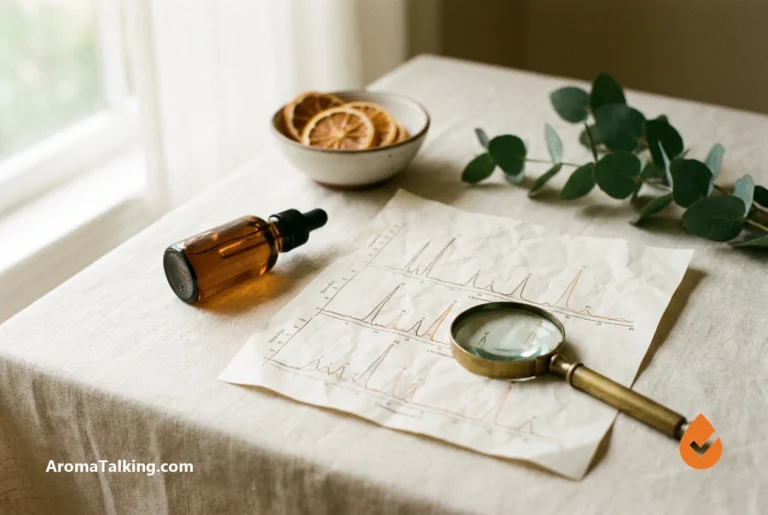
Clove oil’s strongest skin evidence is antibacterial, and it sits mostly at the lab-dish level. In one study, clove essential oil inhibited the acne bacterium Cutibacterium acnes (formerly P. acnes) at a minimum inhibitory concentration of 0.31 mg/mL (Archives of Dermatology, 2009, retrieved 2026-06-29). That’s promising, but in-vitro results don’t automatically translate to clearer skin.
So let me sort the claims by how strong the evidence actually is. Some are worth a careful try. Others are marketing.
Acne and bacteria: real, but mostly in-vitro
This is clove’s best case, and it’s still mostly lab work. Beyond the 2009 MIC result, eugenol (clove’s main compound) suppressed the inflammatory response of acne bacteria in cell and mouse models (Biocatalysis and Agricultural Biotechnology / Taylor & Francis, 2017, retrieved 2026-06-29). The one human trial I could find tested a clove plus curcumin gel in 27 people and reported it outperformed clindamycin alone (PMC, August 2025, retrieved 2026-06-29). That’s encouraging, but it was a combination formula, small, and short. It doesn’t prove clove on its own clears acne. The honest read: diluted clove may support clearer skin as a spot treatment, but it isn’t a proven cure.
Antioxidant and antifungal: lab-dish signals
Both look good in a test tube and unproven on a face. Eugenol neutralized roughly 80% of free radicals in a DPPH antioxidant assay (ACS Omega, 2025, retrieved 2026-06-29). Clove also inhibited Candida fungi in vitro (PMC, 2022, retrieved 2026-06-29). Useful background, but neither has been tested as a skincare product, so I wouldn’t buy clove for these reasons.
Anti-aging and dark spots: skip the hype
Here’s where most articles overreach. The “anti-aging” angle rests on in-silico modeling, where eugenol docks computationally to a skin enzyme, with no clinical trials behind it (Trends in Sciences, 2024, retrieved 2026-06-29). You’ll also see a “clove SPF” figure floating around. That number came from undiluted oil in a lab, not a safe cosmetic concentration, so please don’t use clove as sun protection. Dark-spot or skin-lightening claims rely on tyrosinase mechanism studies with no human clove research, so I’d treat them as unproven too.
How to use clove oil on skin safely
The single most important rule is dilution: clove tops out at 0.5% on skin. Tisserand and Young set a 0.5% maximum dermal limit for clove bud oil because of its high eugenol content and sensitization risk (Essential Oil Safety, Tisserand & Young, 2014, retrieved 2026-06-29). That works out to about 1 drop of clove bud oil per 2 teaspoons (10 ml) of carrier. Use it as a spot treatment only, never across your whole face.
Read this before you start. Clove is a hot, high-eugenol oil. Always patch test 24 to 48 hours first, never apply it neat (undiluted), keep it off eyes, lips, and broken or inflamed skin, and use it at most 1 to 2 times a week. If you’ve reacted to clove or eugenol before, don’t use it at all (more in the safety section below).
The 0.5% dilution math
You don’t need to eyeball this. Here’s the 0.5% target at a few common carrier amounts. For the why behind dilution percentages in general, see our clove essential oil guide.
The patch test and spot method
- Patch test first. Dab your 0.5% blend on your inner forearm and wait 24 to 48 hours. Any redness, itching, or burning means stop and don’t use it on your face.
- Mix the blend. Combine 1 drop clove bud oil with 2 teaspoons of carrier (jojoba or argan are good defaults).
- Apply to the blemish only. Use a cotton swab to dab the diluted blend on a single spot at night. This is a spot treatment, not an all-over serum.
- Keep it occasional. Use 1 to 2 times a week at most, and stop if skin gets irritated. More is not better with a hot oil.
If you’re new to dilution and blending in general, our how to use essential oils guide covers the basics.
The clove oil you’ll dilute
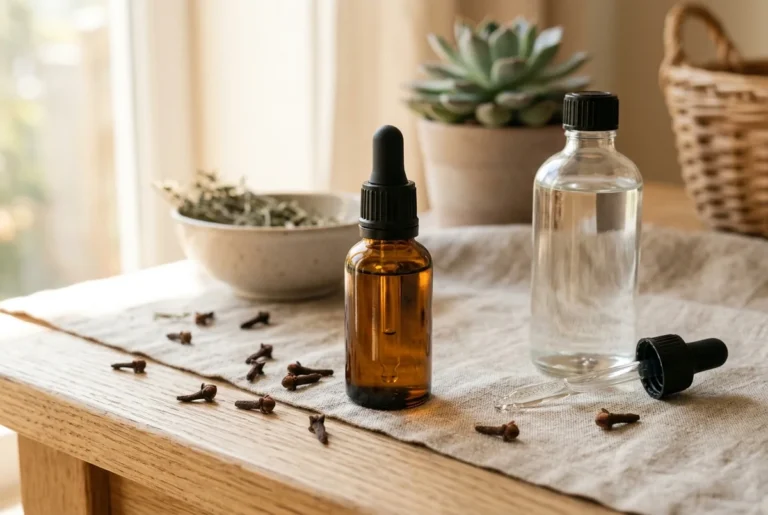
For this you want a plain clove bud essential oil, ideally with a dropper so you can measure that single drop precisely. A small bottle is plenty since you only use a drop at a time. Here are a few widely available options.
As an Amazon Associate we earn from qualifying purchases, at no extra cost to you. Product details and availability are subject to change – check the live listing on Amazon.
| Image | Product | Best for | Buy |
|---|---|---|---|
 | Cliganic Organic Clove Bud Essential Oil | Best organic value, spot use | Buy on Amazon |
 | Organic Clove Essential Oil 30 ml | Larger organic bottle | Buy on Amazon |
 | Siva Clove Bud Essential Oil | Dropper for precise 0.5% dilution | Buy on Amazon |
 | MAYJAM Clove Bud Essential Oil | Lowest price to try | Buy on Amazon |
 | 100% Pure Clove Essential Oil | Small bottle to patch-test first | Buy on Amazon |
Affiliate links · details and availability change · check the live Amazon listing.
Best carrier oils for skin
Your carrier choice matters as much as the clove, especially for acne-prone skin. Carriers are rated on the comedogenic scale from 0 (won’t clog pores) to 5 (very likely to). For breakout-prone skin, argan oil rates 0, while virgin coconut oil rates 4 and can trigger breakouts (Loving Essential Oils, retrieved 2026-06-29). For clove spot treatments, I’d reach for argan or jojoba first.
Safety: who should not use it
Clove’s main risk isn’t just irritation, it’s permanent sensitization, and that’s a one-way door. In one study, 62% of people already sensitized to eugenol reacted at concentrations as low as 0.031% (Contact Dermatitis, 2023, retrieved 2026-06-29). Once sensitized, you can keep reacting to eugenol in toothpaste, fragrance, and food flavoring for life. That’s why patch testing and the 0.5% limit aren’t optional.
Skip clove oil on skin if you:
- Have ever reacted to clove or eugenol (toothpaste, fragrance) before, sensitization can be permanent.
- Have sensitive, reactive, broken, or inflamed skin.
- Are pregnant or breastfeeding, there’s no safety data, so avoid.
- Want to use it on a child under 2.
- Take anticoagulant (blood-thinning) medication, eugenol can affect clotting, so check with your doctor.
Always keep clove away from eyes, lips, and mucous membranes, and never apply it undiluted.
This article is for general information and isn’t medical advice. If you have a skin condition or take medication, check with a qualified healthcare professional before using essential oils.
Frequently asked questions
Can you put clove oil directly on your skin?
No, never apply clove oil neat. It’s a hot, high-eugenol oil that can burn and trigger permanent sensitization. Tisserand & Young (2014) cap clove at 0.5% on skin, which is about 1 drop per 2 teaspoons of carrier, used as a spot treatment only after a patch test.
Does clove oil work for acne?
The evidence is promising but mostly in-vitro. Clove inhibits acne bacteria in lab tests at a MIC of 0.31 mg/mL (Archives of Dermatology, 2009). One small human trial (n=27, 2025) used a clove plus curcumin gel, not clove alone. Treat it as a possible diluted spot treatment, not a proven cure.
Can clove oil fade dark spots?
There’s no good evidence for this. Dark-spot claims rest on lab studies of eugenol and the tyrosinase enzyme, with no human clove research behind them. I’d treat any dark-spot or skin-lightening promise as unproven and choose ingredients with actual clinical trials instead.
What are the side effects of clove oil on skin?
The main risks are skin irritation, burning, and permanent sensitization to eugenol. One study found 62% of sensitized people reacted at just 0.031% (Contact Dermatitis, 2023). Once sensitized, reactions to eugenol in everyday products can persist for life, which is why patch testing is essential.
How do you dilute clove oil for skin?
Dilute to 0.5% maximum, which is roughly 1 drop of clove bud oil per 2 teaspoons (10 ml) of carrier oil. Argan and jojoba are good carrier choices for the face. For the full dilution method across uses, see our clove oil for hair guide and the clove pillar.
The honest bottom line
Clove oil for skin is a promising diluted spot treatment, not a cure. Its strongest case is antibacterial activity against acne bacteria, and even that is mostly lab evidence plus one small combination trial. The antioxidant and antifungal claims stay in the test tube, and the anti-aging and dark-spot angles aren’t backed by human research, so I’d ignore those. If you want to try it, the rules are simple: patch test for 24 to 48 hours, keep it at 0.5%, use it only on the blemish, and never on a full face. If your skin is sensitive, you’re pregnant, or you’ve reacted to eugenol before, this oil isn’t for you, and that’s an honest answer worth more than hype.
Medical disclaimer: This article is general information, not medical advice, and does not diagnose or treat any condition. Essential oils are not a substitute for professional medical care. Never ingest essential oils or apply them undiluted, and check with a qualified professional before use during pregnancy, around children or pets, with a medical condition, or alongside medication.