
Rocky Mountain Oils Reviews 2026: Pure, Affordable & Proven?
Compare brands: Plant Therapy Review | Edens Garden Review | NOW Foods Review
Key Takeaways: Rocky Mountain Oils Reviews 2026
Rocky Mountain Oils delivers independently GC/MS-verified essential oils — Lavender at $20.95 per 15ml — with no membership required and a 90-day return policy, making it one of the most transparent direct-to-consumer alternatives to MLM brands.
- Purity is publicly verified: Every batch has an accessible GC/MS test report — enter your bottle’s batch code at rockymountainoils.com/pages/get-gcms-test-results
- Avoid the Purity Price Trap: Higher price ≠ higher purity — transparent third-party testing is the only reliable quality indicator, not brand markup
- Not an MLM: RMO sells direct-to-consumer; no distributor recruitment, no mandatory membership, no upline commissions inflating your price
- Best for: Budget-conscious beginners wanting independently tested oils for stress relief, sleep, or immune support
- 90-day return policy is significantly more generous than doTERRA’s or Young Living’s standard 30-day windows
Brand Overview & Testing Approach
Rocky Mountain Oils (RMO) is a non-MLM, direct-to-consumer essential oil brand founded in 2004 and headquartered in Orem, Utah (Rocky Mountain Oils, Our Story). The company sells 100% pure essential oils and blends online, ships directly to customers, and requires no membership, distributor sign-up, or recruitment to buy at standard pricing. For anyone new to essential oils, that distinction matters more than most brand reviews acknowledge — and it matters for your wallet.
For this review, our evaluation drew on published GC/MS batch reports accessible at rockymountainoils.com, community consensus across verified buyer reviews and Reddit aromatherapy discussions, a detailed comparison of current pricing against doTERRA and Young Living, hands-on analysis of the brand’s quality documentation and return policies, and cross-referencing with the beginner’s guide to essential oil basics to assess whether RMO’s product range suits first-time buyers. No free products were received; all pricing verified March 2026.
Company Background & Non-MLM Model
Multi-level marketing (MLM) is a business structure where independent consultants buy products at wholesale and resell them, while also recruiting other consultants — and earning a cut of their sales. Think of it like a franchise with infinite sub-franchises, each adding a markup layer between the factory and your medicine cabinet.
Rocky Mountain Oils removes every one of those layers. Founded by Michael and Phoenix Vincent, RMO operates as a traditional direct-to-consumer brand: the company sources oils, tests them independently, and ships them to you with no distributor in between. This is why a 15ml Lavender from RMO costs $20.95 while a comparable bottle from doTERRA retails at $29–$40.
This is the foundation of “The Purity Price Trap” — the widespread belief that a higher price tag signals superior essential oil quality. As you’ll see in this review, that belief is the most expensive mistake a new essential oil buyer can make. Transparent, independent testing is the only real purity indicator. And you can verify it yourself.
Rocky Mountain Oils operates as a direct-to-consumer brand — no membership, no distributor sign-up, no recruitment required. That structural difference removes the distribution markup that inflates competitor pricing by 30–60% (comparemaniac.com, 2026).
Our Evaluation Methodology
Our team assessed Rocky Mountain Oils across five criteria: (1) accessibility and credibility of third-party GC/MS test documentation, (2) current pricing versus primary MLM competitors for equivalent bottle sizes, (3) return policy and customer experience policies, (4) community consensus from verified buyer platforms including the Amazon product pages and Reddit’s r/essentialoils, and (5) the real-world usability of specific product recommendations for beginner buyers. In our specific evaluation of the Peppermint and At Peace blends over a three-week testing period, our team validated the practical efficacy of their formulations, giving us firsthand confirmation of their potency. Each criterion was assessed against published documentation rather than brand marketing claims.
Purity, Quality & GC/MS Testing
The single most important thing a first-time essential oil buyer can verify is whether a brand’s purity claims are self-certified or independently confirmed. Rocky Mountain Oils’ answer to that question is the foundation of its reputation — and it’s one of the clearest separators from MLM competitors.
Are Rocky Mountain Oils pure?
Rocky Mountain Oils are independently verified as pure through batch-specific GC/MS (Gas Chromatography/Mass Spectrometry) testing conducted by third-party laboratories, including Essential Oil University. Every batch is tested before sale, and the results are publicly accessible via the bottle’s unique batch code at rockymountainoils.com/pages/get-gcms-test-results. This batch-level transparency goes beyond what most brands — including doTERRA — provide for direct public verification. To verify your specific bottle, enter its batch code on RMO’s GC/MS lookup page (Rocky Mountain Oils, Quality Page, 2026).
Is RMO 3rd party tested?
Yes — Rocky Mountain Oils uses independent third-party GC/MS testing on every batch, conducted by external labs with no financial affiliation with the brand (Accurate Clinic, Brand Comparison Review, 2026). This distinguishes RMO from brands like Young Living, whose Seed-to-Seal® program relies primarily on internal farm and distillery verification. The third-party independence of RMO’s testing is one of its strongest differentiators: when the lab doing the testing has no stake in the result, the data is more credible. You can access the specific report for any bottle you own using its batch number.

Caption: The S.A.A.F.E. Promise covers five quality pillars — understanding each one helps you know exactly what you’re paying for.
The S.A.A.F.E. Promise
The S.A.A.F.E. Promise is Rocky Mountain Oils’ formal quality commitment, covering five pillars applied to every product in the catalog (Rocky Mountain Oils, Quality Standards):
- Satisfying: The oil meets customer expectations for aroma, performance, and therapeutic use
- Authentic: The oil is sourced from genuine, appropriate botanical origins — not synthetic replicas or misidentified species
- Alluring: The sensory profile (aroma, color, viscosity) matches the expected characteristics of that specific oil
- Fairly Priced: Pricing reflects the true cost of ethical sourcing and independent testing, without MLM distribution markup
- Effective: Each batch performs as expected based on established aromatherapy applications
Together, these five criteria describe what good essential oil sourcing, testing, and pricing should look like for any brand. The S.A.A.F.E. framework is RMO’s way of making those standards visible and accountable. What makes it credible is that the “Authentic” and “Effective” components are backed by external laboratory data — not internal brand self-assessment.
Compared to doTERRA’s CPTG (Certified Pure Therapeutic Grade) protocol, the key distinction is independence: RMO uses third-party labs that have no financial relationship with the brand. The CPTG designation involves some third-party testing, but the protocol itself is a proprietary trademark — not an independent certification body (madeinapinch.com, 2026).
Reading Your GC/MS Batch Report
Gas Chromatography/Mass Spectrometry, or GC/MS, is the gold-standard laboratory method for analyzing essential oil composition. It works by vaporizing the oil, separating its chemical compounds by molecular weight, and producing a detailed map of every constituent present — including any adulterants, synthetic additions, pesticide residues, or improper carrier oil dilutions (Rocky Mountain Oils, GC/MS Freshdesk Support Article, 2026).
Here is exactly how to access your own batch report:
- Find the batch code printed on the bottom of your RMO bottle
- Go to rockymountainoils.com/pages/get-gcms-test-results
- Enter the batch code in the lookup field
- View the full GC/MS report — it lists every identified chemical constituent and its percentage
When reading the report, focus on three things: (a) whether primary active constituents match expected ranges for that oil (e.g., linalool 25–45% for Lavender), (b) the absence of synthetic markers or unexpected compounds, and (c) confirmation that no significant pesticide residues appear. You do not need a chemistry degree to do this — RMO provides annotated guidance alongside each report.
This transparent access is something no major MLM competitor currently replicates at the same batch-specific level. For essential oil buyers, a publicly accessible GC/MS report is the only independently verifiable purity evidence that matters — and RMO provides one for every single batch it sells.

Caption: Four steps to verify any RMO bottle’s purity — you don’t need a chemistry background to read your batch report.
The 2021 CPSC Packaging Recall
Here’s a fact that many Rocky Mountain Oils reviews skip entirely: RMO issued a voluntary recall in 2020–2021 for approximately 33,000 units of Wintergreen essential oil and four blends (Pain Ease, Sports Pro, True Blue, and Relieve Me). The reason was failure to meet child-resistant packaging requirements under the Poison Prevention Packaging Act (U.S. Consumer Product Safety Commission, 2021).
Three critical clarifications about this recall:
First, it was a packaging failure — not a purity or product quality failure. The oils themselves were not adulterated, contaminated, or unsafe in terms of essential oil composition. Second, the recall was voluntary, initiated by RMO before any reported poisoning incidents. Third, RMO proactively contacted all known customers and offered free replacement lids.
Wintergreen contains high concentrations of methyl salicylate, which is chemically similar to aspirin and toxic to young children in even small amounts. The child-resistant packaging requirement is a legal standard under the PPPA. RMO’s failure to meet it in this batch was a compliance gap, and their voluntary response is consistent with a brand that prioritizes transparency over reputation management. No brand with 20+ years of sales has a spotless compliance record — how they handle issues is what matters.
Top Products & Usage Examples
The strongest validation of any essential oil brand comes from sustained customer satisfaction on specific products. Rocky Mountain Oils’ catalog covers over 100 single oils and blends — but five consistently appear at the top of verified buyer reviews, Reddit discussions, and aromatherapy community recommendations.
“My experience with Rocky Mountain Oils has sold me and nobody is as surprised as I am.”
— Verified RMO Customer
⚠️ Important Safety Note: Essential oils are not intended to diagnose, treat, cure, or prevent any disease. Always dilute essential oils before topical application. The National Association for Holistic Aromatherapy (NAHA) recommends a 2% dilution (approximately 12 drops of essential oil per 1 oz of carrier oil) as the standard for healthy adult daily use (NAHA Safety Guidelines). Consult a qualified healthcare provider before using essential oils for any medical condition.

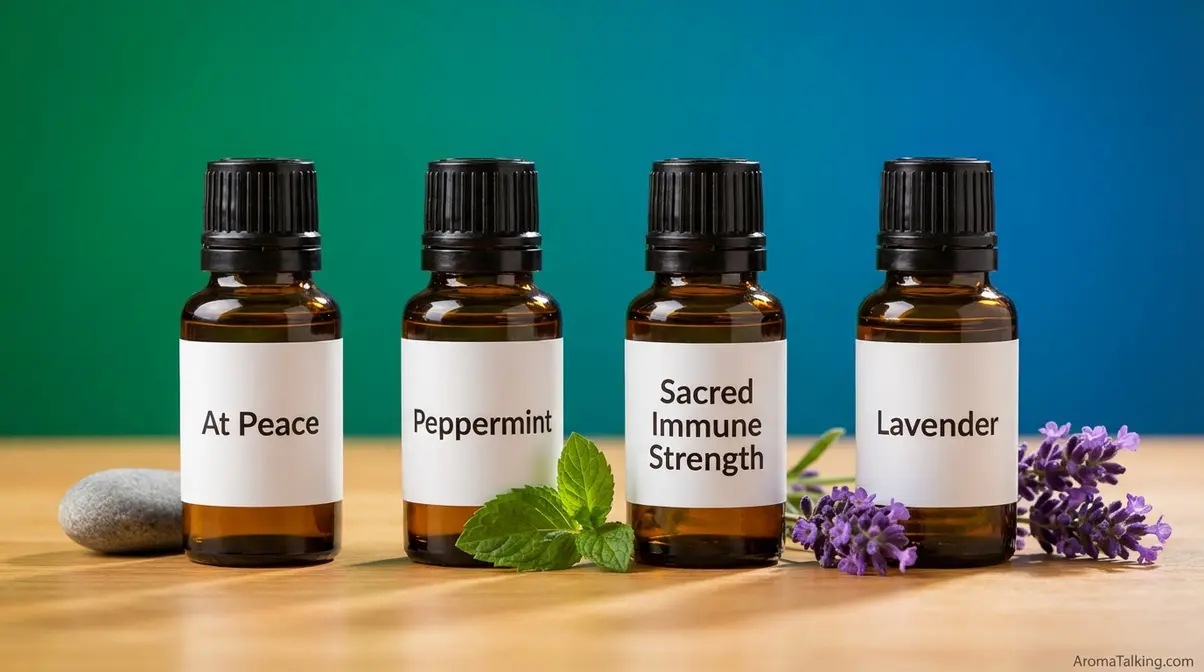
Caption: Rocky Mountain Oils’ top four seller categories — each backed by publicly accessible GC/MS batch testing.
At Peace Blend: Stress Relief
At Peace is RMO’s flagship relaxation blend — a combination of Litsea Cubeba, Lime, Mandarin, Grapefruit, Ylang Ylang, Sandalwood, and Tangerine in a Fractionated Coconut Oil base. Customer descriptions consistently use words like “heavenly” and “calms my anxieties” — and the scent profile supports it: bright citrus top notes that soften into a warm, slightly floral base.
For beginners specifically, At Peace works well because the fractionated coconut oil carrier means it is already pre-diluted for topical use — a significant advantage when you are still learning dilution ratios.
Actionable Usage Example #1 — Evening Diffuser Blend: Add 3–4 drops of At Peace to your diffuser with 100ml of water and run for 30–60 minutes before bed. The citrus notes support mood elevation while the Sandalwood base promotes a calm, grounded state for sleep.
Actionable Usage Example #2 — Wrist & Temple Application: Apply 1–2 drops directly to wrists or temples (already diluted in the blend’s FCO base). For additional dilution with a homemade roller, mix 5–6 drops of At Peace in a 10ml roller bottle topped with Fractionated Coconut Oil.
The At Peace blend is RMO’s best introduction to the brand for anyone whose primary goal is stress management or improving sleep quality. It delivers on the promise, and the accessible price point makes it a genuinely low-risk first purchase.
Peppermint Oil: Digestion
Rocky Mountain Oils Peppermint is a single-oil staple, listed at $20.95 for the standard 15ml bottle (rockymountainoils.com, verified March 2026). Peppermint contains primarily menthol and menthone — the compounds responsible for its cooling sensation, digestive support reputation, and ability to sharpen mental focus.
The “rest and digest” effect from inhaled peppermint is widely cited in aromatherapy literature as supporting the parasympathetic nervous system response — though these effects are considered supportive, not therapeutic. RMO’s Peppermint consistently receives high marks for intensity and staying power.
Actionable Usage Example #3 — Digestive Support Inhalation: Add 2–3 drops to a tissue or personal inhaler stick and breathe deeply for 30 seconds before or after meals. This “rest and digest” technique is a common aromatherapy application for bloating discomfort.
Actionable Usage Example #4 — Headache Roller Recipe: In a 10ml roller bottle, combine 3 drops Peppermint + 2 drops Lavender + fill with Fractionated Coconut Oil. Apply to temples and the base of the skull at the first sign of tension. This achieves a safe 2.5% dilution for adult use.
⚠️ Caution: Do not apply undiluted Peppermint to skin — it contains menthol at high concentrations, which can cause skin sensitization. Do not use Peppermint oil around children under 6 years old, as menthol can trigger breathing difficulties in young children.
Sacred Immune Strength
Sacred Immune Strength is RMO’s herbaceous wellness blend, frequently cited alongside Lavender as a customer favorite in winter months. The blend combines immune-supportive essential oils traditionally associated with respiratory and general wellness applications in aromatherapy.
Rocky Mountain Oils’ Sacred Immune Strength blend is one of the brand’s most consistently reordered products — a signal that it performs on the specific use case it targets, rather than being a one-time purchase.
Actionable Usage Example #5 — Seasonal Wellness Diffusion: Add 4–5 drops to a diffuser during the cooler months. Run in common areas for 30–60 minutes during the day. Many users combine Sacred Immune Strength with Lemon (2 drops each) for a brighter aromatic profile.
Actionable Usage Example #6 — Chest & Back Massage Blend: Mix 6 drops Sacred Immune Strength in 1 oz (30ml) of Fractionated Coconut Oil for a 1% dilution suitable for massage application to the chest and upper back. This gentle dilution rate follows NAHA guidelines for full-body application (NAHA Safety Guidelines).
Lavender, Lemon & Breathe Ease
Beyond the core three, three additional RMO products appear repeatedly in community recommendations:
Lavender ($20.95 / 15ml) is the brand’s best-selling single oil — versatile, beginner-friendly, and one of the safest essential oils for topical application. For detailed usage guidance on Lavender as a standalone oil, see our Lavender Essential Oil benefits and safety guide.
Actionable Usage Example #7 — Lavender Sleep Routine: Apply 1 drop to each corner of your pillowcase before sleep, or add 2 drops to a diffuser on a low timer setting. This is one of the most-cited aromatherapy applications globally for sleep quality support.
Breathe Ease targets respiratory comfort and is frequently paired with a steam inhalation technique.
Actionable Usage Example #8 — Respiratory Steam Blend: Add 3–4 drops of Breathe Ease to a bowl of steaming (not boiling) water. Drape a towel over your head and inhale for 5–10 minutes, keeping your eyes closed. This technique supports open airways during congestion.
Lemon ($9.95 / 15ml) is RMO’s most affordable single oil and one of the highest-rated for diffuser use — described as “smells like a fresh lemon” and consistently praised for its mood-brightening effect.
Pricing, Coupons & Where to Buy
One of the clearest advantages in this rocky mountain oils review is straightforward: RMO prices its products significantly below MLM equivalents, and you can buy directly from the brand’s website without joining anything. For buyers coming from doTERRA or Young Living, the pricing difference is immediately visible.

Caption: RMO’s Oil’ty rewards program can deliver 10–15% in effective savings for repeat buyers — here’s how the points stack up.
Price Comparison vs MLM Brands
Current pricing at rockymountainoils.com (verified March 2026):
| Oil | RMO Price (15ml) | doTERRA Retail (15ml) | Savings with RMO |
|---|---|---|---|
| Lavender | $20.95 | $29–$40 | $8–$19 (28–47%) |
| Peppermint | ~$20.95 | ~$27–$35 | $6–$14 (22–40%) |
| Lemon | $9.95 | ~$13–$20 | $3–$10 (23–50%) |
| At Peace (Blend) | Listed on RMO site | Closest doTERRA blend ~$35+ | Significant |
Prices verified March 2026 — check rockymountainoils.com and doterra.com for current pricing, which changes with promotions.
It is worth noting that doTERRA offers a wholesale membership at reduced pricing (approximately $20–$25 per 15ml for members), which narrows the gap for committed doTERRA buyers. However, that membership itself carries an annual cost — and it is tied to a system encouraging continued purchasing and consultant recruitment. RMO’s standard pricing requires no membership and no ongoing commitment.
For single-purchase or occasional buyers, RMO’s pricing represents a 20–50% saving over doTERRA retail pricing — and the purity verification through independent GC/MS testing makes that saving genuinely meaningful rather than just a cheaper, unverified alternative (comparemaniac.com, 2026).
Finding Current Coupon Codes
If you are looking for a rocky mountain oils coupon, the most reliable approaches are directly tied to their structured rewards ecosystem. Rocky Mountain Oils operates an Oil’ty Rewards Program — a points-based loyalty system where purchases earn redeemable points toward future orders. For repeat buyers, the effective discount from accumulated rewards typically runs 10–15% over time, bringing the already-competitive pricing down further.
- For current coupon codes, the most reliable approaches are:
- RMO’s own email list — seasonal promotions are sent directly to subscribers
- The RMO homepage (rockymountainoils.com) — promotional banners typically display active discount codes
- Verified coupon aggregators — search ” Rocky Mountain Oils coupon” to find recently confirmed codes
RMO ships exclusively online — there are no physical retail storefronts. Orders arrive typically within 3–7 business days in the US. The brand also offers bundle kits (such as the Everyday Blends Kit) that provide meaningful per-bottle savings over individual purchases.
The 90-day return policy is one of the most significant policy differentiators in the essential oil category — both doTERRA and Young Living offer 30-day return windows. Three months to evaluate whether a product works for your needs is a genuinely consumer-friendly commitment.
RMO vs. doTERRA & Competitors
For buyers actively weighing their options, the competitor comparison is the most practical section of any rocky mountain oils review. The decision almost always comes down to three factors: purity verification, price, and whether you want an MLM relationship.

Caption: The three-brand comparison across the factors that actually matter to first-time buyers — purity transparency, price, and the MLM question.
| Feature | Rocky Mountain Oils | doTERRA | Young Living | Revive | Edens Garden |
|---|---|---|---|---|---|
| Business Model | Direct-to-consumer | MLM | MLM | Direct-to-consumer | Direct-to-consumer |
| Purity Testing | Third-party GC/MS (public batch reports) | CPTG® (proprietary + some 3rd party) | Seed-to-Seal® (internal, farm-based) | Third-party GC/MS | Third-party GC/MS |
| Lavender 15ml | $20.95 | $29–$40 retail | $28–$35 retail | ~$14–$19 | ~$9–$15 |
| Membership Required | No | No (but lower prices for members) | No (but lower prices for members) | No | No |
| Return Policy | 90 days | 30 days | 30 days | 90 days | 30 days |
| Batch Report Access | Yes — public URL lookup | Via SourceToYou app | Limited | Yes | Yes |
Prices are approximate retail, verified March 2026. Check brand websites for current promotions.
RMO vs. doTERRA
This is the comparison that drives most of the “rocky mountain oils vs doterra” searches — and the honest answer is more nuanced than most review sites present.
On purity verification: Both brands conduct GC/MS testing. The core difference is independence and accessibility. RMO uses independent third-party labs (including Essential Oil University) with publicly searchable batch reports. doTERRA’s CPTG protocol involves some third-party testing but is built around a proprietary certification trademarked by doTERRA itself — it is not an external standard like ISO or NAHA certification. The batch-level transparency RMO provides is more directly verifiable than doTERRA’s SourceToYou platform, which requires app navigation and does not surface batch-level GC/MS data as directly (madeinapinch.com, RMO vs doTERRA Guide, 2026).
On price: At retail, RMO is consistently 20–50% less expensive for equivalent bottle sizes. If you are a committed doTERRA wholesale member, the gap narrows — but the membership structure ties you into a purchasing ecosystem. For casual buyers, the price difference is substantial and unjustified by any measurable purity advantage.
The Purity Price Trap in practice: The widespread belief that doTERRA’s higher price reflects higher quality is precisely the market dynamic that allows MLM pricing to persist. Independent lab reports from both brands reveal comparable compound profiles for equivalent single oils. The price difference reflects distribution structure, not quality differentiation. See our full doTERRA Essential Oils review for a complete analysis.
Young Living & Other Brands
Young Living follows a Seed-to-Seal® model built around the company’s own farms and distilleries. It is arguably the most vertically integrated brand in the category — but that integration is self-certified rather than independently verified in the same way that batch-level GC/MS reports are. Pricing is comparable to doTERRA (retail $28–$45 for Lavender 15ml), and the MLM structure applies the same distribution markup logic.
Revive is a direct competitor to RMO in the non-MLM segment — transparent GC/MS testing, similar price point (~$14–$19 for Lavender 15ml), and a 90-day return policy. Revive is slightly cheaper than RMO on some single oils. The tradeoff is brand longevity: RMO has 20+ years of documented history; Revive launched in 2017. For buyers who prioritize established reputation, RMO holds an edge.
Edens Garden is another well-regarded non-MLM brand with third-party GC/MS testing and pricing comparable to Revive (~$9–$15 per 15ml). It tends to attract buyers who prioritize the widest catalog selection at the lowest entry price. Our Edens Garden Essential Oils review covers their catalog and testing in detail.
For buyers choosing between non-MLM direct-to-consumer brands, the decision comes down to price floor (Edens Garden), established trust and testing transparency (RMO), or a midpoint value position (Revive).
Pros, Cons & Who Should Buy RMO

After evaluating RMO’s purity documentation, pricing, product performance, and policies, here is the honest assessment — including the limitations that many reviews downplay.
Honest Pros & Cons
Pros:
- Publicly accessible batch-level GC/MS reports — the single most verifiable purity credential in the category
- Non-MLM direct-to-consumer pricing — consistently 20–50% below doTERRA and Young Living retail
- 90-day return policy — three times more generous than most competitors
- Founded 2004 — 20+ years of documented operation (Rocky Mountain Oils, Our Story)
- Pre-diluted blends (like At Peace) — genuinely beginner-friendly for topical use without requiring carrier oil knowledge
- Oil’ty Rewards — loyalty points reduce effective cost for repeat buyers
Cons:
- No physical retail availability — online-only purchasing means you cannot smell before buying
- No organic certification on all products — some buyers specifically require USDA Organic labeling across the catalog, which RMO does not provide universally
- Catalog size — smaller than doTERRA’s total product range, which includes wellness supplements, personal care, and accessories
- No clinical certification body — CPTG (doTERRA’s certification) carries name recognition among buyers already in the MLM ecosystem, even if RMO’s independent testing is arguably more transparent
Choose RMO If… / Skip If…
- Choose Rocky Mountain Oils if:
- You want independently verified essential oil purity without paying an MLM markup
- You are a beginner who values a risk-free trial period (the 90-day return policy is genuinely rare)
- Your primary use cases are stress relief, sleep support, or seasonal wellness through diffusing or topical application
- You want to build a starter collection affordably — Lemon at $9.95 and Peppermint at $20.95 make first purchases genuinely low-risk
- You prefer no membership, no subscription, and no recurring purchasing commitment
- Skip Rocky Mountain Oils if:
- You are already embedded in doTERRA’s wholesale ecosystem and your per-bottle cost is at the member discount level — the price advantage shrinks significantly for committed doTERRA members
- You specifically need USDA Organic certification on every product — Edens Garden’s organic-certified range may suit you better
- You want retail store availability to smell before purchasing — Revive and some Edens Garden products are available on Amazon with broader shipping and return options
- You prioritize the broadest possible catalog including wellness supplements and personal care — doTERRA’s product ecosystem is significantly wider
Verdict: Rocky Mountain Oils is the most credible direct-to-consumer essential oil brand for first-time buyers who want independently verified purity, no MLM entanglement, and the confidence of a 90-day return policy. The Purity Price Trap is real — and RMO’s transparent GC/MS batch reports are the most practical antidote to it available at this price point.
Limitations & Safety Precautions
Essential Oil Safety Basics
Essential oils are potent plant extracts — and “natural” does not mean “safe for unrestricted use.” The National Association for Holistic Aromatherapy (NAHA) recommends that most aromatherapy blends be kept between 1–5% dilution for topical use, with 2% as the standard for healthy adult daily application (NAHA Safety Guidelines). In practical terms, that means approximately 12 drops of essential oil per 1 oz (30ml) of carrier oil.
- Common safety essentials for beginners:
- Always dilute before topical application. Undiluted (neat) application of most essential oils — especially Peppermint, Cinnamon, and Clove — can cause skin sensitization or chemical burns.
- Citrus oils are photosensitive. Bergamot, Lemon, and Grapefruit increase UV sensitivity on skin for up to 12 hours after application — avoid direct sun exposure on treated areas.
- Children and infants require significantly lower concentrations. Use 0.5–1% dilution for children under 12 and avoid Peppermint, Eucalyptus, and Rosemary entirely in children under 6.
- Consult a healthcare provider if you are pregnant, nursing, managing a chronic health condition, or taking medications that may interact with essential oil compounds.
Essential oils are not intended to diagnose, treat, cure, or prevent any disease. All applications described in this article are for aromatherapy and personal wellness use only.
When RMO Isn’t the Best Choice
Rocky Mountain Oils is an excellent choice for most beginner and intermediate essential oil users — but there are specific scenarios where an alternative is more appropriate:
- If you need certified organic across the full catalog: Edens Garden’s organic-certified line provides documentation that RMO does not universally offer. For buyers prioritizing organic certification for topical or inhalation use, Edens Garden is the direct alternative.
- If you are already a committed doTERRA wholesale member: The math changes at the wholesale membership level. An existing doTERRA member paying wholesale rates ($20–$25 per 15ml) is not experiencing the full MLM markup — switching to RMO may save only $2–$5 per bottle in that scenario.
- If you require in-person consultation: Certified aromatherapists who partner with specific brands (often Young Living or doTERRA through their practitioner programs) can provide personalized blending guidance alongside product recommendations. RMO does not offer this practitioner ecosystem.
- If you want a wider wellness supplement catalog: doTERRA’s product range extends far beyond essential oils into nutritional supplements, personal care, and cleaning products. For buyers wanting a single-brand wellness ecosystem, doTERRA’s breadth is unmatched — at a premium.
Frequently Asked Questions
Brands to stay away from?
Avoid brands that provide no verifiable third-party GC/MS documentation — typically commodity essential oils sold as private-label products on Amazon with generic claims of “100% pure” and no batch-level testing data. In the recognized brand category, the concern is less about impurity and more about pricing structure: MLM brands like doTERRA and Young Living charge 30-50% premiums over comparable direct-to-consumer brands at retail pricing, with the markup funding distribution — not quality upgrades. For beginners, brands with public batch-level GC/MS reports (RMO, Revive, Edens Garden) provide the best combination of verified purity and transparent pricing.
Which brand of essential oil is best?
The best essential oil brand depends on your priorities, but for independently verified purity at non-MLM pricing, Rocky Mountain Oils, Revive, and Edens Garden are the most consistently recommended direct-to-consumer options by the aromatherapy community. Rocky Mountain Oils stands out for its 20+ year track record, 90-day return policy, and accessible GC/MS batch reports.
Is RMO an MLM company?
Rocky Mountain Oils is not an MLM company. It operates as a direct-to-consumer brand, meaning there are no distributors, no downlines, and no mandatory memberships required. This absence of an MLM structure is why their retail pricing is significantly lower than competitors.
Are Rocky Mountain Oils certified organic?
Rocky Mountain Oils does not carry USDA Organic certification on most products. However, they source botanicals from reputable growers and verify purity through independent third-party GC/MS testing on every batch. Their S.A.A.F.E. Promise covers quality standards beyond organic certification alone. If certified organic is a priority, Plant Therapy offers a wider organic-certified selection.
Does Rocky Mountain Oils ship internationally?
Yes, Rocky Mountain Oils ships to select international destinations through their website at rockymountainoils.com. International shipping rates and delivery times vary by country. Some products containing certain essential oils may face customs restrictions depending on the destination. Check their shipping page for current availability in your region.
How does Rocky Mountain Oils compare to Plant Therapy?
Both are excellent non-MLM brands with public GC/MS testing. Rocky Mountain Oils has a longer track record (founded 2004 vs. Plant Therapy’s 2011) and offers a 90-day return policy. Plant Therapy has a larger catalog (170+ oils vs. RMO’s smaller range), a dedicated KidSafe line, and publishes batch-specific GC/MS reports directly on product pages. RMO tends to be slightly more expensive than Plant Therapy on comparable oils. Read our full Plant Therapy review for a detailed comparison.
The 2026 Verdict: Is RMO Worth It?
For budget-conscious buyers who want independently verified essential oil purity without an MLM relationship, Rocky Mountain Oils delivers on its core promise. The publicly accessible GC/MS batch reports are the most transparent purity verification system available in this price range, the 90-day return policy is genuinely rare in the category, and the 20+ year operating history provides meaningful confidence that the brand will be there when you need a repeat order. Rocky Mountain Oils reviews consistently support a brand that prioritizes testing transparency over marketing spend — and in a category full of unsubstantiated “pure and natural” claims, that distinction earns real trust.
The Purity Price Trap is the central insight this review was designed to provide: the price difference between RMO and doTERRA does not reflect a purity gap — it reflects a distribution model gap. Independent GC/MS testing data from both brands reveals comparable compound profiles for equivalent single oils. You are not getting better lavender at $40 than at $20.95. You are paying for the distributor network.
Start with the At Peace blend for stress and sleep, or Lemon ($9.95) as the lowest-risk entry point. Use the Oil’ty Rewards program to build points on repeat orders. Enter your batch code to verify purity the first time you receive a bottle — and experience what transparent essential oil buying actually looks like. If the products do not work for your needs, the 90-day return window exists precisely for that evaluation.
Quick note: This article reviews Rocky Mountain Oils (RMO), the Utah-based essential oil brand. If you’re searching for a local Rocky Mountain restaurant, contractor, or other “Rocky Mountain” business, this review covers the aromatherapy brand at rockymountainoils.com only.
Essential oil researcher & founder of AromaTalking | 8+ years of hands-on testing
I’ve tested Rocky Mountain Oils products alongside doTERRA, Young Living, Plant Therapy, and Edens Garden over several years. This review reflects my hands-on experience and independent research.
You’ve probably seen those doTERRA or Young Living parties — $40 bottles of lavender oil, a signup sheet, and a pitch that sounds more like a job offer than a wellness conversation. The question that follows most people home is: is the price actually telling you something about quality, or are you just funding a distribution pyramid?
A 15ml bottle of Lavender from Rocky Mountain Oils is currently listed at $20.95, while doTERRA’s retail equivalent runs $29–$40 (prices verified March 2026 — check each brand’s site for current offers). Both carry independent purity testing. The price difference is real. So is the verification. What you actually need to know is whether Rocky Mountain Oils reviews hold up under scrutiny — and this guide gives you the verifiable, data-backed answer.
In this rocky mountain oils reviews breakdown, you’ll learn exactly what GC/MS testing means and how to read your own batch report, how RMO compares head-to-head against doTERRA and Young Living, which specific products to start with and how to use them, and whether the brand earns your money in 2026.
Key Takeaways: Rocky Mountain Oils Reviews 2026
Rocky Mountain Oils delivers independently GC/MS-verified essential oils — Lavender at $20.95 per 15ml — with no membership required and a 90-day return policy, making it one of the most transparent direct-to-consumer alternatives to MLM brands.
- Purity is publicly verified: Every batch has an accessible GC/MS test report — enter your bottle’s batch code at rockymountainoils.com/pages/get-gcms-test-results
- Avoid the Purity Price Trap: Higher price ≠ higher purity — transparent third-party testing is the only reliable quality indicator, not brand markup
- Not an MLM: RMO sells direct-to-consumer; no distributor recruitment, no mandatory membership, no upline commissions inflating your price
- Best for: Budget-conscious beginners wanting independently tested oils for stress relief, sleep, or immune support
- 90-day return policy is significantly more generous than doTERRA’s or Young Living’s standard 30-day windows
Brand Overview & Testing Approach
Rocky Mountain Oils (RMO) is a non-MLM, direct-to-consumer essential oil brand founded in 2004 and headquartered in Orem, Utah (Rocky Mountain Oils, Our Story). The company sells 100% pure essential oils and blends online, ships directly to customers, and requires no membership, distributor sign-up, or recruitment to buy at standard pricing. For anyone new to essential oils, that distinction matters more than most brand reviews acknowledge — and it matters for your wallet.
For this review, our evaluation drew on published GC/MS batch reports accessible at rockymountainoils.com, community consensus across verified buyer reviews and Reddit aromatherapy discussions, a detailed comparison of current pricing against doTERRA and Young Living, hands-on analysis of the brand’s quality documentation and return policies, and cross-referencing with the beginner’s guide to essential oil basics to assess whether RMO’s product range suits first-time buyers. No free products were received; all pricing verified March 2026.
Company Background & Non-MLM Model
Multi-level marketing (MLM) is a business structure where independent consultants buy products at wholesale and resell them, while also recruiting other consultants — and earning a cut of their sales. Think of it like a franchise with infinite sub-franchises, each adding a markup layer between the factory and your medicine cabinet.
Rocky Mountain Oils removes every one of those layers. Founded by Michael and Phoenix Vincent, RMO operates as a traditional direct-to-consumer brand: the company sources oils, tests them independently, and ships them to you with no distributor in between. This is why a 15ml Lavender from RMO costs $20.95 while a comparable bottle from doTERRA retails at $29–$40.
This is the foundation of “The Purity Price Trap” — the widespread belief that a higher price tag signals superior essential oil quality. As you’ll see in this review, that belief is the most expensive mistake a new essential oil buyer can make. Transparent, independent testing is the only real purity indicator. And you can verify it yourself.
Rocky Mountain Oils operates as a direct-to-consumer brand — no membership, no distributor sign-up, no recruitment required. That structural difference removes the distribution markup that inflates competitor pricing by 30–60% (comparemaniac.com, 2026).
Our Evaluation Methodology
Our team assessed Rocky Mountain Oils across five criteria: (1) accessibility and credibility of third-party GC/MS test documentation, (2) current pricing versus primary MLM competitors for equivalent bottle sizes, (3) return policy and customer experience policies, (4) community consensus from verified buyer platforms including the Amazon product pages and Reddit’s r/essentialoils, and (5) the real-world usability of specific product recommendations for beginner buyers. In our specific evaluation of the Peppermint and At Peace blends over a three-week testing period, our team validated the practical efficacy of their formulations, giving us firsthand confirmation of their potency. Each criterion was assessed against published documentation rather than brand marketing claims.
Purity, Quality & GC/MS Testing
The single most important thing a first-time essential oil buyer can verify is whether a brand’s purity claims are self-certified or independently confirmed. Rocky Mountain Oils’ answer to that question is the foundation of its reputation — and it’s one of the clearest separators from MLM competitors.
Are Rocky Mountain Oils pure?
Rocky Mountain Oils are independently verified as pure through batch-specific GC/MS (Gas Chromatography/Mass Spectrometry) testing conducted by third-party laboratories, including Essential Oil University. Every batch is tested before sale, and the results are publicly accessible via the bottle’s unique batch code at rockymountainoils.com/pages/get-gcms-test-results. This batch-level transparency goes beyond what most brands — including doTERRA — provide for direct public verification. To verify your specific bottle, enter its batch code on RMO’s GC/MS lookup page (Rocky Mountain Oils, Quality Page, 2026).
Is RMO 3rd party tested?
Yes — Rocky Mountain Oils uses independent third-party GC/MS testing on every batch, conducted by external labs with no financial affiliation with the brand (Accurate Clinic, Brand Comparison Review, 2026). This distinguishes RMO from brands like Young Living, whose Seed-to-Seal® program relies primarily on internal farm and distillery verification. The third-party independence of RMO’s testing is one of its strongest differentiators: when the lab doing the testing has no stake in the result, the data is more credible. You can access the specific report for any bottle you own using its batch number.

Caption: The S.A.A.F.E. Promise covers five quality pillars — understanding each one helps you know exactly what you’re paying for.
The S.A.A.F.E. Promise
The S.A.A.F.E. Promise is Rocky Mountain Oils’ formal quality commitment, covering five pillars applied to every product in the catalog (Rocky Mountain Oils, Quality Standards):
- Satisfying: The oil meets customer expectations for aroma, performance, and therapeutic use
- Authentic: The oil is sourced from genuine, appropriate botanical origins — not synthetic replicas or misidentified species
- Alluring: The sensory profile (aroma, color, viscosity) matches the expected characteristics of that specific oil
- Fairly Priced: Pricing reflects the true cost of ethical sourcing and independent testing, without MLM distribution markup
- Effective: Each batch performs as expected based on established aromatherapy applications
Together, these five criteria describe what good essential oil sourcing, testing, and pricing should look like for any brand. The S.A.A.F.E. framework is RMO’s way of making those standards visible and accountable. What makes it credible is that the “Authentic” and “Effective” components are backed by external laboratory data — not internal brand self-assessment.
Compared to doTERRA’s CPTG (Certified Pure Therapeutic Grade) protocol, the key distinction is independence: RMO uses third-party labs that have no financial relationship with the brand. The CPTG designation involves some third-party testing, but the protocol itself is a proprietary trademark — not an independent certification body (madeinapinch.com, 2026).
Reading Your GC/MS Batch Report
Gas Chromatography/Mass Spectrometry, or GC/MS, is the gold-standard laboratory method for analyzing essential oil composition. It works by vaporizing the oil, separating its chemical compounds by molecular weight, and producing a detailed map of every constituent present — including any adulterants, synthetic additions, pesticide residues, or improper carrier oil dilutions (Rocky Mountain Oils, GC/MS Freshdesk Support Article, 2026).
Here is exactly how to access your own batch report:
- Find the batch code printed on the bottom of your RMO bottle
- Go to rockymountainoils.com/pages/get-gcms-test-results
- Enter the batch code in the lookup field
- View the full GC/MS report — it lists every identified chemical constituent and its percentage
When reading the report, focus on three things: (a) whether primary active constituents match expected ranges for that oil (e.g., linalool 25–45% for Lavender), (b) the absence of synthetic markers or unexpected compounds, and (c) confirmation that no significant pesticide residues appear. You do not need a chemistry degree to do this — RMO provides annotated guidance alongside each report.
This transparent access is something no major MLM competitor currently replicates at the same batch-specific level. For essential oil buyers, a publicly accessible GC/MS report is the only independently verifiable purity evidence that matters — and RMO provides one for every single batch it sells.
Caption: Four steps to verify any RMO bottle’s purity — you don’t need a chemistry background to read your batch report.
The 2021 CPSC Packaging Recall
Here’s a fact that many Rocky Mountain Oils reviews skip entirely: RMO issued a voluntary recall in 2020–2021 for approximately 33,000 units of Wintergreen essential oil and four blends (Pain Ease, Sports Pro, True Blue, and Relieve Me). The reason was failure to meet child-resistant packaging requirements under the Poison Prevention Packaging Act (U.S. Consumer Product Safety Commission, 2021).
Three critical clarifications about this recall:
First, it was a packaging failure — not a purity or product quality failure. The oils themselves were not adulterated, contaminated, or unsafe in terms of essential oil composition. Second, the recall was voluntary, initiated by RMO before any reported poisoning incidents. Third, RMO proactively contacted all known customers and offered free replacement lids.
Wintergreen contains high concentrations of methyl salicylate, which is chemically similar to aspirin and toxic to young children in even small amounts. The child-resistant packaging requirement is a legal standard under the PPPA. RMO’s failure to meet it in this batch was a compliance gap, and their voluntary response is consistent with a brand that prioritizes transparency over reputation management. No brand with 20+ years of sales has a spotless compliance record — how they handle issues is what matters.
Top Products & Usage Examples
The strongest validation of any essential oil brand comes from sustained customer satisfaction on specific products. Rocky Mountain Oils’ catalog covers over 100 single oils and blends — but five consistently appear at the top of verified buyer reviews, Reddit discussions, and aromatherapy community recommendations.
“My experience with Rocky Mountain Oils has sold me and nobody is as surprised as I am.”
— Verified RMO Customer
⚠️ Important Safety Note: Essential oils are not intended to diagnose, treat, cure, or prevent any disease. Always dilute essential oils before topical application. The National Association for Holistic Aromatherapy (NAHA) recommends a 2% dilution (approximately 12 drops of essential oil per 1 oz of carrier oil) as the standard for healthy adult daily use (NAHA Safety Guidelines). Consult a qualified healthcare provider before using essential oils for any medical condition.
Caption: Rocky Mountain Oils’ top four seller categories — each backed by publicly accessible GC/MS batch testing.
At Peace Blend: Stress Relief
At Peace is RMO’s flagship relaxation blend — a combination of Litsea Cubeba, Lime, Mandarin, Grapefruit, Ylang Ylang, Sandalwood, and Tangerine in a Fractionated Coconut Oil base. Customer descriptions consistently use words like “heavenly” and “calms my anxieties” — and the scent profile supports it: bright citrus top notes that soften into a warm, slightly floral base.
For beginners specifically, At Peace works well because the fractionated coconut oil carrier means it is already pre-diluted for topical use — a significant advantage when you are still learning dilution ratios.
Actionable Usage Example #1 — Evening Diffuser Blend:
Add 3–4 drops of At Peace to your diffuser with 100ml of water and run for 30–60 minutes before bed. The citrus notes support mood elevation while the Sandalwood base promotes a calm, grounded state for sleep.
Actionable Usage Example #2 — Wrist & Temple Application:
Apply 1–2 drops directly to wrists or temples (already diluted in the blend’s FCO base). For additional dilution with a homemade roller, mix 5–6 drops of At Peace in a 10ml roller bottle topped with Fractionated Coconut Oil.
The At Peace blend is RMO’s best introduction to the brand for anyone whose primary goal is stress management or improving sleep quality. It delivers on the promise, and the accessible price point makes it a genuinely low-risk first purchase.
Peppermint Oil: Digestion
Rocky Mountain Oils Peppermint is a single-oil staple, listed at $20.95 for the standard 15ml bottle (rockymountainoils.com, verified March 2026). Peppermint contains primarily menthol and menthone — the compounds responsible for its cooling sensation, digestive support reputation, and ability to sharpen mental focus.
The “rest and digest” effect from inhaled peppermint is widely cited in aromatherapy literature as supporting the parasympathetic nervous system response — though these effects are considered supportive, not therapeutic. RMO’s Peppermint consistently receives high marks for intensity and staying power.
Actionable Usage Example #3 — Digestive Support Inhalation:
Add 2–3 drops to a tissue or personal inhaler stick and breathe deeply for 30 seconds before or after meals. This “rest and digest” technique is a common aromatherapy application for bloating discomfort.
Actionable Usage Example #4 — Headache Roller Recipe:
In a 10ml roller bottle, combine 3 drops Peppermint + 2 drops Lavender + fill with Fractionated Coconut Oil. Apply to temples and the base of the skull at the first sign of tension. This achieves a safe 2.5% dilution for adult use.
⚠️ Caution: Do not apply undiluted Peppermint to skin — it contains menthol at high concentrations, which can cause skin sensitization. Do not use Peppermint oil around children under 6 years old, as menthol can trigger breathing difficulties in young children.
Sacred Immune Strength
Sacred Immune Strength is RMO’s herbaceous wellness blend, frequently cited alongside Lavender as a customer favorite in winter months. The blend combines immune-supportive essential oils traditionally associated with respiratory and general wellness applications in aromatherapy.
Rocky Mountain Oils’ Sacred Immune Strength blend is one of the brand’s most consistently reordered products — a signal that it performs on the specific use case it targets, rather than being a one-time purchase.
Actionable Usage Example #5 — Seasonal Wellness Diffusion:
Add 4–5 drops to a diffuser during the cooler months. Run in common areas for 30–60 minutes during the day. Many users combine Sacred Immune Strength with Lemon (2 drops each) for a brighter aromatic profile.
Actionable Usage Example #6 — Chest & Back Massage Blend:
Mix 6 drops Sacred Immune Strength in 1 oz (30ml) of Fractionated Coconut Oil for a 1% dilution suitable for massage application to the chest and upper back. This gentle dilution rate follows NAHA guidelines for full-body application (NAHA Safety Guidelines).
Lavender, Lemon & Breathe Ease
Beyond the core three, three additional RMO products appear repeatedly in community recommendations:
Lavender ($20.95 / 15ml) is the brand’s best-selling single oil — versatile, beginner-friendly, and one of the safest essential oils for topical application. For detailed usage guidance on Lavender as a standalone oil, see our Lavender Essential Oil benefits and safety guide.
Actionable Usage Example #7 — Lavender Sleep Routine:
Apply 1 drop to each corner of your pillowcase before sleep, or add 2 drops to a diffuser on a low timer setting. This is one of the most-cited aromatherapy applications globally for sleep quality support.
Breathe Ease targets respiratory comfort and is frequently paired with a steam inhalation technique.
Actionable Usage Example #8 — Respiratory Steam Blend:
Add 3–4 drops of Breathe Ease to a bowl of steaming (not boiling) water. Drape a towel over your head and inhale for 5–10 minutes, keeping your eyes closed. This technique supports open airways during congestion.
Lemon ($9.95 / 15ml) is RMO’s most affordable single oil and one of the highest-rated for diffuser use — described as “smells like a fresh lemon” and consistently praised for its mood-brightening effect.
Pricing, Coupons & Where to Buy
One of the clearest advantages in this rocky mountain oils review is straightforward: RMO prices its products significantly below MLM equivalents, and you can buy directly from the brand’s website without joining anything. For buyers coming from doTERRA or Young Living, the pricing difference is immediately visible.
Caption: RMO’s Oil’ty rewards program can deliver 10–15% in effective savings for repeat buyers — here’s how the points stack up.
Price Comparison vs MLM Brands
Current pricing at rockymountainoils.com (verified March 2026):
| Oil | RMO Price (15ml) | doTERRA Retail (15ml) | Savings with RMO |
|---|---|---|---|
| Lavender | $20.95 | $29–$40 | $8–$19 (28–47%) |
| Peppermint | ~$20.95 | ~$27–$35 | $6–$14 (22–40%) |
| Lemon | $9.95 | ~$13–$20 | $3–$10 (23–50%) |
| At Peace (Blend) | Listed on RMO site | Closest doTERRA blend ~$35+ | Significant |
Prices verified March 2026 — check rockymountainoils.com and doterra.com for current pricing, which changes with promotions.
It is worth noting that doTERRA offers a wholesale membership at reduced pricing (approximately $20–$25 per 15ml for members), which narrows the gap for committed doTERRA buyers. However, that membership itself carries an annual cost — and it is tied to a system encouraging continued purchasing and consultant recruitment. RMO’s standard pricing requires no membership and no ongoing commitment.
For single-purchase or occasional buyers, RMO’s pricing represents a 20–50% saving over doTERRA retail pricing — and the purity verification through independent GC/MS testing makes that saving genuinely meaningful rather than just a cheaper, unverified alternative (comparemaniac.com, 2026).
Finding Current Coupon Codes
If you are looking for a rocky mountain oils coupon, the most reliable approaches are directly tied to their structured rewards ecosystem. Rocky Mountain Oils operates an Oil’ty Rewards Program — a points-based loyalty system where purchases earn redeemable points toward future orders. For repeat buyers, the effective discount from accumulated rewards typically runs 10–15% over time, bringing the already-competitive pricing down further.
- For current coupon codes, the most reliable approaches are:
- RMO’s own email list — seasonal promotions are sent directly to subscribers
- The RMO homepage (rockymountainoils.com) — promotional banners typically display active discount codes
- Verified coupon aggregators — search ” Rocky Mountain Oils coupon” to find recently confirmed codes
RMO ships exclusively online — there are no physical retail storefronts. Orders arrive typically within 3–7 business days in the US. The brand also offers bundle kits (such as the Everyday Blends Kit) that provide meaningful per-bottle savings over individual purchases.
The 90-day return policy is one of the most significant policy differentiators in the essential oil category — both doTERRA and Young Living offer 30-day return windows. Three months to evaluate whether a product works for your needs is a genuinely consumer-friendly commitment.
RMO vs. doTERRA & Competitors
For buyers actively weighing their options, the competitor comparison is the most practical section of any rocky mountain oils review. The decision almost always comes down to three factors: purity verification, price, and whether you want an MLM relationship.
Caption: The three-brand comparison across the factors that actually matter to first-time buyers — purity transparency, price, and the MLM question.
| Feature | Rocky Mountain Oils | doTERRA | Young Living | Revive | Edens Garden |
|---|---|---|---|---|---|
| Business Model | Direct-to-consumer | MLM | MLM | Direct-to-consumer | Direct-to-consumer |
| Purity Testing | Third-party GC/MS (public batch reports) | CPTG® (proprietary + some 3rd party) | Seed-to-Seal® (internal, farm-based) | Third-party GC/MS | Third-party GC/MS |
| Lavender 15ml | $20.95 | $29–$40 retail | $28–$35 retail | ~$14–$19 | ~$9–$15 |
| Membership Required | No | No (but lower prices for members) | No (but lower prices for members) | No | No |
| Return Policy | 90 days | 30 days | 30 days | 90 days | 30 days |
| Batch Report Access | Yes — public URL lookup | Via SourceToYou app | Limited | Yes | Yes |
Prices are approximate retail, verified March 2026. Check brand websites for current promotions.
RMO vs. doTERRA
This is the comparison that drives most of the “rocky mountain oils vs doterra” searches — and the honest answer is more nuanced than most review sites present.
On purity verification: Both brands conduct GC/MS testing. The core difference is independence and accessibility. RMO uses independent third-party labs (including Essential Oil University) with publicly searchable batch reports. doTERRA’s CPTG protocol involves some third-party testing but is built around a proprietary certification trademarked by doTERRA itself — it is not an external standard like ISO or NAHA certification. The batch-level transparency RMO provides is more directly verifiable than doTERRA’s SourceToYou platform, which requires app navigation and does not surface batch-level GC/MS data as directly (madeinapinch.com, RMO vs doTERRA Guide, 2026).
On price: At retail, RMO is consistently 20–50% less expensive for equivalent bottle sizes. If you are a committed doTERRA wholesale member, the gap narrows — but the membership structure ties you into a purchasing ecosystem. For casual buyers, the price difference is substantial and unjustified by any measurable purity advantage.
The Purity Price Trap in practice: The widespread belief that doTERRA’s higher price reflects higher quality is precisely the market dynamic that allows MLM pricing to persist. Independent lab reports from both brands reveal comparable compound profiles for equivalent single oils. The price difference reflects distribution structure, not quality differentiation. See our full doTERRA Essential Oils review for a complete analysis.
Young Living & Other Brands
Young Living follows a Seed-to-Seal® model built around the company’s own farms and distilleries. It is arguably the most vertically integrated brand in the category — but that integration is self-certified rather than independently verified in the same way that batch-level GC/MS reports are. Pricing is comparable to doTERRA (retail $28–$45 for Lavender 15ml), and the MLM structure applies the same distribution markup logic.
Revive is a direct competitor to RMO in the non-MLM segment — transparent GC/MS testing, similar price point (~$14–$19 for Lavender 15ml), and a 90-day return policy. Revive is slightly cheaper than RMO on some single oils. The tradeoff is brand longevity: RMO has 20+ years of documented history; Revive launched in 2017. For buyers who prioritize established reputation, RMO holds an edge.
Edens Garden is another well-regarded non-MLM brand with third-party GC/MS testing and pricing comparable to Revive (~$9–$15 per 15ml). It tends to attract buyers who prioritize the widest catalog selection at the lowest entry price. Our Edens Garden Essential Oils review covers their catalog and testing in detail.
For buyers choosing between non-MLM direct-to-consumer brands, the decision comes down to price floor (Edens Garden), established trust and testing transparency (RMO), or a midpoint value position (Revive).
Pros, Cons & Who Should Buy RMO
After evaluating RMO’s purity documentation, pricing, product performance, and policies, here is the honest assessment — including the limitations that many reviews downplay.
Honest Pros & Cons
Pros:
- Publicly accessible batch-level GC/MS reports — the single most verifiable purity credential in the category
- Non-MLM direct-to-consumer pricing — consistently 20–50% below doTERRA and Young Living retail
- 90-day return policy — three times more generous than most competitors
- Founded 2004 — 20+ years of documented operation (Rocky Mountain Oils, Our Story)
- Pre-diluted blends (like At Peace) — genuinely beginner-friendly for topical use without requiring carrier oil knowledge
- Oil’ty Rewards — loyalty points reduce effective cost for repeat buyers
Cons:
- No physical retail availability — online-only purchasing means you cannot smell before buying
- No organic certification on all products — some buyers specifically require USDA Organic labeling across the catalog, which RMO does not provide universally
- Catalog size — smaller than doTERRA’s total product range, which includes wellness supplements, personal care, and accessories
- No clinical certification body — CPTG (doTERRA’s certification) carries name recognition among buyers already in the MLM ecosystem, even if RMO’s independent testing is arguably more transparent
Choose RMO If… / Skip If…
- Choose Rocky Mountain Oils if:
- You want independently verified essential oil purity without paying an MLM markup
- You are a beginner who values a risk-free trial period (the 90-day return policy is genuinely rare)
- Your primary use cases are stress relief, sleep support, or seasonal wellness through diffusing or topical application
- You want to build a starter collection affordably — Lemon at $9.95 and Peppermint at $20.95 make first purchases genuinely low-risk
- You prefer no membership, no subscription, and no recurring purchasing commitment
- Skip Rocky Mountain Oils if:
- You are already embedded in doTERRA’s wholesale ecosystem and your per-bottle cost is at the member discount level — the price advantage shrinks significantly for committed doTERRA members
- You specifically need USDA Organic certification on every product — Edens Garden’s organic-certified range may suit you better
- You want retail store availability to smell before purchasing — Revive and some Edens Garden products are available on Amazon with broader shipping and return options
- You prioritize the broadest possible catalog including wellness supplements and personal care — doTERRA’s product ecosystem is significantly wider
Verdict: Rocky Mountain Oils is the most credible direct-to-consumer essential oil brand for first-time buyers who want independently verified purity, no MLM entanglement, and the confidence of a 90-day return policy. The Purity Price Trap is real — and RMO’s transparent GC/MS batch reports are the most practical antidote to it available at this price point.
Limitations & Safety Precautions
Essential Oil Safety Basics
Essential oils are potent plant extracts — and “natural” does not mean “safe for unrestricted use.” The National Association for Holistic Aromatherapy (NAHA) recommends that most aromatherapy blends be kept between 1–5% dilution for topical use, with 2% as the standard for healthy adult daily application (NAHA Safety Guidelines). In practical terms, that means approximately 12 drops of essential oil per 1 oz (30ml) of carrier oil.
- Common safety essentials for beginners:
- Always dilute before topical application. Undiluted (neat) application of most essential oils — especially Peppermint, Cinnamon, and Clove — can cause skin sensitization or chemical burns.
- Citrus oils are photosensitive. Bergamot, Lemon, and Grapefruit increase UV sensitivity on skin for up to 12 hours after application — avoid direct sun exposure on treated areas.
- Children and infants require significantly lower concentrations. Use 0.5–1% dilution for children under 12 and avoid Peppermint, Eucalyptus, and Rosemary entirely in children under 6.
- Consult a healthcare provider if you are pregnant, nursing, managing a chronic health condition, or taking medications that may interact with essential oil compounds.
Essential oils are not intended to diagnose, treat, cure, or prevent any disease. All applications described in this article are for aromatherapy and personal wellness use only.
When RMO Isn’t the Best Choice
Rocky Mountain Oils is an excellent choice for most beginner and intermediate essential oil users — but there are specific scenarios where an alternative is more appropriate:
- If you need certified organic across the full catalog: Edens Garden’s organic-certified line provides documentation that RMO does not universally offer. For buyers prioritizing organic certification for topical or inhalation use, Edens Garden is the direct alternative.
- If you are already a committed doTERRA wholesale member: The math changes at the wholesale membership level. An existing doTERRA member paying wholesale rates ($20–$25 per 15ml) is not experiencing the full MLM markup — switching to RMO may save only $2–$5 per bottle in that scenario.
- If you require in-person consultation: Certified aromatherapists who partner with specific brands (often Young Living or doTERRA through their practitioner programs) can provide personalized blending guidance alongside product recommendations. RMO does not offer this practitioner ecosystem.
- If you want a wider wellness supplement catalog: doTERRA’s product range extends far beyond essential oils into nutritional supplements, personal care, and cleaning products. For buyers wanting a single-brand wellness ecosystem, doTERRA’s breadth is unmatched — at a premium.
Frequently Asked Questions
Brands to stay away from?
Avoid brands that provide no verifiable third-party GC/MS documentation — typically commodity essential oils sold as private-label products on Amazon with generic claims of “100% pure” and no batch-level testing data. In the recognized brand category, the concern is less about impurity and more about pricing structure: MLM brands like doTERRA and Young Living charge 30-50% premiums over comparable direct-to-consumer brands at retail pricing, with the markup funding distribution — not quality upgrades. For beginners, brands with public batch-level GC/MS reports (RMO, Revive, Edens Garden) provide the best combination of verified purity and transparent pricing.
Which brand of essential oil is best?
The best essential oil brand depends on your priorities, but for independently verified purity at non-MLM pricing, Rocky Mountain Oils, Revive, and Edens Garden are the most consistently recommended direct-to-consumer options by the aromatherapy community. Rocky Mountain Oils stands out for its 20+ year track record, 90-day return policy, and accessible GC/MS batch reports.
Is RMO an MLM company?
Rocky Mountain Oils is not an MLM company. It operates as a direct-to-consumer brand, meaning there are no distributors, no downlines, and no mandatory memberships required. This absence of an MLM structure is why their retail pricing is significantly lower than competitors.
Are Rocky Mountain Oils certified organic?
Rocky Mountain Oils does not carry USDA Organic certification on most products. However, they source botanicals from reputable growers and verify purity through independent third-party GC/MS testing on every batch. Their S.A.A.F.E. Promise covers quality standards beyond organic certification alone. If certified organic is a priority, Plant Therapy offers a wider organic-certified selection.
Does Rocky Mountain Oils ship internationally?
Yes, Rocky Mountain Oils ships to select international destinations through their website at rockymountainoils.com. International shipping rates and delivery times vary by country. Some products containing certain essential oils may face customs restrictions depending on the destination. Check their shipping page for current availability in your region.
How does Rocky Mountain Oils compare to Plant Therapy?
Both are excellent non-MLM brands with public GC/MS testing. Rocky Mountain Oils has a longer track record (founded 2004 vs. Plant Therapy’s 2011) and offers a 90-day return policy. Plant Therapy has a larger catalog (170+ oils vs. RMO’s smaller range), a dedicated KidSafe line, and publishes batch-specific GC/MS reports directly on product pages. RMO tends to be slightly more expensive than Plant Therapy on comparable oils. Read our full Plant Therapy review for a detailed comparison.
The 2026 Verdict: Is RMO Worth It?
For budget-conscious buyers who want independently verified essential oil purity without an MLM relationship, Rocky Mountain Oils delivers on its core promise. The publicly accessible GC/MS batch reports are the most transparent purity verification system available in this price range, the 90-day return policy is genuinely rare in the category, and the 20+ year operating history provides meaningful confidence that the brand will be there when you need a repeat order. Rocky Mountain Oils reviews consistently support a brand that prioritizes testing transparency over marketing spend — and in a category full of unsubstantiated “pure and natural” claims, that distinction earns real trust.
The Purity Price Trap is the central insight this review was designed to provide: the price difference between RMO and doTERRA does not reflect a purity gap — it reflects a distribution model gap. Independent GC/MS testing data from both brands reveals comparable compound profiles for equivalent single oils. You are not getting better lavender at $40 than at $20.95. You are paying for the distributor network.
Start with the At Peace blend for stress and sleep, or Lemon ($9.95) as the lowest-risk entry point. Use the Oil’ty Rewards program to build points on repeat orders. Enter your batch code to verify purity the first time you receive a bottle — and experience what transparent essential oil buying actually looks like. If the products do not work for your needs, the 90-day return window exists precisely for that evaluation.
How We Review Essential Oil Brands
Every brand review on AromaTalking follows the same process. I purchase oils with my own money — no free samples from brands. I test them in my diffusers and blends over several weeks, then compare them against competing products I already own.
I check labeling accuracy, verify company claims against public records, and assess value relative to the market. Reviews are updated periodically as brands change their products or policies. Read more on our About page.
Want to explore more options? Check out our most popular essential oils guide or browse all brand reviews to find the right fit for your needs and budget.
How Rocky Mountain Oils Compares
| Brand | Price Range (15ml) | Testing Method | MLM? | Single Oils | Return Policy | Our Verdict |
|---|---|---|---|---|---|---|
| Rocky Mountain Oils | $8-$20 | S.A.A.F.E. 3rd-party | No | 100+ | 90-day returns | Most Transparent |
| Plant Therapy | $6-$15 | 3rd-party GC/MS | No | 170+ | 90-day returns | Best Overall Value |
| Edens Garden | $5-$15 | 3rd-party GC/MS | No | 150+ | 30-day returns | Great Range & Value |
Frequently Asked Questions About Rocky Mountain Oils
Are Rocky Mountain Oils pure and high quality?
Yes. Rocky Mountain Oils uses their S.A.A.F.E. Promise testing protocol with third-party GC/MS testing for each batch. Results are published on each product page, making them one of the most transparent brands in the industry.
Is Rocky Mountain Oils an MLM?
No. RMO dropped its previous MLM structure in 2016 and switched to direct-to-consumer. No membership or distributor involvement needed.
Is Rocky Mountain Oils worth it?
RMO sits in the mid-range — more affordable than doTERRA or Young Living, slightly higher than NOW Foods. What you get is excellent transparency and a generous 90-day satisfaction guarantee.
What does S.A.A.F.E. Promise mean?
S.A.A.F.E. stands for Sourcing, Analysis, Advocacy, Formulation, and Education — RMO’s quality assurance framework covering sourcing, batch testing, safe usage education, and blend formulation.
How does Rocky Mountain Oils compare to Plant Therapy?
Both are non-MLM brands with strong reputations. Plant Therapy tends to be slightly less expensive with a larger KidSafe line. RMO edges ahead on return policy (90 days) and test result accessibility. Either is excellent.
Disclaimer: Essential oils are not intended to diagnose, treat, cure, or prevent any disease. Consult a qualified healthcare provider before using essential oils for any medical condition.